
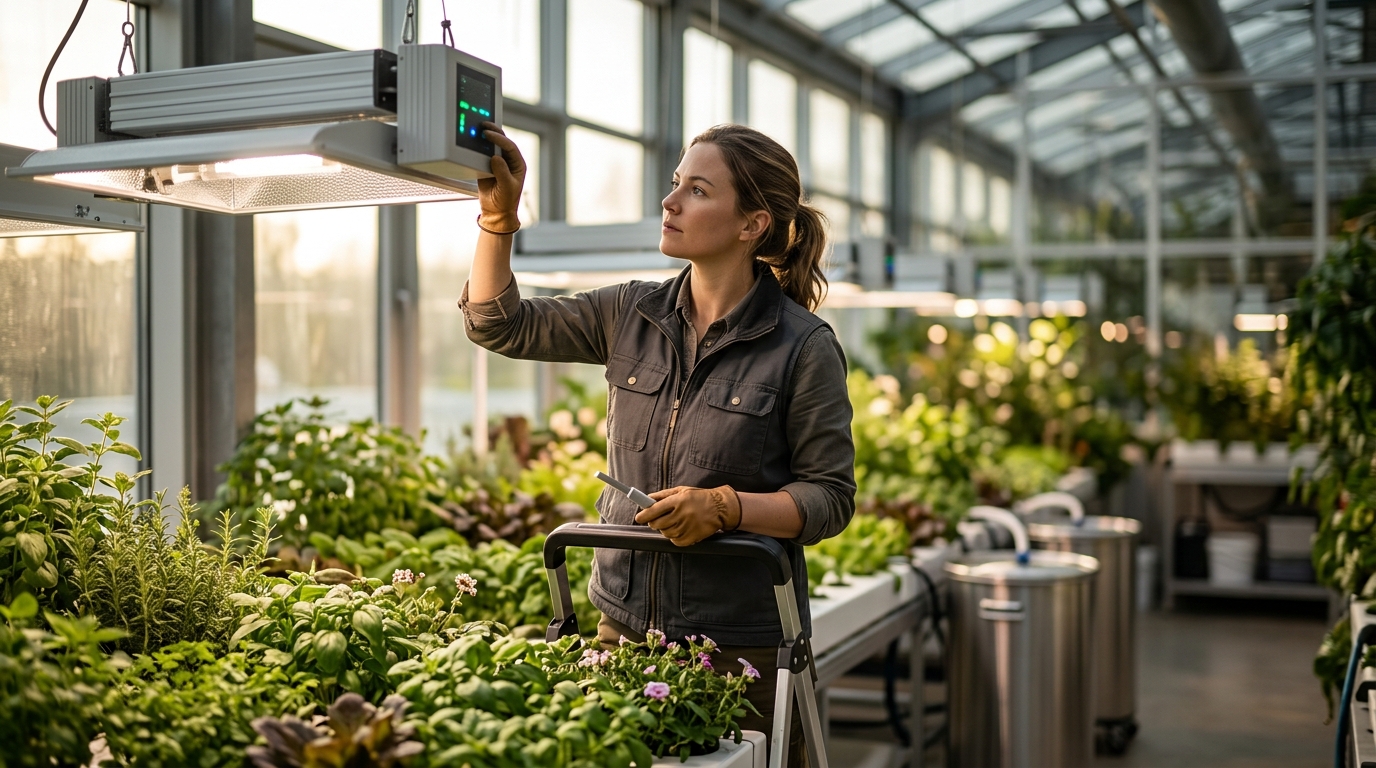
Indoor horticulture is undergoing a massive shift toward energy efficiency, with the global smart greenhouse market projected to grow significantly through 2030 as growers seek to reduce operational costs. Industry reports indicate that lighting alone can account for up to 35% of a commercial grow facility's total energy consumption. Choosing the wrong fixture does not just waste electricity; it can stunt plant growth, increase heat stress, and destroy your return on investment. This guide identifies the most critical setup mistakes and provides the technical corrections needed to optimize your canopy. (Contact Nano Grow Light)
Mistake 1: Ignoring Spectral Purity and PAR Density
Many growers focus exclusively on wattage when buying energy-efficient lights. This is a fundamental error. Wattage measures energy input, not light output or plant utility. The true metric for plant growth is Photosynthetically Active Radiation (PAR), which measures the number of photons in the 400-700 nanometer range that plants actually use for photosynthesis.
PAR Density is the critical factor. A high-wattage LED with poor lensing may deliver less usable light to the canopy than a lower-wattage fixture with advanced photon redirection. When you choose a light that scatters photons in every direction, you are paying for energy that hits your walls, floor, or ceiling instead of your plants. This scatter creates "hot spots" and "cold spots," leading to uneven growth and mold risk in low-light areas.
To avoid this, you must evaluate the spectral distribution. Ceramic Metal Halide (CMH) lamps, for example, provide a continuous full-spectrum output without the diode gaps common in LED arrays. This continuity ensures that plants receive a balanced diet of blue and red wavelengths essential for vegetative growth and flowering. According to manufacturer-reported internal testing, fixtures with specialized reflector coatings can redirect scattered light into a tighter, more usable beam, effectively increasing the PAR density at the canopy level.
Mistake 2: Overlooking Thermal Management in CMH Fixtures
CMH technology is often misunderstood as being purely inefficient due to its heat output. However, the mistake lies not in the technology itself, but in the lack of thermal planning by the grower. CMH lamps operate at higher surface temperatures than standard LEDs. A typical 250W CMH fixture can report approximately 340 BTU/hr of heat output and reach a steady-state surface temperature of roughly 45°C.
If you install a CMH fixture too close to delicate foliage without accounting for this radiant heat, you will cause thermal stress. Symptoms include leaf curling, bleaching, and reduced stomatal function, which halts photosynthesis. The error is assuming that "energy efficient" means "cool." While CMH is more efficient per photon than older HID technologies, it still requires robust heat dissipation strategies.
The solution is precise positioning. You must maintain a safe distance between the fixture and the canopy, especially for sensitive houseplants like African violets. Using a simple timer to manage the light schedule also helps regulate the thermal load on the grow space. Always check leaves for signs of stress during the first week of operation.
Mistake-3: Miscalculating Coverage Area and Canopy Distance
Another frequent error is scaling incorrectly. Growers often buy a single fixture for a space that requires multiple units, or they cluster too many lights in a small tent, causing heat buildup. A single 250W CMH fixture is engineered to cover approximately a 3.5 by 3.5 feet area effectively. Attempting to stretch this coverage beyond its optical limits results in a rapid drop-off in PAR intensity.
For larger operations, such as commercial greenhouses or vertical farms, you must array multiple fixtures across rows or bays. Scaling up by adding more fixtures is often more energy-efficient and provides more uniform coverage than switching to one massive, high-wattage unit. This modular approach allows for better heat management and easier maintenance.
When determining the correct setup, look for fixtures that offer bundle options. A 2-pack or 3-pack bundle allows you to cover larger square footage with consistent light intensity. This method ensures that every plant receives the same photon flux, promoting uniform maturity and harvest times.
Mistake 4: Neglecting the Role of Reflective Technology
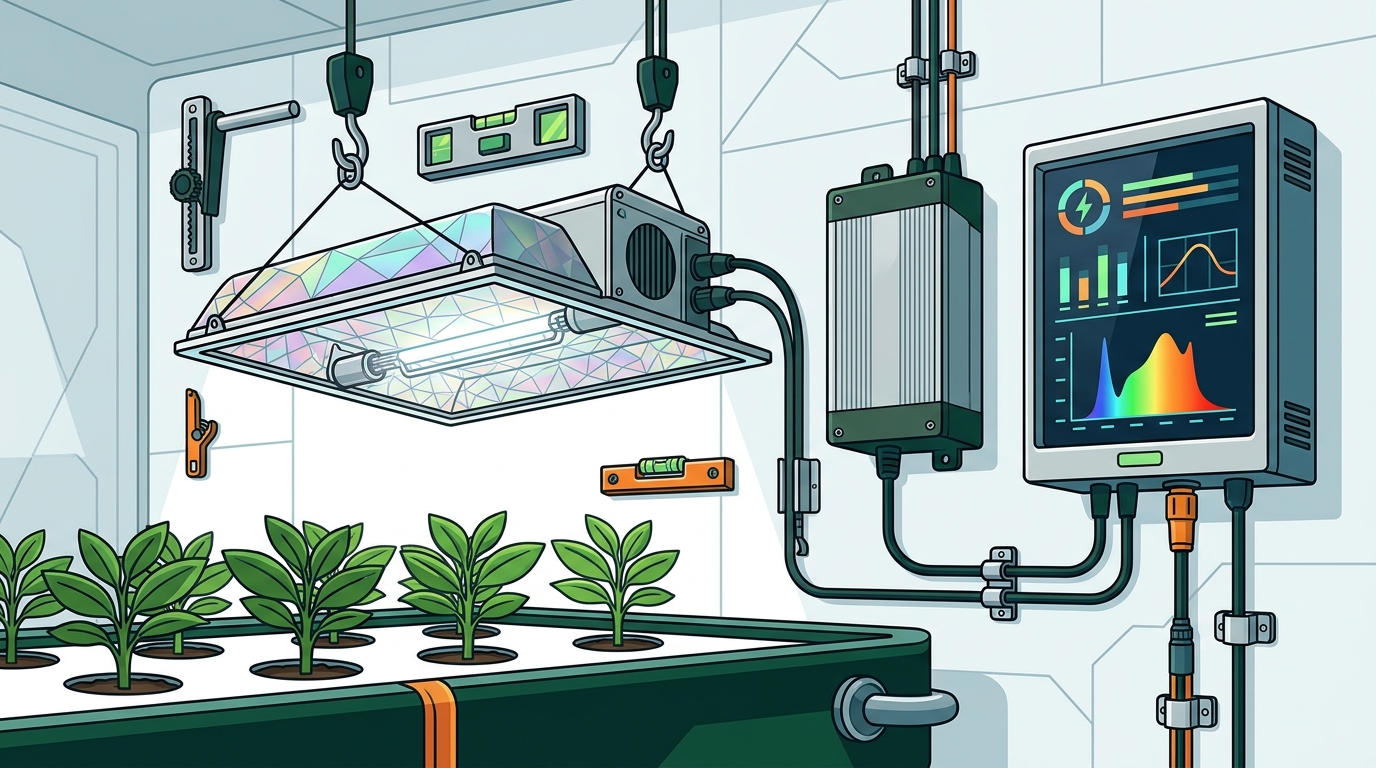
The reflector inside your grow light is just as important as the lamp itself. Standard bare aluminum reflectors lose usable light to scatter and absorption. This is where advanced nano-structured coatings make a measurable difference. The Nano Liquid Photonic Coating, for instance, consists of nano-scale clusters approximately 20 to 80 nanometers in size. When applied to the reflector, this cured coating measures about 2 to 6 microns thick.
This technology aims to improve light reflectance and spectral output compared to standard reflectors. It shifts more of the reflected spectrum toward the blue and red wavelength bands used in photosynthesis. According to manufacturer-reported internal testing, this coating increases visible-light and PAR reflectance. By redirecting photons that would otherwise be lost, the fixture delivers a denser, more targeted beam to the canopy.
Ignoring this technology means accepting lower efficiency. If you are choosing between a standard reflector and a nano-enhanced one, the latter offers a higher return on investment by maximizing the utility of every watt consumed. This is particularly vital for microgreens and fast-cycling crops where time is money.
Mistake 5: Choosing LED Over CMH Without Proper Analysis
The industry has pushed LEDs as the default for energy efficiency. While LEDs are excellent, they are not always the best choice for every grower. The mistake is assuming LEDs are universally superior. CMH lamps provide a broader spectral distribution than typical LED diodes. They produce a continuous full-spectrum output without the gaps that can occur in LED arrays.
For certain applications, such as flowering plants or specific microgreens, the spectral purity of CMH can accelerate development. In real-world use, growers have reported bringing fast-cycling crops like lettuce to harvest in as little as 28 days using optimized CMH setups. This speed is attributed to the nano-enhanced photon delivery and the balanced spectral output.
However, CMH lamps run hotter than typical horticultural LED fixtures. If your space has poor ventilation or you are growing heat-sensitive species, LEDs might be the safer choice. But if you prioritize spectral quality and photon density, and you can manage the heat, CMH with a nano-coated reflector offers a compelling alternative to standard LED setups.
Key Takeaways
- PAR Over Watts: Always prioritize Photosynthetically Active Radiation (PAR) density over raw wattage to ensure plants receive usable light.
- Thermal Planning: CMH fixtures emit approximately 340 BTU/hr; maintain safe distances to prevent thermal stress on foliage.
- Spectral Purity: CMH lamps offer continuous full-spectrum output, avoiding the diode gaps found in many LED arrays.
- Reflective Tech: Nano-scale reflector coatings can significantly increase PAR reflectance and redirect light toward the canopy.
- Correct Scaling: A single 250W fixture covers roughly 3.5x3.5 feet; use bundles for larger areas to maintain uniformity.
- Heat Management: Monitor surface temperatures (approx. 45°C) and use timers to regulate light and heat exposure.
- Proven Results: Optimized setups have shown lettuce harvests in 28 days, compared to 42 days outdoors in some trials.
Frequently Asked Questions
Is CMH better than LED for energy efficiency?
CMH is more energy-efficient per photon delivered than older HID technologies. While LEDs are highly efficient, CMH with a nano-coated reflector can offer superior spectral purity and PAR density, potentially leading to faster growth rates.
How far should I hang a 250W CMH grow light?
Due to the heat output of approximately 340 BTU/hr, you must hang the fixture at a safe distance to prevent leaf burn. Start with a wider gap and gradually lower it while monitoring plant response.
What is the Nano Liquid Photonic Coating?
It is a proprietary nano-scale reflector treatment applied to the fixture's internal reflector. It consists of clusters 20-80 nanometers in size and aims to redirect scattered light into a tighter beam for the canopy.
Can I use this light for African Violets?
Yes. African violets require bright, consistent, full-spectrum light. The 250W CMH fixture provides the necessary blue and white wavelengths for blooming, but you must manage the heat carefully.
How many fixtures do I need for a 4x4 tent?
A single fixture covers approximately 3.5x3.5 feet. For a 4x4 tent, you would likely need a 2-pack or 3-pack bundle to ensure even coverage across the entire canopy.
Does the nano coating increase heat output?
No, the coating does not increase heat. It increases light reflectance. The heat comes from the 250W CMH lamp itself, which is a standard characteristic of this technology.
What is the typical coverage area of one fixture?
One 250W fixture is designed to effectively cover an area of approximately 3.5 feet by 3.5 feet.
Optimize Your Grow Setup Today
Avoiding these common setup mistakes can transform your indoor garden from a struggle with uneven growth to a high-yield operation. By choosing the right technology, such as a 250W CMH fixture with Nano Liquid Photonic Coating, you ensure that every watt of energy is converted into plant growth. Shop Nano Grow Light today to upgrade your setup with proven, energy-efficient horticultural lighting.