
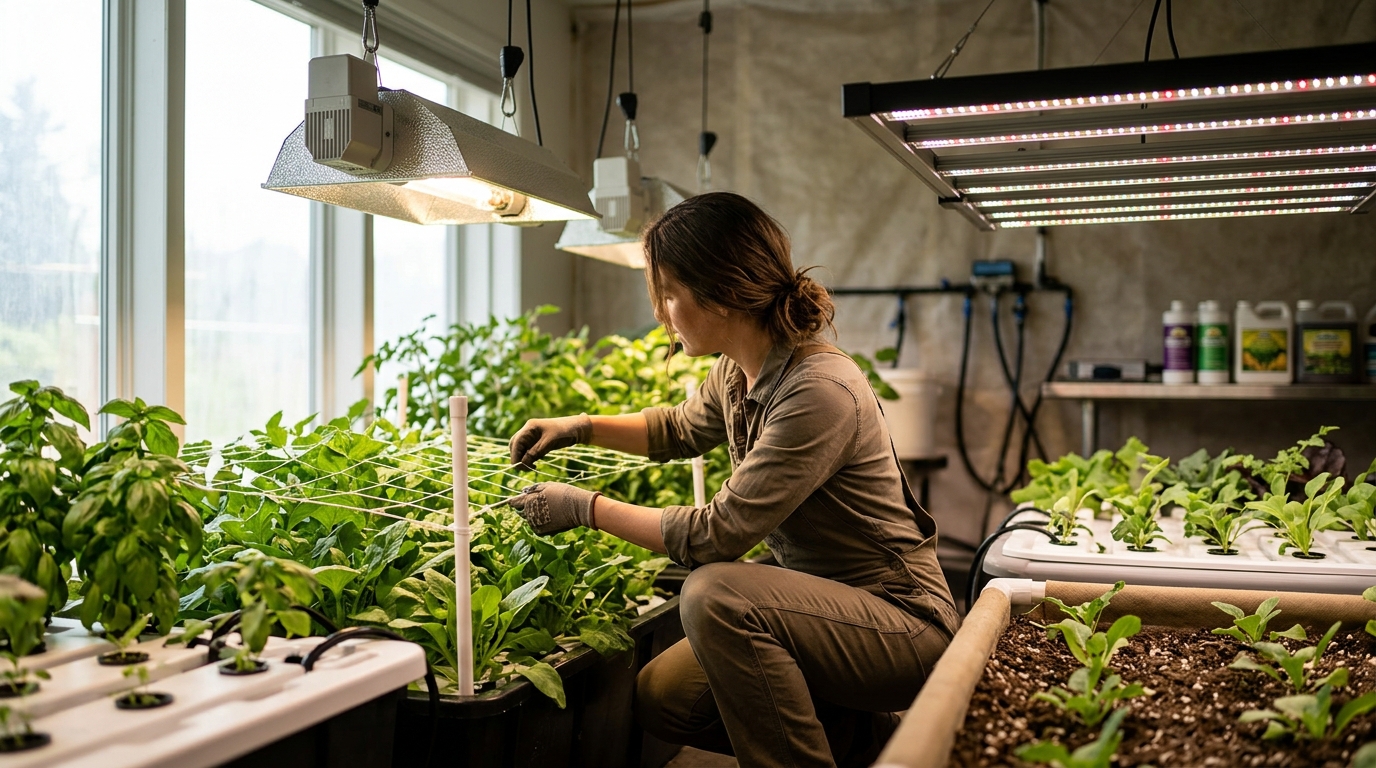
Indoor horticulture has shifted dramatically toward energy efficiency, yet many growers still struggle with thermal management in compact spaces. According to recent industry data, modern LED fixtures dominate the market with over 70% share due to their low thermal output, yet Ceramic Metal Halide (CMH) technology maintains a loyal following for its superior spectral quality. This guide dissects the thermal profiles, spectral outputs, and operational costs of both technologies to help you select the right system for your specific grow environment.
Understanding Thermal Profiles in Grow Lights
Heat is the primary constraint for indoor growers operating in closets, cabinets, or small rooms. Traditional High-Pressure Sodium (HPS) lamps generate excessive radiant heat, often requiring expensive ventilation systems to prevent plant stress. In contrast, modern low-heat technologies aim to minimize radiant energy while maximizing Photosynthetically Active Radiation (PAR).
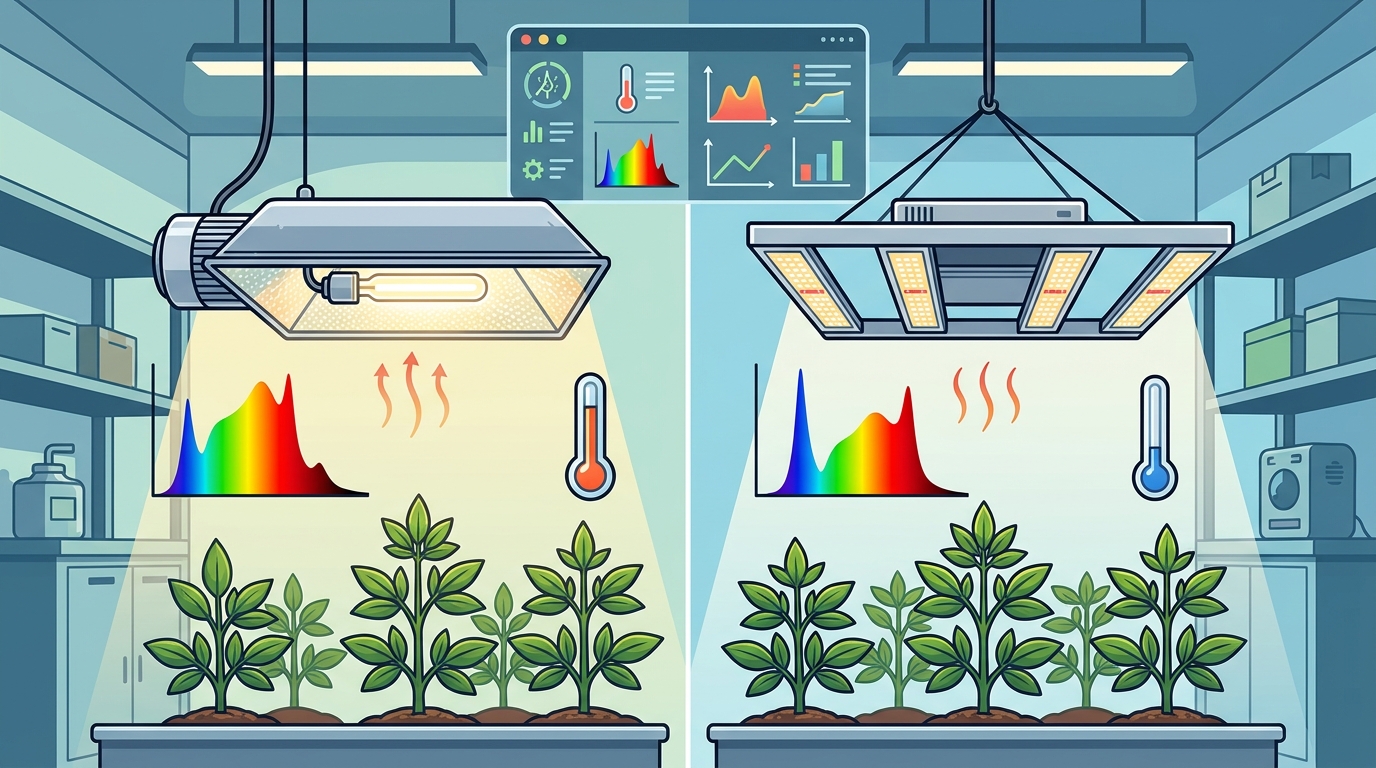
LED grow lights are widely recognized for their cool operation. Because they emit light through electroluminescence rather than thermal radiation, they produce significantly less radiant heat than gas-discharge lamps. However, LEDs still generate waste heat at the driver and heat sink, requiring active cooling fans that can add noise and complexity to a grow setup.
CMH fixtures, such as those offered by Nano Grow Light, operate differently. While the lamp itself runs hotter than an LED diode, the fixture design focuses on directing that energy efficiently. The Nano Grow Light fixture reports approximately 340 BTU/hr of heat output and a surface temperature of roughly 45°C at steady state. This thermal profile is manageable in small spaces but requires careful positioning to avoid leaf scorch on delicate plants.
Spectral Output: CMH vs LED Diodes
The quality of light is just as critical as the quantity. The spectral distribution determines how plants perceive and utilize energy for photosynthesis and photomorphogenesis.
The CMH Advantage
Ceramic Metal Halide lamps provide a continuous full-spectrum output. Unlike LEDs, which use discrete diodes that can create gaps in the spectrum, CMH lamps emit a smooth, broad spectrum similar to natural sunlight. This continuity ensures that plants receive consistent wavelengths across the blue, red, and green bands, which is crucial for vegetative growth and flowering stages.
According to manufacturer-reported internal testing, the Nano Liquid Photonic Coating shifts more of the reflected spectrum toward the blue and red wavelength bands used in photosynthesis. This targeted delivery enhances the efficiency of the light, allowing plants to absorb more energy per watt consumed.
The LED Spectrum
LEDs allow for precise tuning of the spectrum. Growers can select specific diode combinations to target vegetative or flowering stages. However, lower-quality LED fixtures may suffer from "diode gaps," where certain wavelengths are underrepresented, potentially leading to uneven plant development. High-end LED systems mitigate this by using a wide array of diodes to approximate a full spectrum.
The Role of Nano Liquid Photonic Coating
Standard reflectors, typically made of bare or painted aluminum, lose usable light to scatter and absorption. Nano Grow Light addresses this inefficiency with its proprietary Nano Liquid Photonic Coating.
This coating consists of nano-scale clusters, approximately 20 to 80 nanometers in size, applied to the fixture’s reflector. The cured coating measures approximately 2 to 6 microns thick. The primary function of this technology is to redirect scattered photons into a tighter, more usable beam aimed directly at the plant canopy.
In a 28-day prototype trial versus a standard LED fixture at equal wattage, Nano Grow Light measured increased vegetative biomass and denser leaf canopy. The coating increases visible-light and PAR reflectance compared to a bare aluminum reflector. This results in a denser PAR field that boosts yields while using less energy. For growers concerned about heat, this efficiency means less wasted energy is converted into ambient heat in the grow room.
Technical Comparison Matrix
The following table summarizes the key differences between CMH and LED technologies, highlighting the unique value proposition of Nano Grow Light’s approach.
| Feature | Nano Grow Light (CMH) | Standard LED Fixture | Traditional HPS |
|---|---|---|---|
| Spectral Quality | Continuous full-spectrum | Discrete diodes (potential gaps) | Heavy red/orange bias |
| Heat Output | ~340 BTU/hr (45°C surface) | Low radiant heat | Very High |
| Efficiency Tech | Nano Liquid Photonic Coating | Heat sink & driver design | Reflector bowl |
| Best For | Compact spaces, high PAR needs | Large warehouses, heat-sensitive crops | Outdoor supplemental lighting |
| Lamp Life | ~10,000 hours | 50,000+ hours | ~24,000 hours |
Selection Criteria for Your Grow Space
Choosing the right low-heat grow light depends on your specific operational constraints. Here are the critical factors to evaluate.
Space Constraints
If you are growing in a closet, cabinet, or small tent, heat dissipation is paramount. While LEDs are cooler, the Nano Grow Light’s 250W CMH fixture covers approximately 3.5 by 3.5 feet. Its compact size and the Nano Liquid Photonic Coating’s efficiency make it ideal for small-scale operations where every watt counts. For larger spaces, you can array multiple fixtures, as detailed in our Shop section.
Plant Type
Different plants have varying light requirements. African violets, for example, need bright, consistent, full-spectrum light to bloom well indoors. The Nano Grow Light is specifically recommended for African Violets due to its full-spectrum output and compact form factor. Similarly, microgreens growers benefit from the rapid development cycles enabled by the nano-enhanced photon delivery.
Operational Costs
While LEDs have a longer lifespan, CMH fixtures offer a lower initial cost and high PAR density. The Nano Grow Light fixture is designed for durability and efficiency. According to manufacturer-reported internal testing, plants can grow up to 1 inch per day, reducing a typical 3-month cycle to as little as 2 months. This speed translates to faster turnover and higher revenue for commercial growers.
Key Takeaways
- Thermal Management: Nano Grow Light fixtures report ~340 BTU/hr output, making them suitable for small spaces when positioned correctly.
- Spectral Superiority: CMH technology provides a continuous full-spectrum output, avoiding the diode gaps common in LED fixtures.
- Nano Coating Efficiency: The Nano Liquid Photonic Coating redirects scattered light, increasing PAR delivery and reducing energy waste.
- Rapid Growth: Internal trials show lettuce maturing in 28 days, compared to 42 days outdoors, demonstrating significant yield acceleration.
- Versatility: The 250W CMH fixture is ideal for African violets, microgreens, and small-scale commercial operations.
- Scalability: Growers can start with a single fixture and scale up using 2-pack or 3-pack bundles for larger areas.
- Cost-Effectiveness: Lower initial investment compared to high-end LED systems, with high PAR density per watt.
Frequently Asked Questions
Is CMH hotter than LED?
Yes, the lamp itself runs hotter than an LED diode. However, the Nano Grow Light fixture manages this heat through its design, reporting a surface temperature of 45°C. It is cooler than traditional HPS lights and suitable for small indoor spaces if plants are kept at a safe distance.
How does the Nano Liquid Photonic Coating work?
The coating consists of nano-scale clusters that redirect scattered photons into a tighter beam. This increases the PAR density at the canopy and improves the overall efficiency of the light fixture.
Can I use Nano Grow Light for African Violets?
Yes, the full-spectrum output and compact size make it an excellent choice for African violets. It provides the consistent light needed for blooming without taking up much space.
What is the coverage area of a single fixture?
A single 250W CMH fixture covers approximately 3.5 by 3.5 feet. For larger grow areas, you can use multiple fixtures in an array.
How long do the lamps last?
CMH lamps typically last around 10,000 hours. Regular replacement ensures optimal spectral output and PAR delivery.
Does the nano coating affect the color of the light?
The coating shifts the reflected spectrum toward blue and red wavelengths, which are critical for photosynthesis. This enhances plant growth without altering the perceived color significantly.
Is Nano Grow Light suitable for commercial greenhouses?
Yes, multiple fixtures can be arrayed for larger indoor operations, including commercial greenhouse supplemental lighting. The scalability of the system allows for flexible deployment.
Start Your Low-Heat Grow Journey
Whether you are cultivating microgreens, African violets, or commercial crops, selecting the right low-heat grow light technology is essential for success. Nano Grow Light offers a unique blend of CMH spectral quality and nano-enhanced efficiency. Explore our Shop to find the perfect fixture for your needs, or visit our About page to learn more about our technology. Contact us at Contact for personalized grow support.