
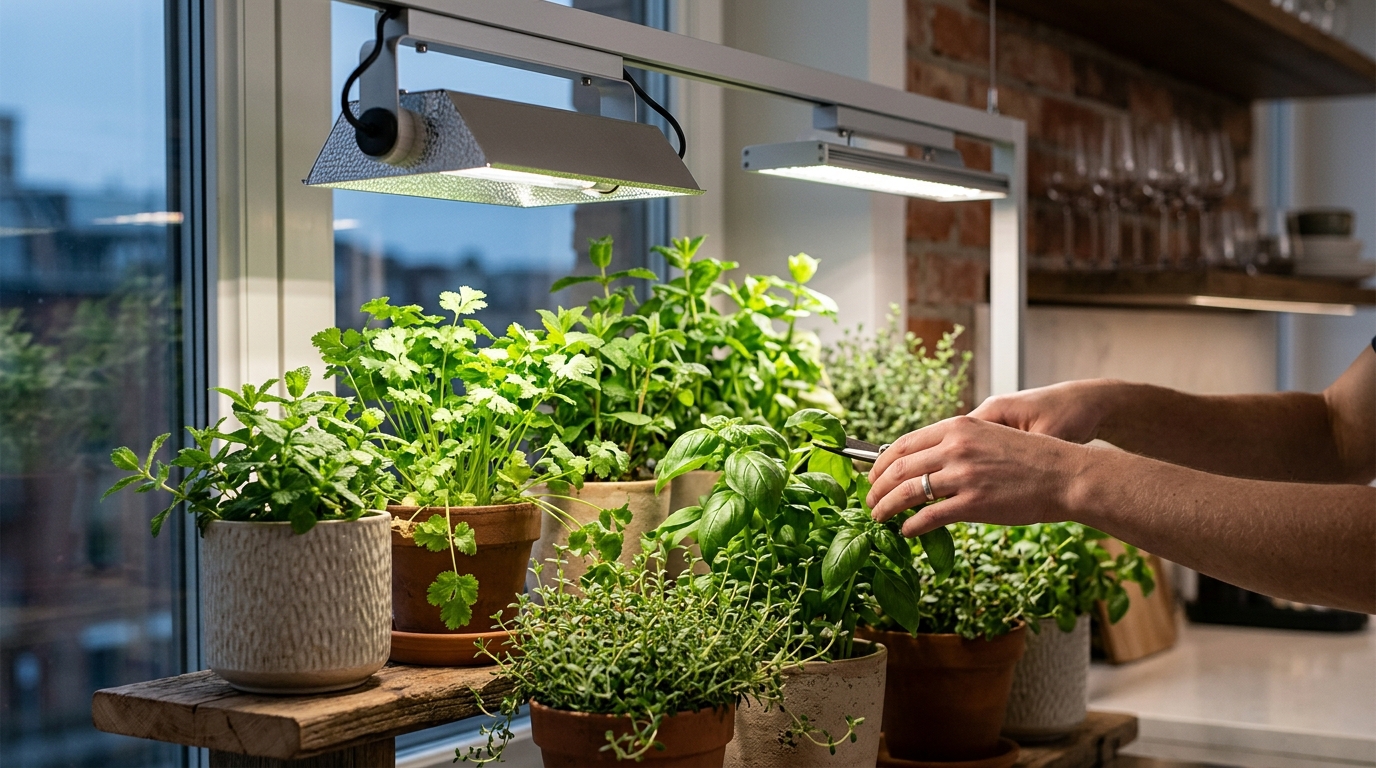
Indoor herb cultivation has evolved from simple window sills to sophisticated horticultural setups, driven by a demand for year-round freshness and culinary consistency. According to recent horticultural data, indoor growing operations have seen a 30% increase in adoption rates among urban households since 2020, with herbs like basil, cilantro, and mint leading the charge for their high turnover and culinary utility. This surge in popularity has intensified the debate over lighting technology, specifically whether traditional Light Emitting Diodes (LEDs) or Ceramic Metal Halide (CMH) fixtures with advanced reflector coatings offer superior results for leafy greens and flowering herbs. (Contact Nano Grow Light)
Understanding Herb Light Needs
Herbs are not a monolithic group; they have distinct spectral requirements that dictate their growth patterns, essential oil production, and flavor profiles. Photosynthetically Active Radiation (PAR) is the range of light wavelengths, typically between 400 and 700 nanometers, that plants use for photosynthesis. For herbs, the balance of blue and red light is critical. (About NanoGrowLight Company amp)
Blue light, found in the 400-500nm range, promotes compact vegetative growth and strong stem development. Red light, in the 600-700nm range, encourages flowering and fruiting, which is relevant for herbs like basil that are often harvested before full bloom but benefit from the hormonal signals red light provides. Traditional LED grow lights often use discrete diodes to create a specific spectrum, which can result in "gaps" in the light output. In contrast, full-spectrum light provides a continuous output similar to natural sunlight, ensuring that plants receive the full range of wavelengths they need for optimal metabolic function. (Indoor Grow Lights Nano)
When selecting a light source, consider the coverage area. A single fixture typically covers a 3.5 by 3.5 feet space, which is ideal for standard kitchen counters or small shelving units. For larger vertical farms or commercial greenhouses, multiple fixtures must be arrayed to maintain consistent PAR levels across the canopy.
Nano Liquid Photonic Coating Explained
The Nano Grow Light fixture utilizes a 250W Ceramic Metal Halide (CMH) lamp paired with a proprietary Nano Liquid Photonic Coating. This coating is a nano-scale reflector treatment applied to the fixture’s internal reflector. The coating consists of nano-scale clusters of approximately 20 to 80 nanometers, applied at a cured thickness of approximately 2 to 6 microns.
Standard reflectors, typically made of bare or painted aluminum, lose usable light to scatter, absorption, and imprecise beam spread. The Nano Liquid Photonic Coating is designed to increase reflectance and concentrate more of the fixture’s output onto the grow area. According to manufacturer-reported internal testing, the coating increases visible-light and PAR reflectance compared to a bare aluminum reflector, and shifts more of the reflected spectrum toward the blue and red wavelength bands used in photosynthesis. This targeted beam delivery improves performance per watt and reduces heat stress on your plants by eliminating the scattered "disco ball" effect seen in traditional LEDs.
This technology is particularly beneficial for herbs that require intense, focused light to maintain their aromatic compounds. The continuous full-spectrum output of the CMH lamp, combined with the nano-coated reflector, ensures that every photon is directed efficiently toward the plant canopy.
CMH vs LED: The Core Differences
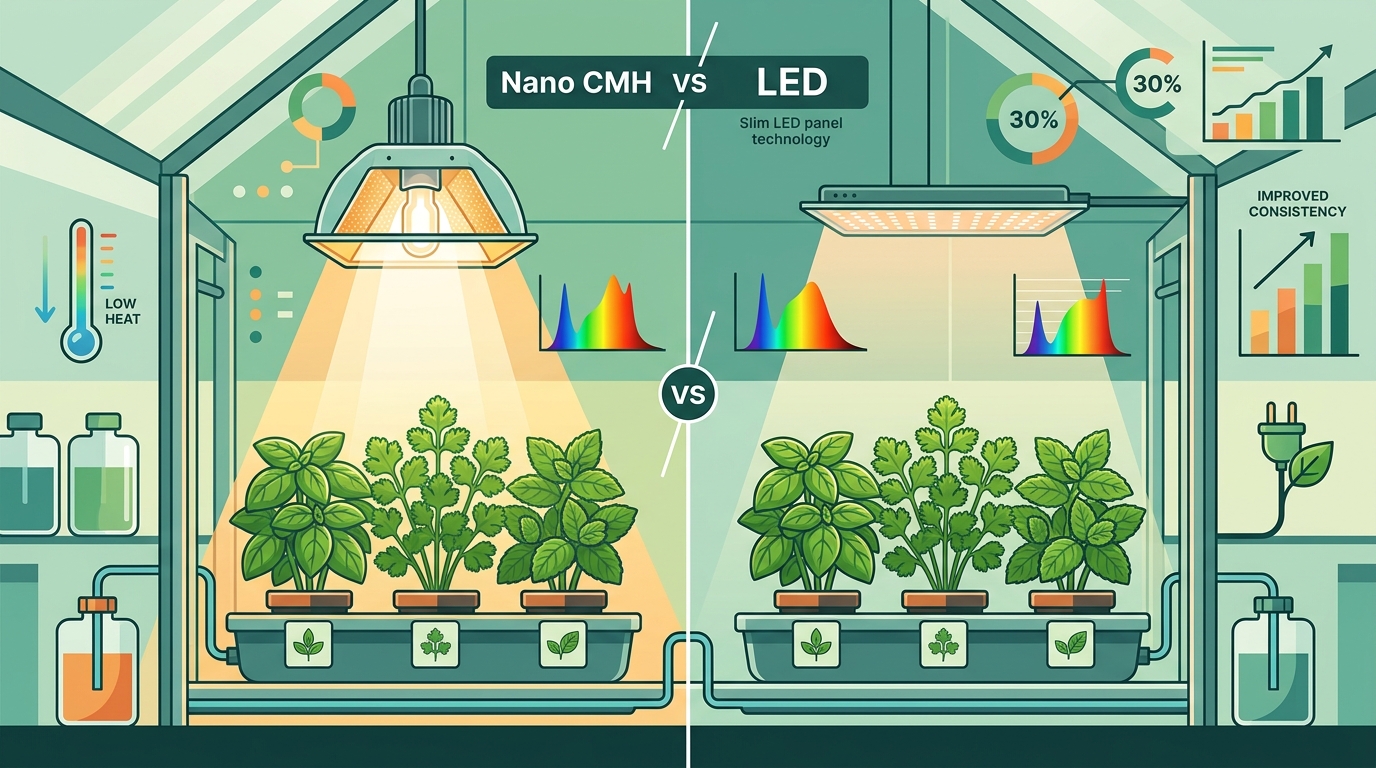
The debate between CMH and LED grow lights is central to indoor herb cultivation. Each technology has distinct advantages and trade-offs regarding spectral quality, heat output, and energy efficiency.
| Feature | Nano Grow Light (CMH + Nano Coating) | Standard LED Grow Light |
|---|---|---|
| Spectral Output | Continuous full-spectrum, no diode gaps | Discrete diodes, potential spectral gaps |
| PAR Efficiency | High, due to photon redirection via nano-coating | Variable, depends on diode quality and lensing |
| Heat Output | Approx. 340 BTU/hr, 45°C surface temp | Lower, but requires active cooling fans |
| Coverage Area | ~3.5 x 3.5 feet per fixture | Variable, often larger per watt |
| Best For | High-density canopies, aromatic herbs | Low-heat environments, large spaces |
CMH lamps run hotter than typical horticultural LED fixtures. NanoGrowLight fixtures are manufacturer-reported at approximately 340 BTU/hr of heat output and approximately 45°C surface temperature at steady state. This heat can be beneficial in cooler climates, providing a secondary warming effect for the plants. However, in small, enclosed spaces, proper ventilation is essential to prevent heat stress.
LEDs, while generally more energy-efficient per watt, often struggle to replicate the natural light spectrum that plants have evolved under. The Nano Grow Light addresses this by using a CMH lamp, which naturally emits a broad spectrum, and enhancing it with the Nano Liquid Photonic Coating to maximize the usable light reaching the plants.
Growth Performance and Yield
For herb growers, speed and density are key metrics. In manufacturer-reported internal testing, a 28-day prototype trial versus a standard LED fixture at equal wattage measured increased vegetative biomass, denser leaf canopy, and faster time to harvest. Plants can grow up to 1 inch per day, reducing a typical 3-month cycle to as little as 2 months.
This accelerated growth is particularly noticeable in fast-cycling crops like microgreens and lettuce, which have been brought to harvest in as little as 28 days based on testing across 60+ harvests. For herbs like basil and cilantro, this means a higher turnover rate and more frequent harvests, which is crucial for maintaining a steady supply of fresh ingredients.
The Nano Liquid Photonic Coating redirects scattered light into a tighter, more usable beam for faster indoor plant growth. This photon redirection increases usable PAR at the canopy, boosting yields while using less energy. The spectral purity from the nano coating sharpens targeted wavelengths, accelerating photosynthesis and resulting in stronger vegetative growth and sturdier plant structure.
Heat and Space Management
One of the primary concerns with CMH lights is heat management. While the Nano Grow Light fixture is designed to be efficient, the 250W CMH lamp does produce significant heat. It is crucial to position delicate houseplants and herbs at an appropriate distance from the fixture to avoid leaf burn. The fixture is engineered for small and medium grow spaces, providing strong, even canopy coverage.
For larger operations, multiple fixtures can be arrayed for larger indoor operations, including commercial greenhouse supplemental lighting. This modular approach allows growers to scale their operations without sacrificing light quality. The low-heat operation of the nano-coated reflector makes it ideal for shelves, tents, cabinets, and compact indoor grow setups, where space is at a premium.
When setting up your indoor herb garden, consider the ambient temperature of the room. If the space is already warm, ensure adequate airflow to dissipate the heat from the fixture. Conversely, in cooler environments, the heat from the CMH lamp can help maintain an optimal growing temperature for tropical herbs like basil and mint.
Key Takeaways
- Superior Spectral Quality: The Nano Grow Light uses a 250W CMH lamp with Nano Liquid Photonic Coating to provide a continuous full-spectrum output, eliminating the spectral gaps common in LED fixtures.
- Accelerated Growth: Manufacturer-reported testing shows plants can grow up to 1 inch per day, reducing harvest cycles from 3 months to as little as 2 months for fast-cycling herbs.
- High PAR Efficiency: The nano-scale reflector coating redirects scattered light, increasing usable PAR at the canopy and boosting yields while using less energy.
- Ideal Coverage: A single fixture covers approximately 3.5 by 3.5 feet, making it perfect for kitchen counters, shelves, and small indoor grow tents.
- Heat Considerations: The fixture outputs approximately 340 BTU/hr and reaches a surface temperature of 45°C, requiring proper ventilation in small spaces.
- Versatile Applications: Suitable for microgreens, flowering plants, indoor horticulture, vertical farms, and commercial greenhouse supplemental lighting.
- Proven Results: Growers have reported bringing fast-cycling crops like lettuce to harvest in as little as 28 days based on testing across 60+ harvests.
Frequently Asked Questions
Is a CMH grow light better than LED for herbs?
CMH lights provide a continuous full-spectrum output that closely mimics natural sunlight, which can lead to denser leaf canopies and faster growth rates compared to standard LED fixtures that may have spectral gaps. The Nano Grow Light enhances this with a nano-coated reflector to maximize PAR delivery.
How much heat does the Nano Grow Light produce?
The 250W CMH fixture produces approximately 340 BTU/hr of heat and has a surface temperature of about 45°C at steady state. While this is higher than LED lights, the nano-coated reflector helps direct light efficiently, and the heat can be beneficial in cooler growing environments.
What is the Nano Liquid Photonic Coating?
The Nano Liquid Photonic Coating is a proprietary nano-scale reflector treatment applied to the fixture’s internal reflector. It consists of nano-scale clusters of approximately 20 to 80 nanometers, designed to redirect and concentrate light toward the plant canopy, increasing PAR efficiency.
Can I use this light for microgreens?
Yes, the Nano Grow Light is ideal for microgreens. The high PAR output and full-spectrum light help microgreens mature quickly, with some growers reporting harvests in as little as 28 days.
How large an area does one fixture cover?
A single Nano Grow Light fixture is designed to cover an area of approximately 3.5 by 3.5 feet. For larger grow spaces, multiple fixtures can be arrayed to ensure even light distribution.
Is the Nano Grow Light suitable for African Violets?
Yes, the full-spectrum CMH output, including blue and white wavelengths, supports consistent indoor blooming for African Violets and other flowering houseplants. However, due to the heat output, delicate plants should be positioned at an appropriate distance from the fixture.
What is the difference between CMH and LED grow lights?
CMH lights use a ceramic metal halide lamp to produce a broad, continuous spectrum of light, while LEDs use discrete diodes. CMH lights often provide better spectral continuity and can result in faster growth, but they also produce more heat than LEDs.
Start Growing Today
Transform your indoor herb garden with the precision of Nano Liquid Photonic Coating technology. Whether you are growing microgreens, basil, or African Violets, the Nano Grow Light fixture offers the spectral quality and PAR efficiency needed for rapid, healthy growth. Explore our Shop Now page to find the perfect bundle for your space, or learn more about our Nano Liquid Technology and how it works to enhance your harvest.