

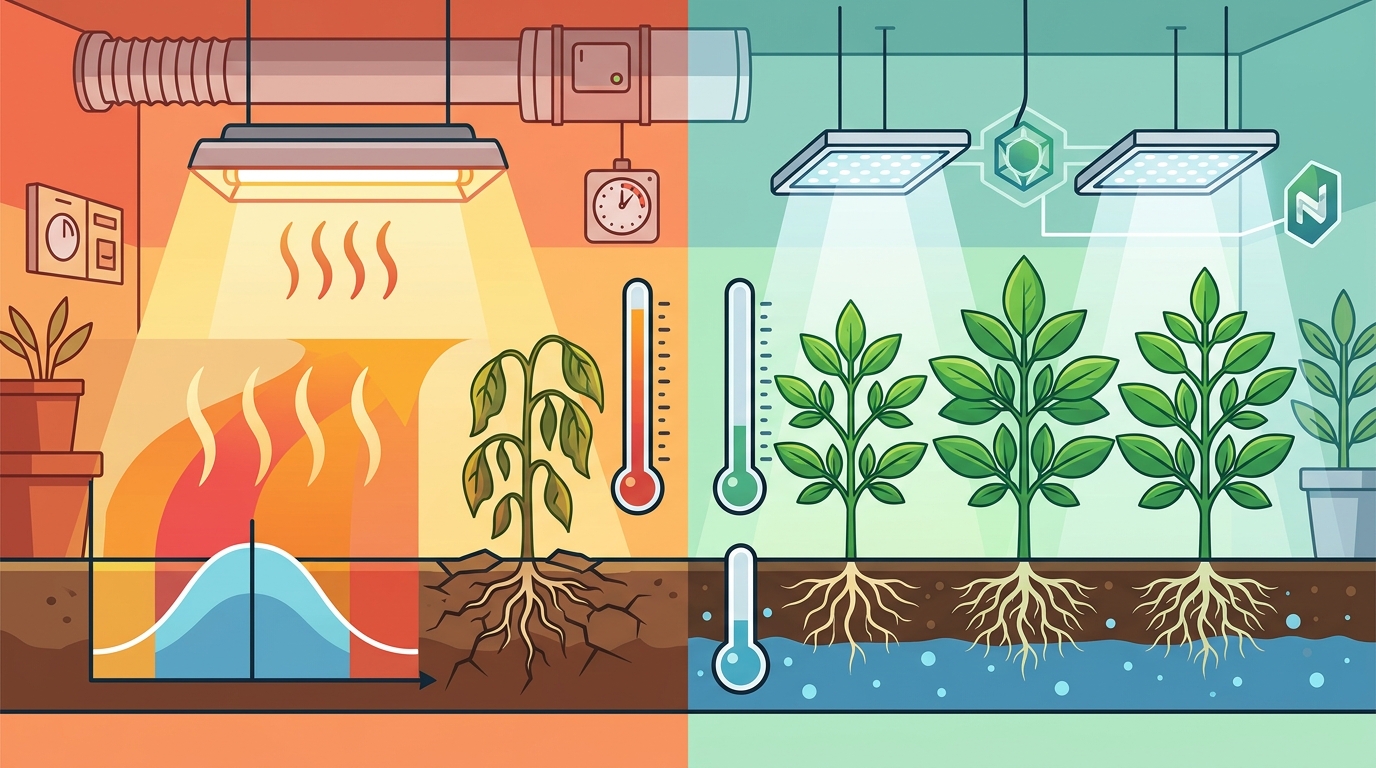
Heat management is the primary constraint in compact indoor gardening. Standard high-intensity discharge lamps can raise ambient temperatures by 10 to 15 degrees Fahrenheit in small grow tents, creating stress for sensitive foliage. According to horticultural thermal dynamics research, excessive radiant heat accelerates transpiration rates, causing plants to lose water faster than their roots can absorb it. This physiological stress often leads to wilting, nutrient lockout, and reduced photosynthetic efficiency. Selecting the correct light source is therefore not just about brightness, but about thermal control. (About NanoGrowLight Company amp)
LED vs. CMH: The Thermal Divide
When evaluating indoor horticulture lighting, the debate between Light Emitting Diodes (LED) and Ceramic Metal Halide (CMH) fixtures centers on spectral quality versus thermal management. Traditional CMH lamps are renowned for their full-spectrum output, which closely mimics natural sunlight. However, they operate at significantly higher surface temperatures than modern LED arrays. Manufacturer data indicates that a standard 250W CMH fixture can reach surface temperatures of approximately 45°C (113°F) at steady state. This radiant heat requires careful positioning to avoid burning delicate leaves.
LED technology has evolved to address these thermal concerns. High-quality LED grow lights convert a higher percentage of electrical energy into usable photosynthetically active radiation (PAR) rather than infrared heat. This efficiency allows LEDs to be placed closer to the plant canopy without causing thermal damage. For growers in small spaces, such as closets or cabinets, this proximity is critical for maximizing light intensity without overheating the environment. The shift toward LED dominance in the residential market is largely driven by this ability to maintain stable ambient temperatures.
Nano Liquid Photonic Coating Explained
While LEDs are the standard for low heat, innovations in CMH technology are attempting to bridge the gap between spectral purity and thermal efficiency. One such advancement is the Nano Liquid Photonic Coating. This technology involves applying a nano-scale reflective treatment to the internal reflector of a CMH fixture. The coating is designed to redirect scattered photons toward the plant canopy, increasing the usable PAR density.
According to manufacturer-reported internal testing, this nano-structured reflector improves light reflectance compared to standard bare aluminum reflectors. By concentrating the light output, the fixture delivers more energy to the plant per watt of electricity consumed. This efficiency means that growers can achieve robust vegetative growth without needing to increase the wattage of the bulb, thereby controlling heat generation. The Nano Liquid Photonic Coating is applied at a cured thickness of approximately 2 to 6 microns, creating a precise optical surface that minimizes light loss.
This technology is particularly relevant for growers who prefer the spectral characteristics of CMH but need to mitigate heat stress. The fixture is engineered to operate with a 250W ceramic metal halide lamp, providing a broad spectral distribution that supports both vegetative and flowering stages. While the bulb itself generates heat, the optimized reflector ensures that the energy is utilized more effectively, reducing the need for excessive cooling systems in small grow setups.
Heat Output Comparison by Fixture Type
Understanding the thermal profile of different grow lights is essential for designing a stable indoor growing environment. The following table compares the heat characteristics of common lighting technologies used in indoor horticulture.
| Fixture Type | Wattage | Surface Temperature | Heat Output (BTU/hr) | Best For |
|---|---|---|---|---|
| Nano Grow Light (CMH) | 250W | ~45°C | ~340 BTU/hr | Small tents, microgreens |
| Standard LED Array | 100-300W | ~30-35°C | Variable | Cabinets, shelves |
| Fluorescent (T5) | 54W | ~25°C | Low | Seedlings, cuttings |
| HPS (High-Pressure Sodium) | 400W+ | >60°C | High | Large commercial greenhouses |
As shown in the data, traditional High-Pressure Sodium (HPS) lamps are significant heat generators, often requiring powerful exhaust fans to maintain safe temperatures. In contrast, LED and nano-enhanced CMH fixtures offer more manageable thermal profiles. The Nano Grow Light, for instance, is designed for small and medium grow spaces, providing strong, even canopy coverage while keeping heat output within a range that is easier to manage with standard ventilation.
Ideal Applications for Low-Heat Lighting
Low-heat grow lights are not a one-size-fits-all solution. They are specifically tailored for environments where space is limited and air circulation is restricted. For example, growing African violets under artificial light requires a gentle heat profile to prevent leaf scorch. The Nano Grow Light is often recommended for such delicate houseplants because its full-spectrum output supports consistent blooming without the intense radiant heat that can damage sensitive foliage.
Microgreens growers also benefit from low-heat fixtures. Microgreens have shallow root systems and are highly susceptible to drying out. A light source that emits excessive heat can rapidly dehydrate the growing medium, stunting growth. By using a fixture with optimized photon delivery, such as one with Nano Liquid Photonic Coating, growers can ensure that the light reaches the canopy efficiently without creating a hot spot above the greens. This allows for faster harvest cycles, with some growers reporting harvest times as short as 28 days for lettuce and other fast-cycling crops.
Vertical farming setups are another area where thermal management is critical. In multi-tier rack systems, heat from upper lights can accumulate and stress plants on lower tiers. Low-heat LED fixtures or efficiently coated CMH units help maintain a uniform temperature gradient across all levels. This uniformity is essential for consistent growth rates and yield quality. According to industry data on vertical farming efficiency, reducing radiant heat load can decrease cooling energy costs by up to 20% in large-scale operations.
Key Takeaways
- Thermal Control is Critical: Excessive heat accelerates transpiration, leading to water stress and nutrient issues in indoor plants.
- LEDs Lead in Efficiency: Modern LED grow lights generally produce the least amount of radiant heat, allowing for closer placement to plants.
- Nano Technology Enhances CMH: The Nano Liquid Photonic Coating improves reflectance in CMH fixtures, directing more light to the canopy while managing heat output.
- Surface Temperature Matters: A 250W CMH fixture with nano-coating reaches approximately 45°C, which is manageable with proper spacing.
- Application Specificity: Low-heat lights are ideal for African violets, microgreens, and vertical farming where heat accumulation is a risk.
- Spectral Quality: CMH lamps provide a broad full-spectrum output, which is beneficial for flowering plants, even when heat is a concern.
- Scalability: Larger operations can achieve low-heat profiles by arraying multiple efficient fixtures rather than using single high-wattage heat generators.
Frequently Asked Questions
Which grow light produces the least heat?
LED grow lights generally produce the least amount of radiant heat compared to other technologies like HPS or standard CMH. They convert more energy into light and less into infrared radiation, making them ideal for small, enclosed spaces.
Can I use CMH lights in a small grow tent?
Yes, but you must manage the heat carefully. A 250W CMH fixture, especially one with Nano Liquid Photonic Coating, is designed for smaller spaces. However, it still emits more heat than an equivalent LED, so proper ventilation and distance are required to prevent leaf burn.
What is Nano Liquid Photonic Coating?
Nano Liquid Photonic Coating is a proprietary nano-scale reflector treatment applied to the internal reflector of a grow light fixture. It is designed to redirect scattered light toward the plant canopy, increasing the efficiency of the light output.
How close can I place a Nano Grow Light to my plants?
Due to the heat output of the 250W CMH bulb, you should maintain a safe distance to avoid thermal stress. While the nano-coating improves light delivery, the bulb itself reaches surface temperatures of approximately 45°C. Always monitor leaf temperature and adjust height as needed.
Are nano-enhanced lights better for African violets?
Many growers find nano-enhanced CMH lights beneficial for African violets because they provide a full-spectrum output that supports blooming. The controlled heat profile, compared to traditional HPS lights, helps prevent scorching the delicate leaves of these houseplants.
Do low-heat grow lights affect plant growth speed?
Not necessarily. In fact, by reducing heat stress, low-heat lights can promote healthier and potentially faster growth. Efficient light delivery, such as that provided by nano-coated reflectors, ensures that plants receive adequate PAR for photosynthesis without the negative effects of overheating.
What is the coverage area of a single Nano Grow Light?
A single Nano Grow Light fixture is sized for approximately 3.5 by 3.5 feet of coverage. For larger grow spaces, you can array multiple fixtures to achieve uniform light distribution and manageable heat levels.
Start Growing Smarter Today
Choosing the right grow light is about balancing spectral needs with thermal management. Whether you opt for the efficiency of LEDs or the spectral purity of nano-enhanced CMH, ensuring your plants stay cool is key to a successful harvest. Explore our shop now page to find the perfect fixture for your indoor garden. For more insights on plant care and technology, visit our blog or check out our customer success stories. If you have specific questions about your setup, contact us for expert guidance.