
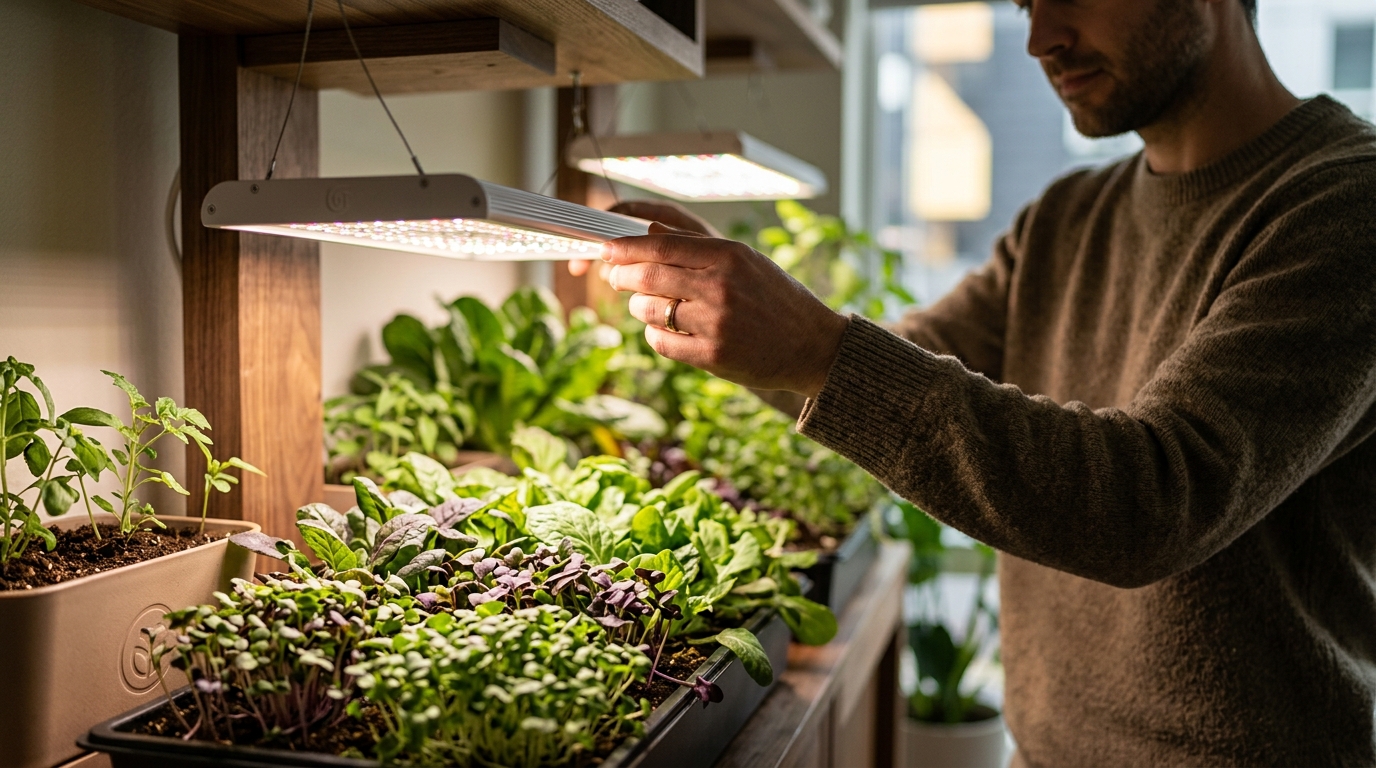
Indoor horticulture has evolved from a niche hobby into a multi-billion dollar industry driven by the demand for year-round freshness and controlled cultivation environments. As energy costs fluctuate and sustainability becomes a primary concern for growers, the efficiency of lighting technology has moved to the forefront of equipment selection. According to recent industry data, lighting accounts for approximately 60 to 70 percent of the total operational energy costs in indoor grow facilities. This statistic highlights why selecting the right light source is not just a matter of plant health, but also of economic viability and environmental responsibility. (Contact Nano Grow Light)
LED vs. CMH: The Efficiency Debate
For years, Light Emitting Diodes (LEDs) have been the undisputed champions of energy efficiency in indoor gardening. LEDs convert a high percentage of electrical energy directly into light with minimal heat loss compared to traditional sources. However, the definition of "efficiency" in horticulture is complex. It is not merely about watts per square foot, but about Photosynthetically Active Radiation (PAR) delivery and spectral quality.
Ceramic Metal Halide (CMH) lights, such as those offered by Nano Grow Light, present a compelling alternative. While CMH fixtures may consume similar wattage to high-end LEDs, their efficiency is measured by the quality of the light spectrum and the intensity of photon delivery. CMH lamps provide a continuous full-spectrum output that closely mimics natural sunlight, which many growers argue leads to more robust plant structures and higher yields per watt of usable light.
The traditional view holds that LEDs are more efficient because they run cooler. However, this perspective often ignores the "disco ball" effect of standard reflectors, where light scatters in all directions, wasting energy. This is where advanced reflector technology changes the equation entirely.
The Role of Nano Liquid Photonic Coating
Nano Liquid Photonic Coating is a proprietary nano-scale reflector treatment designed to redirect and concentrate light toward the plant canopy. This technology addresses the primary inefficiency of traditional grow lights: photon scatter. Ordinary grow lights scatter photons in every direction, wasting energy on wavelengths plants cannot use or on areas outside the grow zone.
By applying a nano-structured reflective coating to the fixture’s internal reflector, the light beam is tightened and directed with pinpoint accuracy. According to manufacturer-reported internal testing, this coating increases visible-light and PAR reflectance compared to a bare aluminum reflector. The result is a denser, more usable PAR field aimed straight at the canopy.
This targeted beam delivery improves performance per watt and reduces heat stress on your plants. The coating is made up of nano-scale clusters of approximately 20 to 80 nanometers applied to the fixture’s reflector at a cured thickness of approximately 2 to 6 microns. This precision engineering ensures that every watt of energy consumed by the 250W ceramic metal halide lamp is utilized effectively for photosynthesis.
Spectral Output and PAR Efficiency
Efficiency is also defined by spectral purity. CMH lamps provide a broader spectral distribution than typical LED diodes. LEDs often have "gaps" in their spectrum where no light is emitted, whereas CMH produces a continuous full-spectrum output without these gaps. This continuous spectrum supports all stages of plant growth, from vegetative development to flowering.
The Nano Liquid Photonic Coating shifts more of the reflected spectrum toward the blue and red wavelength bands used in photosynthesis. This spectral purity sharpens targeted wavelengths, accelerating photosynthesis and promoting up to 3× faster development in ideal conditions. Plants can grow up to 1 inch per day, reducing a typical 3-month cycle to as little as 2 months. In real-world use, growers have brought fast-cycling crops like lettuce to harvest in as little as 28 days, based on our own testing across 60+ harvests.
Heat Management and Coverage Area
While CMH lamps run hotter than typical horticultural LED fixtures, the efficiency of the Nano Grow Light fixture mitigates this through intelligent design. The fixture is manufacturer-reported at approximately 340 BTU/hr of heat output and approximately 45°C surface temperature at steady state. This low-heat operation makes it ideal for shelves, tents, cabinets, and compact indoor grow setups.
A single fixture is sized for approximately 3.5 by 3.5 feet of coverage. This precise coverage area ensures that light is not wasted on empty space. For larger operations, multiple fixtures can be arrayed for larger indoor operations, including commercial greenhouse supplemental lighting. This modular approach allows growers to scale their efficiency without sacrificing light intensity.
Comparing Lighting Options
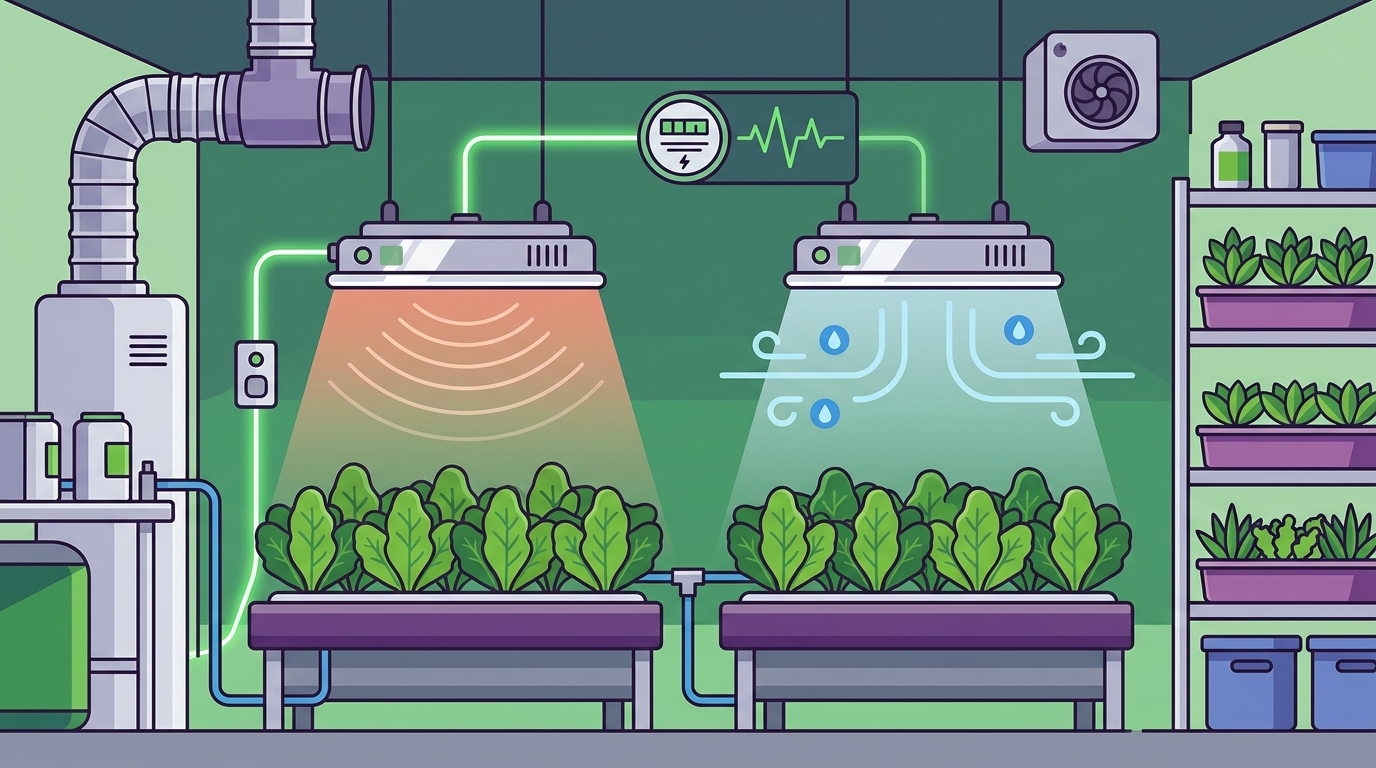
Choosing the right grow light depends on your specific growing goals, space constraints, and budget. The following table compares the key efficiency metrics of different lighting technologies.
| Lighting Technology | Energy Efficiency (Watts/Sq Ft) | Spectral Quality | Heat Output | Best For |
|---|---|---|---|---|
| Nano Grow Light (CMH + Nano Coating) | High (via photon redirection) | Continuous Full-Spectrum | Moderate (340 BTU/hr) | Compact spaces, high-yield microgreens |
| Standard LED | Very High | Targeted Peaks (Blue/Red) | Low | Large commercial facilities |
| Traditional CMH | Moderate | Full-Spectrum | High | Greenhouse supplemental lighting |
| Fluorescent (T5) | Low | Variable | Very Low | Seedlings and clones |
As shown in the table, the Nano Grow Light offers a unique balance of spectral quality and efficient light delivery. While standard LEDs may have a lower wattage per square foot, the Nano Grow Light’s ability to concentrate light via its Nano Liquid Photonic Coating ensures that the light is actually used by the plants, not wasted in the air or on the walls of the grow tent.
Key Takeaways
- Lighting accounts for 60-70% of indoor grow energy costs, making efficiency critical.
- Nano Liquid Photonic Coating redirects scattered light into a tighter, more usable beam for faster indoor plant growth.
- CMH lamps provide a continuous full-spectrum output without the diode gaps found in many LEDs.
- The Nano Grow Light fixture covers approximately 3.5 by 3.5 feet per unit.
- Photon redirection increases usable PAR at the canopy, boosting yields while using less energy.
- Growers have reported harvesting lettuce in as little as 28 days using this technology.
- Multiple fixtures can be arrayed for larger indoor operations, including commercial greenhouses.
Frequently Asked Questions
Are CMH grow lights more energy efficient than LEDs?
While LEDs generally consume less power, CMH lights with Nano Liquid Photonic Coating can be more efficient in terms of usable PAR delivery. The coating reduces light scatter, ensuring more energy reaches the plant canopy compared to standard reflectors.
How does Nano Liquid Photonic Coating work?
Nano Liquid Photonic Coating is a nano-scale reflector treatment applied to the fixture’s internal reflector. It redirects and concentrates light toward the plant canopy, increasing reflectance and shifting the spectrum toward photosynthetically active wavelengths.
What is the coverage area of a Nano Grow Light fixture?
A single Nano Grow Light fixture is designed to cover approximately 3.5 by 3.5 feet of grow space. This size is ideal for small to medium indoor gardens, vertical farms, and microgreens cultivation.
Can I use Nano Grow Lights for African Violets?
Yes, the Nano Grow Light is suitable for African Violets. Its full-spectrum CMH output, including blue and white wavelengths, supports consistent indoor blooming. However, due to the heat output of CMH lamps, delicate houseplants should be positioned at an appropriate distance from the fixture.
Is the Nano Grow Light suitable for commercial use?
Yes, larger installations are achieved by arraying multiple fixtures across rows, bays, or multi-tier racks. This modular approach allows for scalable, efficient lighting in commercial greenhouses and professional grow operations.
How much heat does the Nano Grow Light emit?
The fixture is manufacturer-reported at approximately 340 BTU/hr of heat output and approximately 45°C surface temperature at steady state. This low-heat operation makes it ideal for compact indoor grow setups.
What is the lifespan of the Nano Grow Light fixture?
The lifespan depends on the CMH lamp replacement schedule. The fixture itself is durable, but the lamp should be replaced according to manufacturer guidelines to maintain optimal spectral output and efficiency.
Start Growing Efficiently
Optimizing your indoor garden requires more than just choosing a light source; it requires a system designed for maximum efficiency and yield. The Nano Grow Light fixture, with its proprietary Nano Liquid Photonic Coating, offers a powerful solution for growers seeking to reduce energy waste while accelerating plant growth. Whether you are cultivating microgreens, flowering plants, or African Violets, this technology provides the targeted, high-efficiency plant growth you need.
Ready to grow faster? Shop Nano Grow Light today and see the difference for yourself. Explore our Customer Success Stories to learn how other growers are achieving remarkable results with our technology. For more information on our Nano Liquid Technology, visit our dedicated page.