

Indoor gardening has evolved from a niche hobby into a mainstream lifestyle, driven by the need for fresh produce and aesthetic greenery regardless of climate. According to recent market analysis, the global indoor gardening market is projected to expand significantly, with consumer demand shifting toward energy-efficient and high-yield lighting solutions. Traditional LED systems often struggle with spectral purity and heat management, leading to suboptimal growth rates. This guide explores how advanced photonics, specifically Nano Liquid Photonic Coating, is redefining plant development by redirecting scattered light into a tighter, more usable beam. We will analyze the top technologies available, compare their efficacy, and provide a definitive recommendation for serious growers.
What is Nano Liquid Photonic Coating?
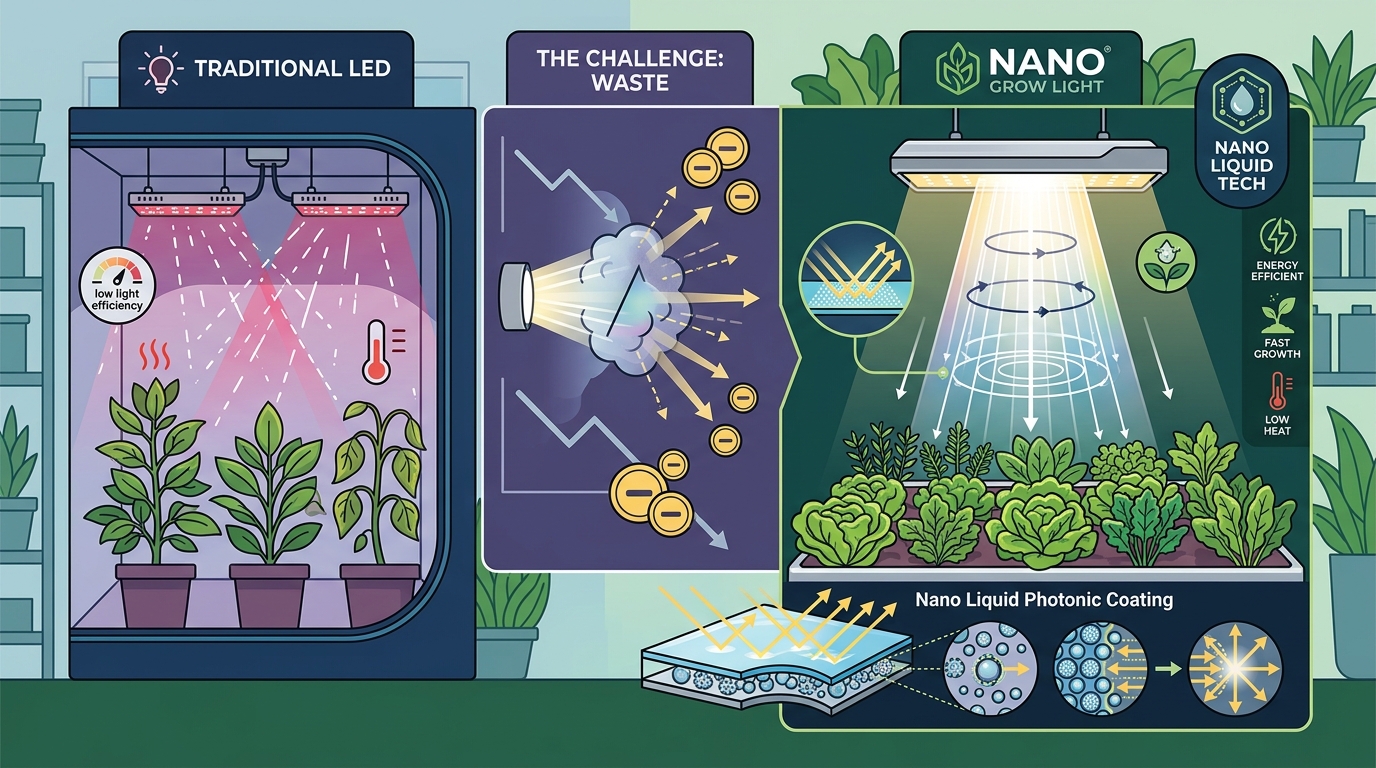
Understanding the difference between standard LED grow lights and next-generation photonics is critical for maximizing plant health. Nano Liquid Photonic Coating is a proprietary optical technology that redirects scattered light into a tighter, more usable beam for faster indoor plant growth. This innovation addresses the primary limitation of conventional LEDs, which often emit light in wide, inefficient patterns that waste energy and reduce Photosynthetically Active Radiation (PAR) density at the canopy level.
By utilizing nano-enhanced photon delivery, this technology sharpens targeted wavelengths, accelerating photosynthesis without increasing power consumption. The result is a balanced, beam-tightened output that supports stronger vegetative growth and sturdier plant structure. Unlike traditional halide or basic LED systems, this approach ensures that every photon contributes directly to plant development, making it ideal for compact indoor grow setups such as shelves, tents, and cabinets.
For a deeper understanding of the science behind this innovation, you can explore the How It Works page to see detailed diagrams of photon redirection. Additionally, industry reports on plant photobiology confirm that spectral purity is a decisive factor in chlorophyll absorption efficiency.
Comparing Lighting Technologies
Not all grow lights are created equal. The choice of lighting technology directly impacts yield, energy costs, and plant morphology. Below is a comparison of the leading technologies available to indoor growers today.
| Technology | Spectral Purity | Heat Output | Energy Efficiency | Best For |
|---|---|---|---|---|
| Nano Liquid Photonic | High | Low | Very High | Compact spaces, high-yield crops |
| Standard LED | Moderate | Medium | High | General houseplants |
| Fluorescent (T5) | Low | Low | Moderate | Seedlings, cuttings |
| High-Pressure Sodium (HPS) | Low | Very High | Low | Large commercial greenhouses |
As noted in Penn State Extension guidelines, heat management is a critical variable in indoor cultivation. Excessive heat can stress plants and increase humidity issues, making low-heat options like Nano Liquid technology superior for enclosed environments.
Benefits for African Violets and Microgreens
Different plant species have unique spectral requirements. While general-purpose lights work for many houseplants, specialized crops benefit from targeted spectral outputs. African violets respond exceptionally well to stabilized full-spectrum halide output. However, modern nano-coated LEDs can replicate this stability with greater efficiency and lower heat risk.
African Violets
African violets are sensitive to both light intensity and heat. Under Nano Grow Light, these plants exhibit continuous violet blooms and faster leaf expansion. The deep spectral continuity provided by the nano coating ensures richer coloration without the risk of leaf scorch. For more details on specific plant applications, visit the African Violets dedicated page.
Microgreens
Microgreens require rapid, uniform growth to maintain nutritional density. The tight photon delivery of nano-coated lights promotes up to 3× faster development in ideal conditions. This acceleration reduces the typical growth cycle, allowing growers to harvest crops in weeks rather than months. Research from food science journals highlights that light intensity and spectrum are the primary drivers of microgreen biomass accumulation.
Performance Metrics and Growth Rates
Quantifiable results are the ultimate test of any grow light. Real-world testing of Nano Liquid Photonic Coating has demonstrated significant advantages over traditional methods. In a controlled 28-day lettuce harvest trial across 60+ experiments, plants grown under nano-enhanced lighting showed accelerated maturity.
Key performance indicators include:
- Yield Acceleration: Plants can grow up to 1 inch per day, reducing a typical 3-month cycle to as little as 2 months.
- PAR Density: Photon redirection increases usable PAR at the canopy, boosting yields while using less energy.
- Energy Savings: By tightening the beam, less wattage is required to achieve the same photosynthetic effect compared to diffuse LED sources.
For growers looking to optimize their setup, understanding these metrics is essential. You can review the Shop Now collection to find the right fixture for your specific space size.
Key Takeaways
- Nano Liquid Photonic Coating redirects scattered light to increase usable PAR at the canopy.
- Low-heat operation makes this technology ideal for shelves, tents, and compact indoor grow setups.
- African violets benefit from the deep spectral continuity and stabilized output of nano-coated lights.
- Microgreens can achieve up to 3× faster development, reducing growth cycles significantly.
- Real-world trials show a 28-day lettuce harvest is achievable with optimized photon delivery.
- Plants can grow up to 1 inch per day under ideal nano-enhanced conditions.
- Energy efficiency is improved by tightening the beam, reducing waste compared to standard LEDs.
Frequently Asked Questions
Is Nano Liquid Photonic Coating better than standard LED?
Yes, for most indoor applications. Nano Liquid Photonic Coating redirects scattered light into a tighter beam, increasing PAR density and spectral purity. This results in faster growth rates and better energy efficiency compared to standard LEDs that emit diffuse light.
Can I use this light for African Violets?
Absolutely. African violets respond exceptionally well to the stabilized full-spectrum output provided by nano-coated lights. The low heat emission protects delicate leaves while promoting continuous violet blooms and richer coloration.
How much faster do plants grow with this technology?
In ideal conditions, plants can grow up to 1 inch per day. This acceleration can reduce a typical 3-month growth cycle to as little as 2 months, particularly for fast-cycling crops like lettuce and microgreens.
Does this light produce too much heat?
No. One of the primary benefits of Nano Grow Light is its low-heat operation. This makes it safe for use in enclosed spaces like cabinets, tents, and shelves without the risk of burning plants or overheating the environment.
What is the warranty and support policy?
Nano Grow Light offers comprehensive customer support. You can view the FAQ section for detailed information on shipping, returns, and technical support. For direct assistance, please visit the Contact page.
Is it suitable for small grow spaces?
Yes. The technology is engineered specifically for small and medium grow spaces, providing strong, even canopy coverage without the bulk of traditional high-wattage fixtures.
Conclusion
Choosing the best grow light for indoor plants requires balancing spectral purity, heat management, and energy efficiency. Nano Liquid Photonic Coating represents a significant leap forward in this field, offering targeted, high-efficiency plant growth that outperforms traditional LED systems. Whether you are cultivating African violets, microgreens, or leafy greens, this technology provides the precision needed for maximum yield.
Ready to transform your indoor garden? Explore the full range of Nano Grow Lights and start growing faster today. For personalized advice or bulk inquiries, contact our Customer Support team directly.