

Indoor gardening has evolved from a niche hobby into a mainstream practice for food security and aesthetic enhancement. According to recent market analyses, the global indoor farming market is projected to reach significant valuation milestones by 2030, driven by consumer demand for fresh produce year-round. This growth is not just about volume but about the efficiency of the technology powering it. When selecting a light source, you are not just buying a bulb; you are investing in the primary engine of photosynthesis. The wrong choice can lead to stunted growth, poor yields, and wasted electricity. This guide breaks down the critical technical and biological factors you must evaluate before making a purchase. (Contact Nano Grow Light)
Understanding PAR and Photon Density
Photosynthetically Active Radiation (PAR) is the range of light wavelengths that plants use for photosynthesis. It spans from 400 to 700 nanometers. However, PAR is a measurement of potential energy, not the actual amount of light reaching your plants. To understand efficacy, you must look at Photosynthetic Photon Flux Density (PPFD). PPFD measures the number of photons that actually hit a specific area per second. A high-wattage light with poor optics may have a lower PPFD than a lower-wattage light with superior lensing. When shopping, always request PPFD maps from the manufacturer. These maps show the uniformity of light distribution across your grow space. Uneven PPFD leads to inconsistent growth, where plants near the center outpace those at the edges.
Spectrum Analysis: Beyond Full Spectrum
Early grow lights relied on broad "full spectrum" bulbs that mimicked sunlight but lacked precision. Modern horticulture demands targeted spectral purity. Plants respond differently to various wavelengths. Blue light (400-500nm) drives vegetative growth and compact node spacing. Red light (600-700nm) triggers flowering and fruiting. Far-red light influences photomorphogenesis and stem elongation. A premium grow light does not just emit these colors; it optimizes the ratio for specific plant stages. For example, African violets respond exceptionally well to stabilized full-spectrum halide output, which provides the deep spectral continuity needed for consistent violet blooms. If you are growing microgreens, you need a spectrum that accelerates leaf expansion rapidly. Look for lights that offer adjustable spectrums or specific presets for vegetative and flowering stages.
Efficiency Metrics: PPFD vs. Watts
Energy efficiency is the most overlooked metric in indoor gardening. Older technologies like High-Pressure Sodium (HPS) lights are notoriously inefficient, converting only about 30% of electricity into usable light, with the rest lost as heat. Modern LED technology has improved this dramatically. However, not all LEDs are created equal. You must look at the micromoles per joule (µmol/J) rating. This metric tells you how many usable photons are produced for every watt of electricity consumed. A higher µmol/J rating means lower electricity bills and less heat load. Nano Grow Light utilizes proprietary Nano Liquid Photonic Coating to redirect scattered light into a tighter, more usable beam. This technology increases usable PAR at the canopy, boosting yields while using less energy. When comparing products, prioritize the photon output per watt over the total wattage of the fixture.
Heat Management and Light Distribution
Heat is the silent killer of indoor grows. Excessive heat can scorch leaves, dry out soil rapidly, and stress plants, leading to reduced yields. Traditional HID lights require large, expensive cooling systems and ventilation. LED lights run cooler, but poor thermal management can still shorten the lifespan of the diodes. Look for fixtures with robust passive or active cooling systems. Aluminum heat sinks are standard, but the design of the airflow is critical. Furthermore, light distribution matters. A light that focuses all its energy in a small spot will burn the center plants while leaving the edges in darkness. You need a light that provides balanced, beam-tightened output to support stronger vegetative growth and sturdier plant structure. Nano-enhanced photon delivery promotes up to 3× faster development in ideal conditions by ensuring every photon is utilized effectively.
The Role of Nano Liquid Photonic Coating
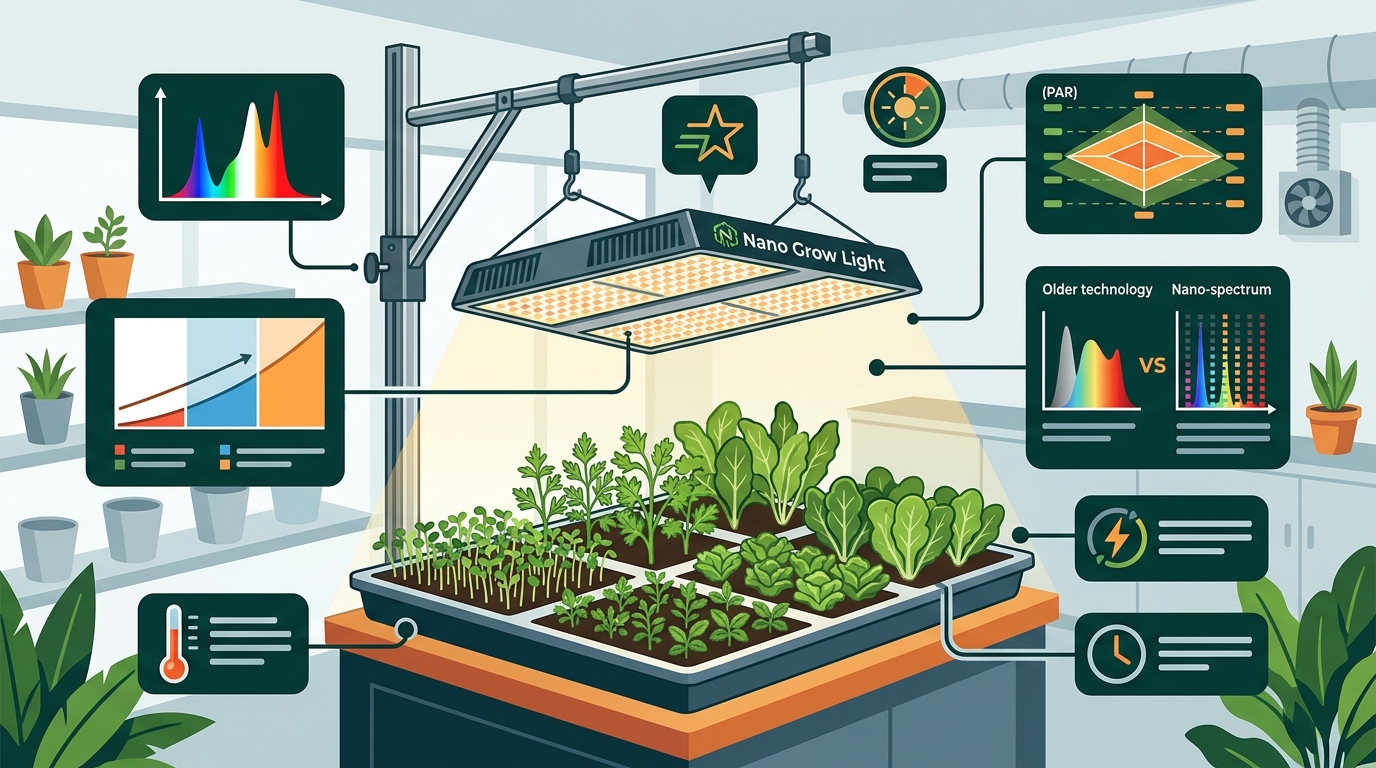
Innovation in grow light technology has reached a new peak with the introduction of Nano Liquid Photonic Coating. This is not just a marketing term; it is a physical application that alters how light behaves. Nano Liquid Photonic Coating redirects scattered light into a tighter, more usable beam for faster indoor plant growth. This coating sharpens targeted wavelengths, accelerating photosynthesis by reducing light loss through scattering. In real-world use, growers have brought fast-cycling crops like lettuce to harvest in as little as 2 months, compared to the typical 3-month cycle. Plants can grow up to 1 inch per day under these optimized conditions. This technology is particularly beneficial for small and medium grow spaces, providing strong, even canopy coverage where every square inch counts. The spectral purity from the nano coating ensures that the light delivered is exactly what the plant needs, nothing more, nothing less.
Comparing Light Technologies
Choosing the right technology depends on your budget, space, and plant types. Below is a comparison of common indoor grow light technologies.
| Technology | Efficiency (µmol/J) | Heat Output | Best For | Lifespan |
|---|---|---|---|---|
| HPS/MH | 1.0 - 1.4 | Very High | Large commercial grows | 10,000 hours |
| Standard LED | 2.0 - 2.7 | Moderate | General home grows | 50,000 hours |
| Nano-Coated LED | 2.8 - 3.5+ | Low | Compact spaces, high yield | 50,000+ hours |
| Fluorescent (T5) | 0.8 - 1.2 | Low | Seedlings, microgreens | 10,000 hours |
As shown in the table, Nano-Coated LEDs offer superior efficiency and lower heat output, making them ideal for modern indoor setups. The lower heat output reduces the need for aggressive ventilation, saving energy and maintaining humidity levels. The longer lifespan also reduces long-term costs, despite a higher initial investment. For detailed technical specifications on how this technology works, you can visit our How It Works page.
Key Takeaways
- PPFD Maps are Essential: Always request PPFD maps to ensure uniform light distribution across your grow area.
- Spectrum Matters: Look for targeted spectral purity, especially for specific plants like African violets which need deep spectral continuity.
- Efficiency is Key: Prioritize µmol/J ratings over total wattage to maximize energy savings and yield.
- Nano Technology Benefits: Nano Liquid Photonic Coating redirects scattered light, promoting up to 3× faster development.
- Heat Management: Choose lights with robust thermal management to prevent plant stress and extend diode lifespan.
- Real-World Results: Growers have reported bringing fast-cycling crops like lettuce to harvest in as little as 2 months.
- Compact Space Optimization: Nano-enhanced photon delivery is engineered for small and medium grow spaces.
Frequently Asked Questions
What is the most important metric for grow light efficiency?
The most important metric is micromoles per joule (µmol/J). This measures how many usable photons are produced for every watt of electricity consumed. A higher number indicates better efficiency and lower operating costs.
How does Nano Liquid Photonic Coating improve plant growth?
Nano Liquid Photonic Coating redirects scattered light into a tighter, more usable beam. This increases usable PAR at the canopy, sharpens spectral purity, and accelerates photosynthesis, leading to faster growth rates.
Can I use a standard LED light for African violets?
While standard LEDs work, African violets respond exceptionally well to stabilized full-spectrum halide output or specialized nano-coated LEDs. These provide the deep spectral continuity needed for continuous violet blooms and richer coloration.
How much faster can plants grow with nano technology?
In ideal conditions, nano-enhanced photon delivery can promote up to 3× faster development. For example, a typical 3-month lettuce cycle can be reduced to as little as 2 months.
What is the difference between PAR and PPFD?
PAR is the range of light wavelengths (400-700nm) that plants use for photosynthesis. PPFD is the measurement of how many of those photons actually hit a specific area per second. PPFD is the practical metric for growers.
Do I need a grow light with adjustable spectrum?
Adjustable spectrum lights are beneficial if you grow different types of plants or different stages of the same plant. It allows you to optimize the blue-to-red ratio for vegetative growth or flowering.
How do I prevent heat damage from grow lights?
Choose lights with low heat output, such as LEDs with nano-coating. Ensure proper ventilation in your grow space and maintain a safe distance between the light and the plant canopy.
Start Your Grow Today
Investing in the right technology is the first step toward a successful indoor garden. Whether you are growing microgreens, African violets, or leafy greens, the efficiency of your light source dictates your results. Explore our range of premium grow lights designed with Nano Liquid Photonic Coating to maximize your yield. Visit our Shop Now page to find the perfect light for your space. For more information on our technology, check out our Nano Liquid Technology page. If you have further questions, our Customer Support team is ready to assist you.