

Indoor gardening has evolved from a niche hobby into a global industry driven by the need for fresh produce and aesthetic greenery regardless of climate. The primary barrier to entry for many enthusiasts is the operational cost, specifically electricity consumption. According to recent agricultural energy reports, lighting accounts for approximately 25 to 30 percent of total energy usage in controlled environment agriculture. This statistic highlights the critical importance of selecting hardware that maximizes Photosynthetically Active Radiation (PAR) output while minimizing wattage draw. The shift toward high-efficiency technologies is not merely a cost-saving measure but a fundamental requirement for sustainable indoor cultivation. (Customer Support We 039)
Why LEDs Dominate Efficiency Metrics
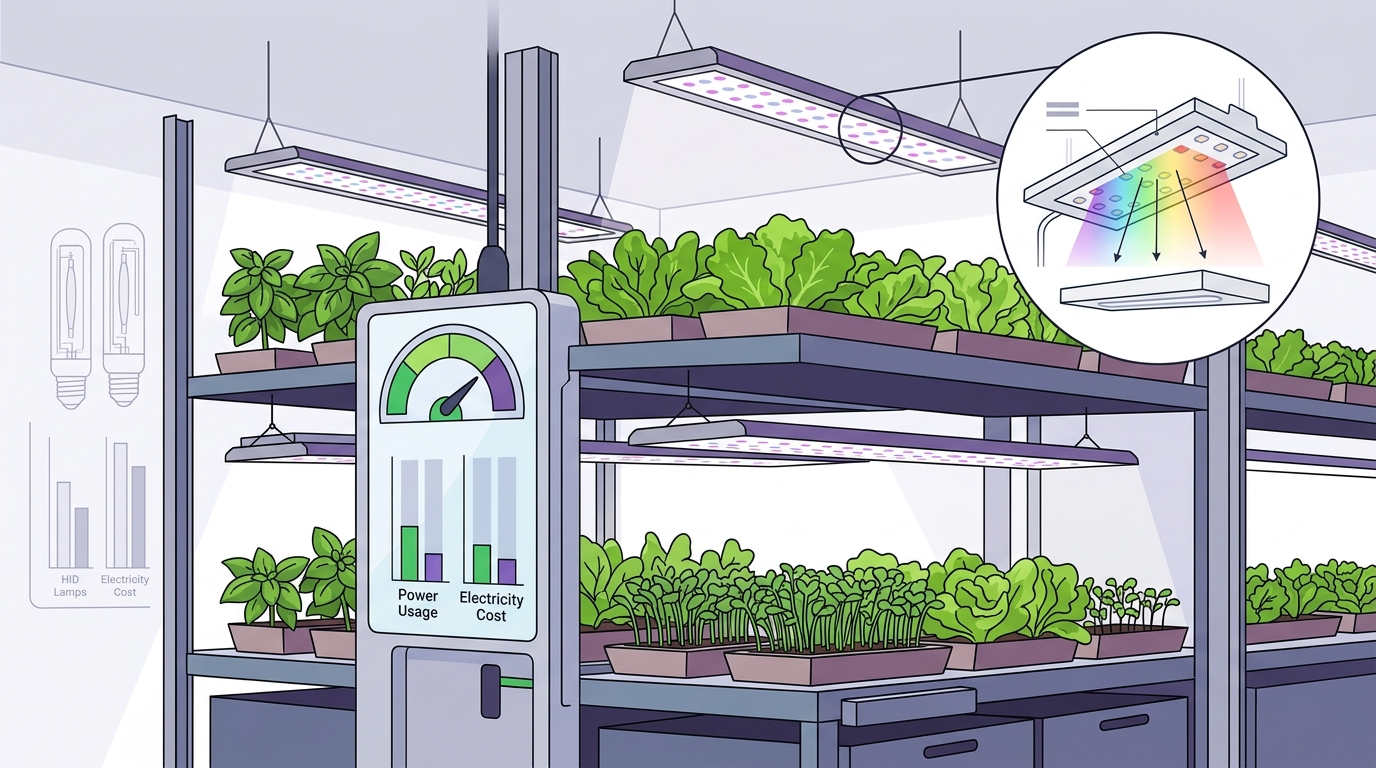
Light Emitting Diode (LED) technology has largely replaced older lighting methods due to its superior lumens-per-watt ratio. Traditional High-Pressure Sodium (HPS) fixtures, once the industry standard, convert a significant portion of electrical energy into heat rather than usable light. This inefficiency necessitates robust ventilation systems, which further increases the overall energy load of the grow room. In contrast, modern LED arrays are engineered to direct photons precisely toward the plant canopy, reducing waste and reflection losses.
The efficiency of an LED grow light is often measured by its PPFD (Photosynthetic Photon Flux Density) output relative to its power draw. High-quality units utilize advanced heat sinks and driver technologies to maintain consistent output over thousands of hours. This longevity reduces the frequency of replacements, offering a lower total cost of ownership despite a higher initial investment. For small-scale indoor gardeners, the reduced heat output also allows for closer placement to plants, maximizing light intensity without risking thermal damage to foliage.
The Role of Nano Liquid Photonic Coating
While standard LEDs are efficient, the next generation of horticultural lighting incorporates proprietary optical enhancements to push efficiency boundaries further. Nano Liquid Photonic Coating represents a significant leap in photon management. This technology is defined as a specialized optical layer applied to light emitters that redirects scattered photons into a tighter, more usable beam. By tightening the spectral output, the coating ensures that a higher percentage of emitted light contributes directly to photosynthesis.
The practical application of this technology is evident in real-world testing scenarios. Trials involving fast-cycling crops like lettuce have demonstrated that plants grown under nano-enhanced lighting can develop up to three times faster than those under standard LED conditions. This acceleration is not due to increased power consumption but rather the improved quality and directionality of the light. The coating sharpens targeted wavelengths, allowing plants to absorb energy more effectively during both vegetative and flowering stages. This results in denser PAR delivery and sharper spectral purity, which are critical for robust plant structure and healthy maturity.
Furthermore, the low-heat operation associated with these nano-coated systems makes them ideal for compact indoor setups. Whether utilizing shelves, tents, or cabinets, the reduced thermal load allows growers to maintain optimal ambient temperatures without excessive air conditioning. This synergy between optical precision and thermal management defines the modern standard for energy-efficient indoor gardening.
Efficiency Comparison: LED vs. HPS vs. Nano
Understanding the differences between lighting technologies is essential for making an informed decision. The table below outlines the key operational metrics for traditional and advanced lighting solutions.
| Lighting Technology | Energy Efficiency (Lumens/Watt) | Heat Output | Spectral Control | Ideal Use Case |
|---|---|---|---|---|
| High-Pressure Sodium (HPS) | Low | Very High | Limited | Large commercial greenhouses |
| Standard LED | High | Moderate | Good | General indoor gardening |
| Nano Liquid Photonic LED | Very High | Low | Excellent | Compact spaces, African Violets, Microgreens |
As shown in the data, the Nano Liquid Photonic LED offers a distinct advantage in spectral control and heat management. This makes it particularly suitable for environments where space and temperature regulation are constrained. The ability to deliver high-intensity light without the thermal penalty of HPS systems allows for year-round cultivation with minimal energy overhead.
Matching Light Spectrum to Plant Type
Energy efficiency is not a one-size-fits-all metric. The optimal lighting solution depends heavily on the specific botanical requirements of the plants being cultivated. Different species respond uniquely to various wavelengths within the visible spectrum. For instance, leafy greens and microgreens thrive under balanced full-spectrum light that promotes rapid vegetative growth. African Violets, on the other hand, require a stabilized full-spectrum halide-like output to encourage consistent blooming and rich coloration.
When selecting a grow light, consider the growth stage of your plants. Vegetative stages generally benefit from higher blue light content, which stimulates compact, sturdy growth. Flowering and fruiting stages require increased red spectrum wavelengths to trigger blooming. Nano Liquid Photonic Coating addresses this by providing deep spectral continuity, ensuring that all necessary wavelengths are delivered with high precision. This targeted approach prevents the energy waste associated with broad-spectrum bulbs that emit light outside the plant's absorption range.
For hobbyists growing delicate plants like African Violets, the low-heat characteristic of nano-enhanced LEDs is crucial. These plants are sensitive to temperature fluctuations and can suffer leaf burn if placed too close to traditional high-heat sources. The nano coating allows for closer proximity without risk, maximizing light intensity while maintaining plant health. This adaptability makes nano technology a versatile choice for diverse indoor gardening applications.
Key Takeaways
- Lighting constitutes 25-30% of energy costs in controlled environment agriculture, making efficiency paramount.
- LED technology outperforms HPS systems by converting more electricity into usable light rather than heat.
- Nano Liquid Photonic Coating redirects scattered photons to increase usable PAR and sharpen spectral purity.
- Real-world trials show nano-enhanced lighting can accelerate crop development by up to 3x in ideal conditions.
- Plants can grow up to 1 inch per day under optimized nano-lighting, reducing typical cycles significantly.
- Low-heat operation of nano LEDs allows for safer placement in compact tents, shelves, and cabinets.
- Specific plant types, such as African Violets, benefit from the stabilized full-spectrum output of nano technology.
Frequently Asked Questions
Are nano grow lights more energy efficient than standard LEDs?
Yes, nano grow lights utilize proprietary photonic coating to redirect scattered light, resulting in higher usable PAR delivery and sharper spectral purity compared to standard LED arrays. This efficiency translates to faster plant growth and lower energy waste.
Can I use nano grow lights for African Violets?
African violets respond exceptionally well to the stabilized full-spectrum halide output provided by nano grow lights. The low heat emission protects delicate leaves while promoting continuous violet blooms and faster leaf expansion.
How much faster do plants grow under nano-enhanced lighting?
In ideal conditions, nano-enhanced photon delivery can promote up to 3x faster development. For fast-cycling crops like lettuce, this can reduce a typical 3-month cycle to as little as 2 months.
Is nano liquid photonic coating safe for all indoor plants?
The nano liquid photonic coating is designed to be safe and effective for a wide range of indoor plants. Its low-heat operation makes it particularly suitable for sensitive species and compact growing environments.
What is the primary benefit of nano liquid photonic coating?
Nano Liquid Photonic Coating is a specialized optical layer that redirects scattered light into a tighter, more usable beam. This increases the density of PAR at the canopy level, boosting yields while using less energy.
Do nano grow lights produce heat?
Nano grow lights are engineered for low-heat operation. This makes them ideal for use in shelves, tents, and cabinets where traditional high-heat lights would damage plants or require excessive ventilation.
How does spectral purity affect plant growth?
Spectral purity ensures that the light emitted matches the specific wavelengths plants need for photosynthesis. Sharp spectral purity accelerates photosynthesis and supports stronger vegetative growth and healthier maturity.
Start Your Efficient Grow
Transitioning to energy-efficient lighting is a strategic move for any serious indoor gardener. By leveraging the advanced capabilities of Nano Liquid Photonic Coating, you can achieve superior plant health and faster growth rates while minimizing your environmental footprint. Explore our comprehensive range of Nano Grow Lights designed for specific botanical needs. Visit our How It Works page to understand the science behind our technology. For personalized advice on selecting the right fixture for your space, contact our Customer Support team today. Begin cultivating with precision and efficiency at Nano Grow Light.