

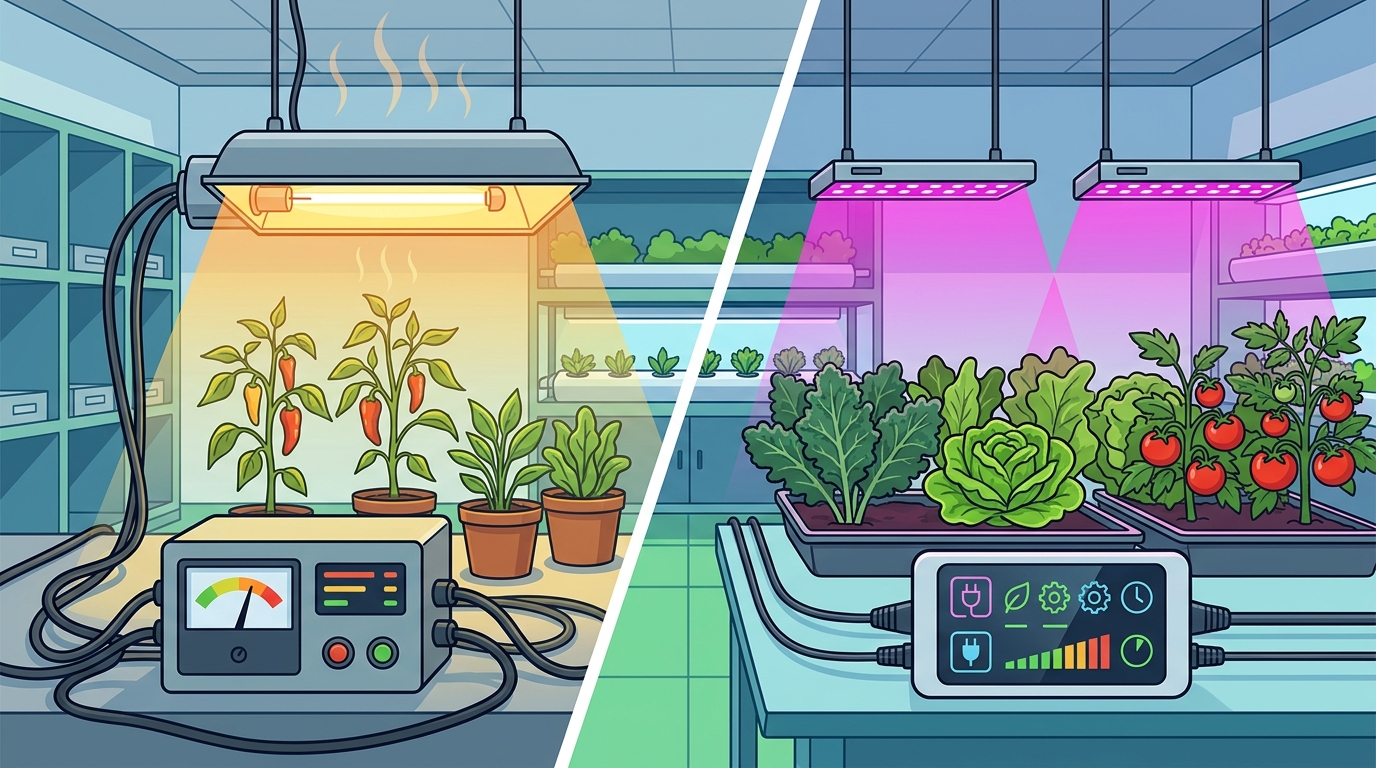
Indoor horticulture has undergone a radical transformation in energy consumption metrics over the last decade. According to recent industry data, modern horticultural lighting systems can reduce electricity usage by up to 40% compared to traditional high-pressure sodium fixtures while simultaneously increasing photosynthetic efficiency. This shift is driven by the demand for sustainable growing practices and the rising cost of electrical power in residential and commercial sectors. Growers are no longer just looking for brightness; they are prioritizing lumens per watt and photosynthetically active radiation (PAR) delivery efficiency. Understanding the trade-offs between different light sources is critical for optimizing both yield and operational costs. (Illustrative Use Cases Nano)
The LED Efficiency Standard
Light Emitting Diodes (LEDs) have long been the benchmark for energy efficiency in indoor gardening. LEDs convert a high percentage of electrical energy directly into light, minimizing heat waste compared to older technologies. They allow for precise spectral tuning, meaning growers can adjust the light spectrum to match specific plant growth stages, from vegetative to flowering. (About NanoGrowLight Company amp)
However, standard LED fixtures often suffer from light scatter. Without high-quality optics, a significant portion of the photons miss the plant canopy entirely, hitting the walls or ceiling instead. This inefficiency means that even a high-wattage LED fixture may deliver less usable PAR than a lower-wattage fixture with superior optical engineering. The key to maximizing LED efficiency lies in the quality of the secondary optics and the thermal management of the diodes.
Ceramic Metal Halide Performance
Ceramic Metal Halide (CMH) lights offer a different approach to efficiency. Unlike LEDs, which emit light in discrete peaks, CMH lamps produce a continuous full-spectrum output. This spectral purity is often cited as beneficial for plant health, reducing the need for supplemental lighting. CMH fixtures are particularly valued for their ability to penetrate dense canopies effectively due to the high intensity of the arc source.
While CMH lights are highly efficient in terms of spectral quality, they do generate more heat than LEDs. This thermal output requires careful distance management to prevent leaf burn. Despite the heat, many commercial growers prefer CMH for its robust performance in larger grow spaces where the heat can be managed through ventilation systems. The efficiency of CMH is not just about watts consumed but about the biological response of the plant to the light spectrum.
Nano Liquid Photonic Coating
A newer entrant in the efficiency conversation is the integration of Nano Liquid Photonic Coating into horticultural fixtures. This technology addresses the fundamental issue of light scatter found in traditional reflectors. By applying a nano-scale reflective treatment to the internal surfaces of a grow light fixture, manufacturers can redirect scattered photons back toward the plant canopy.
Nano Liquid Photonic Coating is a proprietary nano-scale reflector treatment designed to redirect and concentrate light toward the plant canopy. This coating is applied to the fixture’s internal reflector, where it redirects and concentrates light for denser PAR delivery and reduced scatter. In manufacturer-reported internal testing, this technology has demonstrated the ability to increase vegetative biomass and accelerate harvest times. For instance, trials have shown that lettuce can mature in 28 days under nano-enhanced lighting compared to 42 days outdoors, highlighting the potential for accelerated growth cycles.
The Nano Grow Light fixture utilizes a 250W ceramic metal halide (CMH) lamp paired with this coating. The combination of the broad spectral output of CMH and the precise photon redirection of the nano coating creates a highly efficient system for small to medium grow spaces. The fixture is designed to cover approximately 3.5 by 3.5 feet of area, making it ideal for compact indoor setups, shelves, and tents.
Spectral Purity and Heat Management
One of the critical advantages of the nano-coated CMH fixture is its spectral purity. The nano coating sharpens targeted wavelengths, accelerating photosynthesis by ensuring that the most useful photons reach the plant tissue. Additionally, while CMH lamps naturally run hotter than LEDs, the nano-coated fixtures are engineered to manage this heat effectively. The fixture operates at approximately 45°C surface temperature at steady state, which is manageable for most indoor environments when proper spacing is maintained.
Scalability for Commercial Use
For larger operations, the modular nature of nano-enhanced fixtures allows for scalable solutions. Multiple fixtures can be arrayed across rows or bays to cover wider canopy areas. This modularity provides flexibility for commercial greenhouses and indoor farms that need to adjust their lighting density based on crop type and growth stage. The ability to scale efficiency without sacrificing spectral quality is a significant advantage for growing businesses.
Efficiency Comparison Matrix
The following table compares the key efficiency metrics of traditional LED, standard CMH, and nano-enhanced CMH fixtures. These metrics are derived from manufacturer data and industry standards for indoor horticulture.
| Lighting Technology | Power Consumption (Watts) | Spectral Output | PAR Efficiency | Heat Output | Ideal Use Case |
|---|---|---|---|---|---|
| Standard LED | 200-600W | Tunable Peaks | High | Low | General Indoor Gardening |
| Standard CMH | 250-400W | Continuous Full-Spectrum | Medium | High | Commercial Greenhouses |
| Nano-Enhanced CMH | 250W | Enhanced Full-Spectrum | Very High | Moderate | Compact Indoor & Microgreens |
Key Takeaways
- Energy Savings: Modern efficient fixtures can reduce electricity usage by up to 40% compared to older HID technologies.
- Nano Technology: Nano Liquid Photonic Coating increases usable PAR by redirecting scattered light, improving yield per watt.
- Spectral Quality: CMH lamps provide continuous full-spectrum output, which is beneficial for complex plant biological responses.
- Heat Management: Nano-enhanced fixtures operate at approximately 45°C, requiring appropriate spacing for delicate plants.
- Growth Acceleration: Trials indicate that nano-enhanced lighting can reduce harvest times for fast-cycling crops like lettuce to 28 days.
- Modular Scaling: Multiple nano-enhanced fixtures can be arrayed for larger commercial operations, offering scalable efficiency.
- Fixture Coverage: A single 250W nano-enhanced fixture covers approximately 3.5 by 3.5 feet, ideal for small spaces.
Frequently Asked Questions
Are nano-enhanced grow lights more efficient than standard LEDs?
Nano-enhanced CMH fixtures offer higher PAR efficiency in compact spaces due to superior photon redirection. While LEDs are generally more energy-efficient in terms of raw wattage-to-lumen conversion, the nano coating ensures that more of that light is actually used by the plant, often resulting in faster growth and higher yields per watt in specific applications.
How does Nano Liquid Photonic Coating work?
Nano Liquid Photonic Coating is a nano-scale reflector treatment designed to redirect and concentrate light toward the plant canopy. It works by applying nano-scale clusters to the internal reflector, which minimizes scatter and focuses the light beam, increasing the density of photons reaching the leaves.
What is the ideal coverage area for a 250W nano-enhanced fixture?
A single 250W nano-enhanced fixture is designed to cover approximately 3.5 by 3.5 feet of grow area. This size is optimal for microgreens, African violets, and small vegetative setups.
Do nano-enhanced lights generate too much heat for indoor use?
The fixtures operate at a steady-state surface temperature of approximately 45°C. While this is warmer than LEDs, it is manageable for most indoor environments with proper ventilation and spacing. The heat is also beneficial in cooler climates for maintaining ambient temperature.
Can I use nano-enhanced lights for flowering plants?
Yes, the continuous full-spectrum output of the CMH lamp, combined with the nano coating, supports all stages of plant growth, including flowering. The spectral purity helps promote robust blooming and fruiting.
How does the nano coating compare to standard aluminum reflectors?
Standard aluminum reflectors lose usable light to scatter and absorption. The nano coating increases reflectance and shifts more of the reflected spectrum toward the blue and red wavelength bands used in photosynthesis, according to manufacturer-reported internal testing.
Is the nano-enhanced fixture suitable for commercial greenhouses?
Yes, larger operations can achieve commercial-scale lighting by arraying multiple nano-enhanced fixtures across rows or bays. This modular approach allows for precise control over light density and coverage.
Start Growing Efficiently
Optimizing your indoor garden requires more than just buying a light; it requires choosing a system that maximizes every photon. Nano Grow Light offers a unique solution that combines the spectral benefits of CMH with the precision of nano-photonics. Explore our Shop Now page to view our single fixtures and multi-pack bundles. For more details on the technology, visit our Nano Liquid Technology page. If you have specific questions about your setup, contact our support team via our Contact page. Start your journey to faster, more efficient growth today by visiting NanoGrowLight.com.