
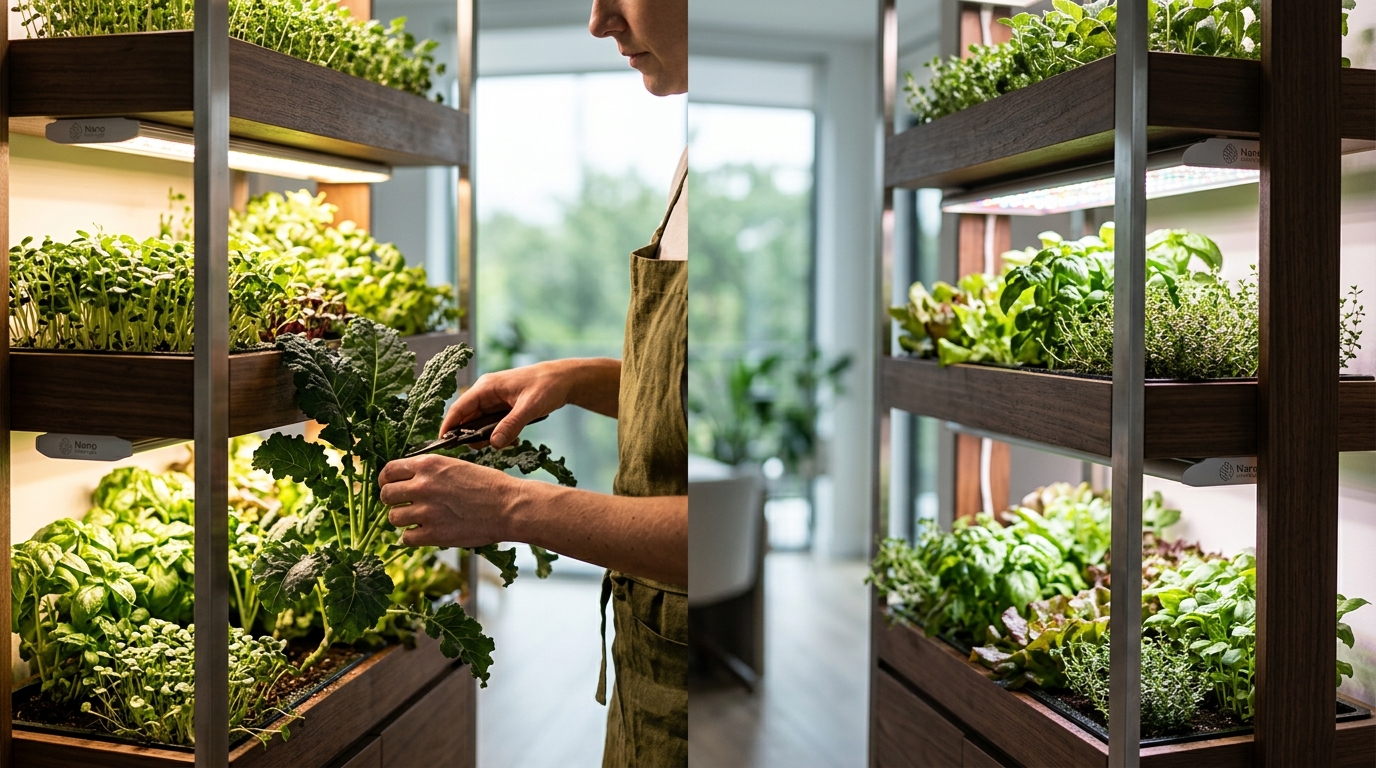
Indoor gardening has evolved from a niche hobby into a global industry driven by the demand for fresh produce and year-round greenery. According to recent market analysis, the global indoor farming market is projected to reach significant valuation milestones by 2030, driven by advancements in horticultural lighting technology. This growth is not merely about convenience; it is about optimizing plant biology through precise spectral control and intensity. For growers, selecting the right light source is the single most critical decision that determines harvest speed, plant health, and energy efficiency. This guide explores the leading technologies, with a deep dive into the innovative Nano Liquid Photonic Coating system offered by NanoGrowLight.
Understanding Light Spectra and PAR
To evaluate the best grow lights, one must first understand Photosynthetically Active Radiation (PAR). PAR is the range of light wavelengths, typically between 400 and 700 nanometers, that plants use for photosynthesis. Not all light is created equal. Traditional incandescent bulbs waste energy as heat, while standard fluorescent tubes often lack the intensity required for robust vegetative growth.
Modern horticultural lighting focuses on delivering high PAR values with minimal energy waste. The efficiency of a light fixture is determined by how much of its output actually reaches the plant canopy. This is where reflector technology becomes paramount. A high-quality reflector minimizes scatter and maximizes the density of photons hitting the leaves. This concept is central to the design philosophy at NanoGrowLight, which prioritizes photon redirection over raw wattage alone.
CMH vs LED: The Core Technology Debate
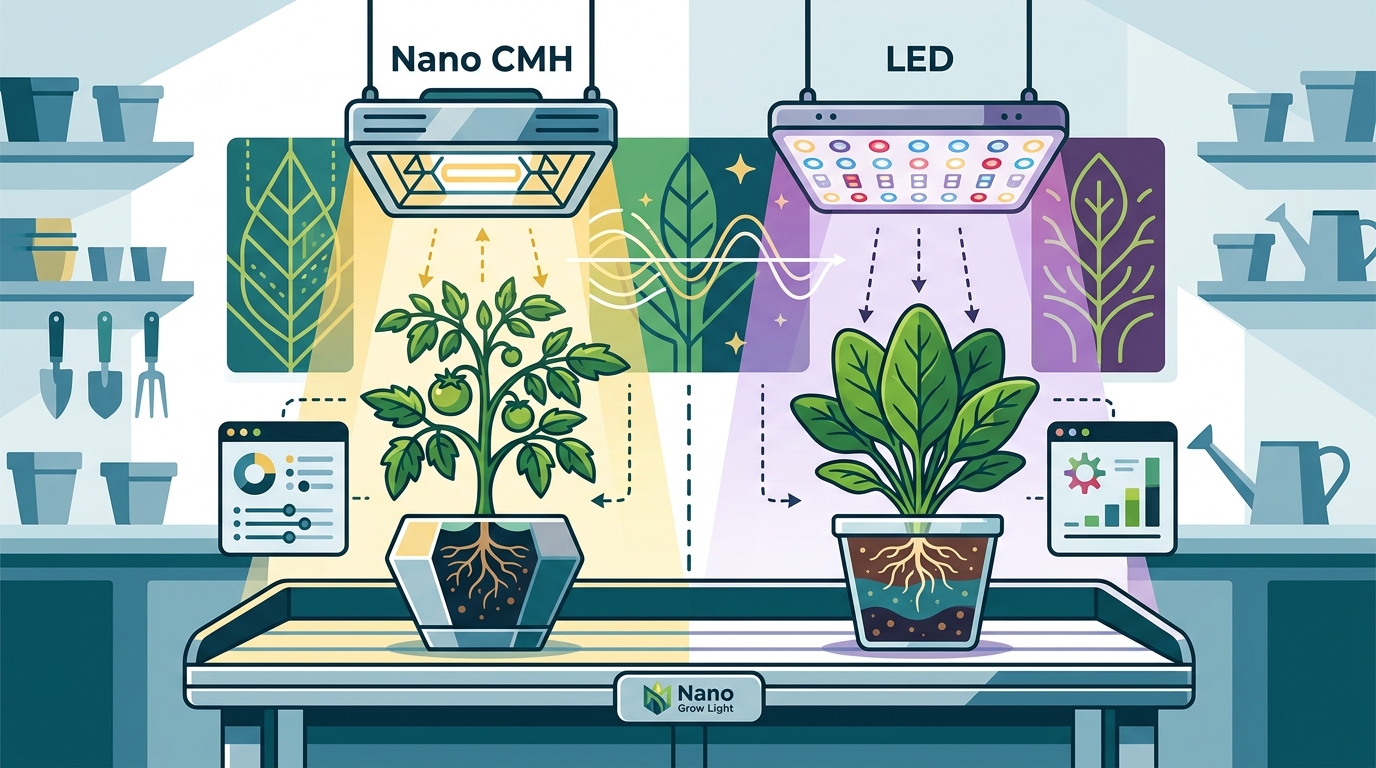
The two dominant technologies in the indoor grow light market are Ceramic Metal Halide (CMH) and Light Emitting Diodes (LED). Each has distinct advantages and limitations.
The Case for Ceramic Metal Halide (CMH)
CMH lamps are known for their broad, continuous full-spectrum output. Unlike LEDs, which emit light at specific discrete wavelengths from individual diodes, CMH lamps produce a smooth spectral curve similar to natural sunlight. This continuity is beneficial for plant development, reducing the risk of spectral gaps that might hinder certain growth stages. The Nano Liquid Photonic Coating is specifically engineered to enhance the output of CMH lamps, addressing the traditional drawback of CMH systems: light scatter.
The Dominance of LED
LEDs have gained market share due to their energy efficiency and low heat output. They allow growers to customize spectral recipes, boosting specific wavelengths for vegetative or flowering stages. However, standard LED fixtures can suffer from "hot spots" and uneven coverage if not properly diffused. Furthermore, the cost of high-quality, full-spectrum LED arrays can be prohibitive for small-scale growers.
Nano Liquid Photonic Coating Explained
NanoGrowLight has introduced a proprietary solution to the limitations of traditional reflectors: the Nano Liquid Photonic Coating. This technology represents a shift from passive reflection to active photon management.
How It Works
The Nano Liquid Photonic Coating is a nano-scale reflector treatment applied to the internal reflector of the fixture. It consists of nano-scale clusters of approximately 20 to 80 nanometers, applied at a cured thickness of roughly 2 to 6 microns. According to manufacturer-reported internal testing, this coating increases visible-light and PAR reflectance compared to bare aluminum reflectors. It shifts more of the reflected spectrum toward the blue and red wavelength bands used in photosynthesis.
This targeted beam delivery improves performance per watt. By redirecting scattered photons into a tighter, more usable beam, the system boosts yields while using less energy. The result is stronger vegetative growth and sturdier plant structure. In trials, lettuce matured in 28 days versus 42 days outdoors, demonstrating the potency of this technology.
Technical Specifications
The Nano Grow Light fixture utilizes a 250W ceramic metal halide (CMH) lamp. While CMH lamps run hotter than typical LED fixtures, with a manufacturer-reported heat output of approximately 340 BTU/hr and a surface temperature of about 45°C, the nano coating helps concentrate the light efficiently. This allows for effective coverage of a 3.5 by 3.5 feet area with a single unit, making it ideal for compact indoor setups.
Ideal Use Cases for Nano Grow Lights
While the technology is versatile, it excels in specific environments where efficiency and spectral quality are paramount.
- Microgreens Production: Microgreens require rapid growth cycles. Growers have reported bringing fast-cycling crops like lettuce to harvest in as little as 28 days using this system.
- African Violets and Flowering Plants: The full-spectrum output supports consistent indoor blooming. The Nano Grow Light for African Violets page details how the blue and white wavelengths support vegetative health while promoting blooms.
- Vertical Farms and Shelves: The fixture is engineered for small and medium grow spaces. Its ability to deliver dense PAR allows for tighter spacing in vertical racks.
- Research Labs: The consistency of the CMH spectrum combined with the nano-coated reflector provides reliable data for horticultural research.
Technology Comparison Matrix
The following table summarizes the key differences between standard LED fixtures, traditional CMH fixtures, and the NanoGrowLight CMH system.
| Feature | Standard LED Fixture | Traditional CMH Fixture | NanoGrowLight CMH + Nano Coating |
|---|---|---|---|
| Spectral Output | Discrete peaks (diode gaps) | Continuous full-spectrum | Continuous full-spectrum with enhanced PAR |
| Reflectivity | Standard aluminum or plastic | Bare or painted aluminum | Nano Liquid Photonic Coating (high reflectance) |
| Heat Output | Low | High (~340 BTU/hr) | High (~340 BTU/hr), but concentrated light |
| Coverage Area | Variable | Approx. 3.5 x 3.5 ft | Approx. 3.5 x 3.5 ft per fixture |
| Best For | Large commercial scales | General hobbyist use | Compact, high-efficiency indoor growth |
Key Takeaways
- Technology Innovation: NanoGrowLight uses a 250W CMH lamp paired with a proprietary Nano Liquid Photonic Coating to maximize PAR delivery.
- Efficiency Gains: The nano coating redirects scattered light, increasing usable PAR at the canopy and boosting yields while using less energy.
- Growth Speed: In manufacturer-reported trials, fast-cycling crops like lettuce reached harvest in 28 days, significantly faster than outdoor cycles.
- Spectral Quality: CMH provides a continuous full-spectrum output, avoiding the diode gaps common in LED fixtures.
- Scalability: The system is designed for modular arrays, allowing growers to scale from single fixtures to commercial greenhouse setups.
- Heat Management: While CMH runs hotter than LED, the concentrated beam allows for effective coverage in compact spaces like tents and cabinets.
- Versatility: Ideal for microgreens, African violets, and vertical farming applications where spectral purity and intensity are critical.
Frequently Asked Questions
Is Nano Grow Light better than LED?
It depends on your goals. NanoGrowLight offers a continuous full-spectrum output with enhanced PAR efficiency through its nano coating, which can lead to faster growth cycles for certain crops compared to standard LED fixtures. However, LEDs generally run cooler.
How does the Nano Liquid Photonic Coating work?
The coating consists of nano-scale clusters applied to the reflector. It redirects scattered photons into a tighter beam, increasing the density of usable light (PAR) reaching the plant canopy.
What is the coverage area of a single Nano Grow Light?
A single 250W fixture is designed to cover approximately 3.5 by 3.5 feet of grow space effectively.
Can I use this light for African Violets?
Yes. The full-spectrum output, including blue and white wavelengths, supports consistent indoor blooming for African violets and other flowering houseplants.
Is the heat output a concern for indoor use?
The CMH lamp produces approximately 340 BTU/hr. While this is higher than LED, the fixture is engineered for safe operation in tents and cabinets, provided adequate ventilation is maintained.
Does NanoGrowLight offer bundles?
Yes, products are offered as single fixtures, 2-pack bundles, and 3-pack bundles to accommodate larger grow spaces.
How fast can plants grow with this light?
In ideal conditions, plants can grow up to 1 inch per day. Trials have shown lettuce maturing in 28 days, compared to typical outdoor cycles of 42 days or more.
Start Growing Faster Today
Transform your indoor gardening experience with technology that prioritizes photon efficiency and spectral purity. Whether you are cultivating microgreens, African violets, or commercial crops, the Nano Grow Light system offers a proven path to faster, healthier growth. Explore the Shop Now page to view available fixtures and bundles. For more technical details, visit the How it Works section or read our Blog for the latest insights on indoor horticulture.