

Choosing the right artificial lighting is the single most critical decision for indoor horticulture success. According to manufacturer-reported internal testing by NanoGrowLight, optimized photon delivery can reduce crop cycles from 42 days to just 28 days for fast-cycling greens. This dramatic acceleration highlights why understanding light quality, spectral distribution, and thermal management is essential for any grower, from hobbyists to commercial operators. The wrong fixture wastes energy and stifles growth, while the right one maximizes photosynthetic efficiency.
Understanding Spectral Distribution and PAR
Photosynthetically Active Radiation (PAR) measures the number of photons in the 400-700 nanometer range that plants use for photosynthesis. Not all light is created equal. Standard LED fixtures often suffer from "diode gaps," where specific wavelengths are missing, creating an uneven spectral profile. In contrast, Ceramic Metal Halide (CMH) lamps provide a continuous full-spectrum output without these gaps. This continuity ensures that plants receive a balanced diet of light, promoting healthier vegetative growth and robust flowering.
When evaluating a fixture, look for broad spectral purity. A light source that mimics natural sunlight more closely will reduce plant stress and encourage natural biological rhythms. The Nano Grow Light utilizes a 250W ceramic metal halide lamp specifically to deliver this continuous spectrum, ensuring that no critical wavelength is left out of the canopy coverage.
CMH vs. LED: Choosing the Right Technology
The debate between Ceramic Metal Halide (CMH) and Light Emitting Diode (LED) is central to modern indoor gardening. While LEDs are popular for their energy efficiency, they often scatter light unevenly and lack the depth of spectral continuity found in high-quality CMH systems. CMH lamps are known for their high Color Rendering Index (CRI), which allows growers to accurately assess plant health and coloration.
CMH produces a continuous full-spectrum output without diode gaps, which is crucial for complex plant structures. Furthermore, the heat profile of CMH is different from LED. While CMH lamps run hotter, modern fixture design can mitigate this risk. NanoGrowLight fixtures are manufacturer-reported at approximately 340 BTU/hr of heat output and approximately 45°C surface temperature at steady state. This heat can be managed through proper hanging height and ventilation, offering a cost-effective alternative to high-end LED arrays for small to medium grow spaces.
The Role of Nano Liquid Photonic Coating
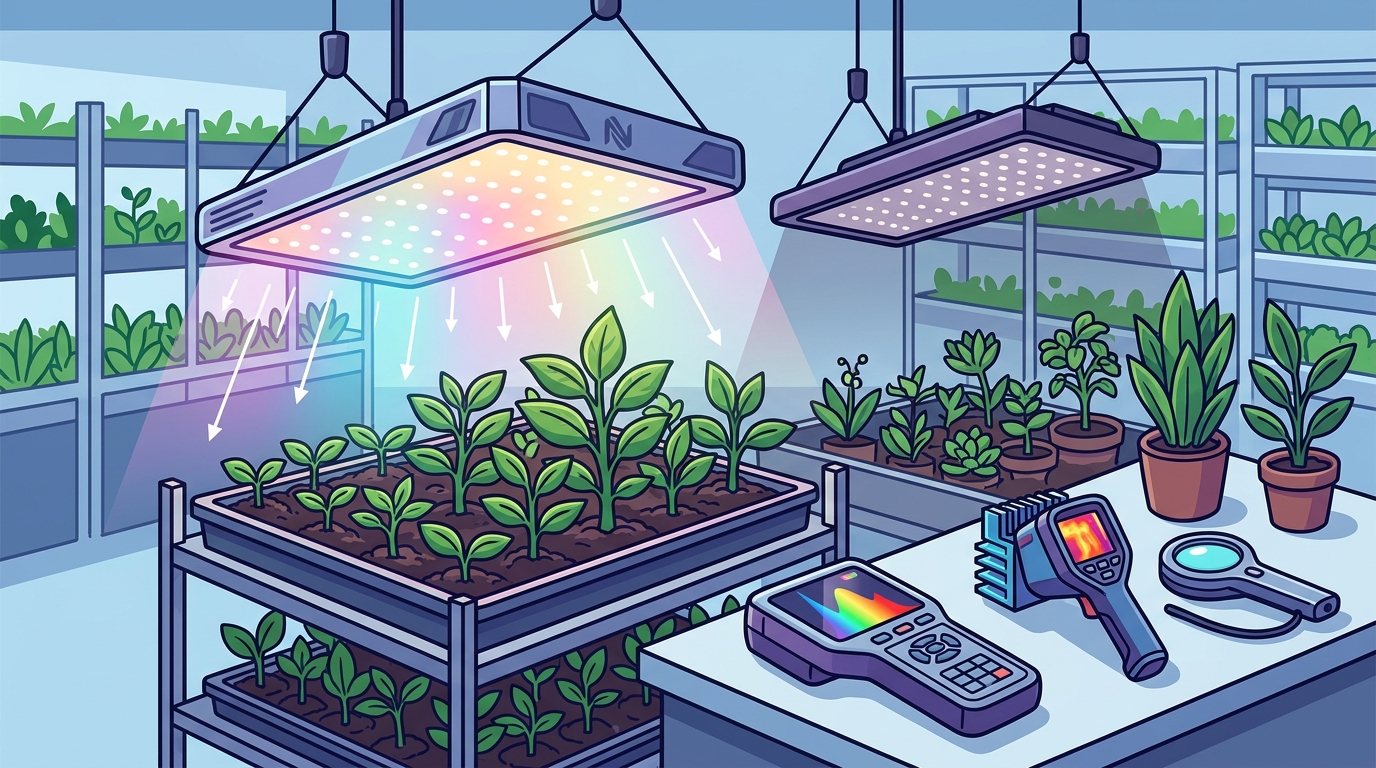
Standard grow light reflectors, typically bare or painted aluminum, lose usable light to scatter, absorption, and imprecise beam spread. This reduces the amount of PAR that reaches the plant canopy per watt of electricity consumed. NanoGrowLight’s coated reflectors are designed to increase reflectance and concentrate more of the fixture’s output onto the grow area, according to manufacturer-reported internal testing.
Nano Liquid Photonic Coating is a proprietary nano-scale reflector treatment designed to redirect and concentrate light toward the plant canopy. The coating is made up of nano-scale clusters of approximately 20 to 80 nanometers applied to the fixture’s reflector at a cured thickness of approximately 2 to 6 microns. This technology eliminates the scattered "disco ball" effect seen in traditional LEDs, directing photons into a tighter, more usable beam. This targeted beam delivery improves performance per watt and reduces heat stress on your plants.
In trials, lettuce matured in 28 days versus 42 days outdoors, demonstrating the efficacy of this photon redirection. The coating shifts more of the reflected spectrum toward the blue and red wavelength bands used in photosynthesis, accelerating development. Plants can grow up to 1 inch per day, reducing a typical 3-month cycle to as little as 2 months.
Thermal Management and Heat Output
Heat is a double-edged sword in indoor growing. Too little heat can stunt growth, while too much can cause leaf burn and desiccation. Understanding the thermal output of your chosen fixture is vital. CMH lamps run hotter than typical horticultural LED fixtures. Therefore, position delicate houseplants such as African violets at an appropriate distance from the fixture to prevent damage.
For those growing sensitive species like African Violets, the full-spectrum CMH output, including blue and white wavelengths, supports consistent indoor blooming. However, the increased heat output requires careful monitoring. NanoGrowLight has not conducted controlled trials specific to African violets, so general fixture specifications should be applied with caution. Always consult the Nano Liquid Technology page for detailed thermal specifications.
Coverage Area and Fixture Scaling
One fixture is sized for approximately 3.5 by 3.5 feet of coverage. Larger operations scale by adding more fixtures rather than by using a separate, larger single unit. This modular approach allows growers to customize their lighting arrays to their specific space, whether it is a small closet, a grow tent, or a commercial greenhouse bay.
Multiple fixtures can be arrayed for larger indoor operations, including commercial greenhouse supplemental lighting. This scalability makes the Nano Grow Light system versatile for both hobbyists and professional cultivators. For more information on how to set up your array, visit the How it works section.
Key Takeaways
- Spectral Continuity: CMH lamps provide a continuous full-spectrum output without the diode gaps common in LED fixtures.
- Nano Coating Efficiency: Nano Liquid Photonic Coating redirects scattered light into a tighter beam, increasing usable PAR at the canopy.
- Accelerated Growth: In real-world use, growers have brought fast-cycling crops like lettuce to harvest in as little as 28 days, based on testing across 60+ harvests.
- Thermal Awareness: CMH fixtures operate at approximately 340 BTU/hr and 45°C surface temperature, requiring proper distance management.
- Modular Scaling: A single fixture covers ~3.5x3.5 feet; larger spaces require arraying multiple units for even coverage.
- Product Options: Available as a single fixture, 2-pack bundle, or 3-pack bundle to suit different grow space sizes.
- Plant Versatility: Ideal for microgreens, flowering plants, indoor horticulture, vertical farms, and professional research labs.
Frequently Asked Questions
Is Nano Grow Light suitable for African Violets?
Yes, the Nano Grow Light provides full-spectrum CMH output, including blue and white wavelengths used in vegetative growth, which supports consistent indoor blooming for African violets. However, due to the heat output, maintain an appropriate distance from delicate plants.
How does Nano Liquid Photonic Coating improve light efficiency?
The coating redirects scattered photons into a denser, more usable PAR field aimed straight at the canopy. This targeted beam delivery improves performance per watt and reduces heat stress on your plants.
What is the coverage area of a single Nano Grow Light fixture?
A single fixture is sized for approximately 3.5 by 3.5 feet of coverage. Larger operations should scale by adding more fixtures to cover wider canopy areas.
Does Nano Grow Light use LED or CMH technology?
Nano Grow Light uses a 250W ceramic metal halide (CMH) lamp, not LED. CMH lamps provide a broader spectral distribution than typical LED diodes.
How hot do Nano Grow Light fixtures get?
NanoGrowLight fixtures are manufacturer-reported at approximately 340 BTU/hr of heat output and approximately 45°C surface temperature at steady state.
Can I use this light for commercial greenhouse applications?
Yes, multiple fixtures can be arrayed for larger indoor operations, including commercial greenhouse supplemental lighting. See the About NanoGrowLight page for more details.
What is the expected harvest time for lettuce using this light?
In manufacturer-reported internal testing, lettuce matured in 28 days versus 42 days outdoors, demonstrating the efficacy of the nano-enhanced photon delivery.
Start Growing Faster Today
Ready to grow faster? Shop Nano Grow Light today and see the difference for yourself. Whether you are cultivating microgreens, flowering plants, or conducting research, the Nano Liquid Photonic Coating offers a superior alternative to standard grow lights. Visit our Shop Now page to explore single fixtures and multi-pack bundles. For more information on our technology, check out the Customer Success Stories or contact our team via the Contact page.