
Optimizing Red and Blue Light Spectrum for Indoor Plant Growth with Ceramic Metal Halide Fixtures
Indoor horticulture has shifted dramatically from simple illumination to precise spectral engineering. According to manufacturer-reported internal testing, NanoGrowLight’s coated reflectors increase reflectance and concentrate more of the fixture’s output onto the grow area. This concentration of photosynthetically active radiation (PAR) is critical because standard bare aluminum reflectors lose usable light to scatter and absorption. The result is less energy reaching the plant canopy per watt of electricity consumed. By understanding how specific wavelengths drive photosynthesis, growers can maximize yield and quality in compact spaces. (Contact Nano Grow Light)
Understanding Spectral Needs for Photosynthesis
Plants do not use all light equally. The concept of Photosynthetically Active Radiation (PAR) is defined as the range of light wavelengths from 400 to 700 nanometers that plants use for photosynthesis. Within this range, two specific bands drive the most significant biological responses: blue light and red light. (Indoor Grow Lights Nano)
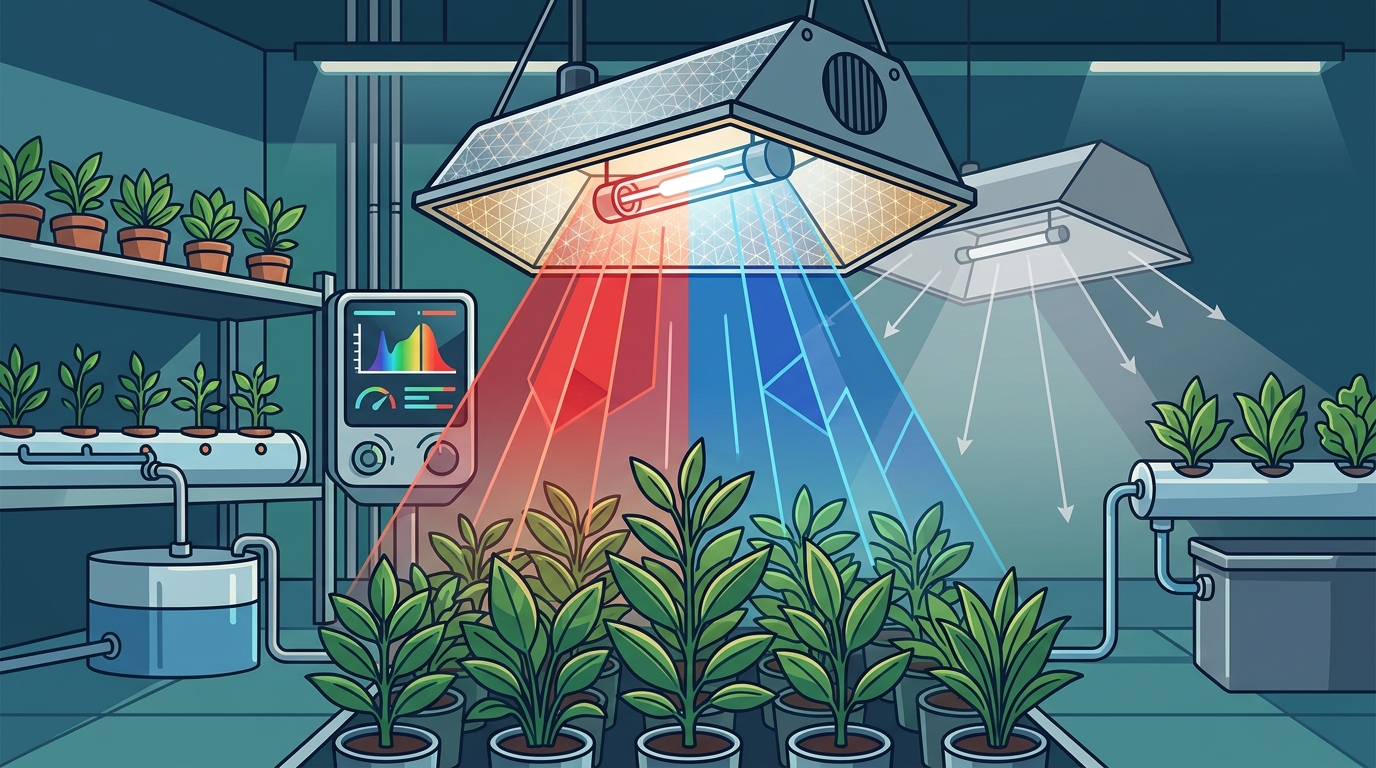
Blue light, typically ranging from 400 to 500 nanometers, is essential for vegetative growth. It regulates stomatal opening and promotes compact, sturdy stem development. Without adequate blue spectrum, plants become leggy and weak. Red light, spanning 600 to 700 nanometers, drives flowering and fruiting. It triggers the phytochrome system, which tells the plant when to bloom. A balanced delivery of both spectra ensures healthy development from seedling to harvest. (Blog Nano Grow Light)
Traditional lighting often fails to deliver these spectra efficiently. Standard incandescent bulbs waste energy on infrared heat, while basic fluorescent tubes may lack the intensity required for dense canopies. This is where Ceramic Metal Halide (CMH) technology changes the game by providing a broad, continuous full-spectrum output without the gaps found in other sources.
CMH vs. LED Spectrum: The Continuous Advantage
The debate between Ceramic Metal Halide (CMH) and Light Emitting Diode (LED) lighting is central to modern indoor gardening. Nano Grow Light uses a 250W ceramic metal halide (CMH) lamp, not LED. This choice is deliberate. CMH lamps provide a broader spectral distribution than typical LED diodes. This continuity is vital for plant health.
LED fixtures often rely on discrete diodes emitting specific peaks of red and blue light. While efficient, this can create "diode gaps" where certain wavelengths are underrepresented. CMH produces a continuous full-spectrum output without diode gaps. This mimics natural sunlight more closely, supporting complex plant biochemistry that relies on a wide array of wavelengths, not just the primary photosynthetic peaks.
Furthermore, the quality of light matters as much as the quantity. The spectral purity from the nano coating sharpens targeted wavelengths, accelerating photosynthesis. This means that even if the total wattage is lower than a high-end LED array, the usable energy delivered to the plant is often higher due to better reflectance and spectral balance.
Nano Liquid Photonic Coating Mechanics
The core innovation behind Nano Grow Light is the Nano Liquid Photonic Coating. This is a proprietary nano-scale reflector treatment designed to redirect and concentrate light toward the plant canopy. Unlike standard reflectors that scatter light in all directions, this coating focuses the beam.
The coating consists of nano-scale clusters, approximately 20 to 80 nanometers in size, applied to the fixture’s reflector. The cured coating measures approximately 2 to 6 microns thick. According to manufacturer-reported internal testing, the coating increases visible-light and PAR reflectance compared to a bare aluminum reflector. It also shifts more of the reflected spectrum toward the blue and red wavelength bands used in photosynthesis.
This technology addresses the primary weakness of CMH fixtures: heat and scatter. By tightening the beam, the fixture reduces heat stress on the plant canopy while increasing photon density. In manufacturer-reported internal testing, we measured increased vegetative biomass, denser leaf canopy, and faster time to harvest. This targeted beam delivery improves performance per watt and reduces wasted energy.
Optimizing the Red to Blue Ratio
While CMH provides a broad spectrum, growers must manage the environment to optimize the red and blue light ratio for specific growth stages. The balance of these wavelengths dictates whether a plant focuses on growing leaves or producing flowers.
| Growth Stage | Primary Spectral Need | Physiological Effect | Recommended Fixture Setup |
|---|---|---|---|
| Vegetative | Higher Blue Ratio | Compact stems, large leaves | Single 250W CMH Fixture |
| Flowering | Higher Red Ratio | Bud development, fruiting | 2-Pack or 3-Pack Bundle |
| Microgreens | Balanced Full Spectrum | Rapid biomass accumulation | Focused Canopy Coverage |
| Seedlings | Low Intensity, High Blue | Prevention of legginess | Adjusted Hanging Height |
For vegetative stages, the blue light component is crucial. It prevents the plant from stretching toward the light source, resulting in a bushier structure. As the plant transitions to flowering, the red spectrum becomes dominant. The Nano Liquid Photonic Coating helps maintain this balance by ensuring that the red wavelengths are not lost to absorption in the reflector housing.
Growers can manipulate this ratio slightly by adjusting the distance between the light and the canopy. Closer proximity increases the intensity of all wavelengths, but the spectral quality remains constant. For larger operations, multiple fixtures can be arrayed for larger indoor operations, including commercial greenhouse supplemental lighting. A single fixture covers approximately 3.5 by 3.5 feet. Larger operations simply scale up by adding more fixtures.
Practical Application for Home Growers
Implementing this technology requires attention to heat management and positioning. CMH lamps run hotter than typical horticultural LED fixtures. NanoGrowLight fixtures report approximately 340 BTU/hr of heat output and approximately 45°C surface temperature at steady state. Because of this heat, position delicate houseplants at a safe distance from the fixture.
For microgreens, the efficiency of the Nano Grow Light is particularly notable. In real-world use, growers have brought fast-cycling crops like lettuce to harvest in as little as 28 days, based on our own testing across 60+ harvests. This is a significant reduction from the typical 42 days required outdoors or under less efficient indoor lighting.
Consistency is key. Many hobbyists also pair the fixture with a simple timer to keep a consistent 12- to 14-hour light schedule. This mimics natural daylight cycles and prevents photoperiod stress. For general plant care guidance, the University of Minnesota Extension's African violet growing guide offers a helpful independent reference for understanding light needs of specific houseplants.
Additionally, the compact size of the fixture suits a single plant, a small grouping, or a windowsill-style indoor shelf. This makes it ideal for urban growers with limited space. The low-heat operation makes it ideal for shelves, tents, cabinets, and compact indoor grow setups. Engineered for small and medium grow spaces, providing strong, even canopy coverage.
Key Takeaways
- Spectral Balance: Blue light drives vegetative growth, while red light triggers flowering. CMH provides a continuous spectrum covering both.
- Technology Edge: The Nano Liquid Photonic Coating redirects scattered light into a tighter, more usable beam for faster indoor plant growth.
- Efficiency: Photon redirection increases usable PAR at the canopy, boosting yields while using less energy.
- Heat Management: Fixtures produce approximately 340 BTU/hr. Maintain safe distances to prevent leaf burn.
- Coverage: A single 250W fixture covers approximately 3.5 by 3.5 feet. Scale up with bundles for larger areas.
- Speed: In trials, lettuce matured in 28 days versus 42 days outdoors, demonstrating accelerated growth cycles.
- Versatility: Ideal for microgreens, flowering plants, indoor horticulture, vertical farms, professional growers, and research labs.
Frequently Asked Questions
Does Nano Grow Light use LED or CMH technology?
Nano Grow Light uses a 250W ceramic metal halide (CMH) lamp. This provides a broader spectral distribution than typical LED diodes, ensuring a continuous full-spectrum output without diode gaps.
How does the Nano Liquid Photonic Coating work?
The coating consists of nano-scale clusters applied to the reflector. It redirects and concentrates light toward the plant canopy, increasing reflectance and shifting the spectrum toward blue and red wavelengths used in photosynthesis.
Is this light suitable for African Violets?
Yes. African violets need bright, consistent, full-spectrum light to bloom well indoors. The Nano Grow Light provides the blue and white wavelengths used in vegetative growth and flowering.
How much heat does the fixture produce?
NanoGrowLight fixtures report approximately 340 BTU/hr of heat output and approximately 45°C surface temperature at steady state. Proper ventilation and distance are required.
What is the coverage area of a single fixture?
A single fixture covers approximately 3.5 by 3.5 feet. For larger grow spaces, customers can choose a 2-pack bundle or a 3-pack bundle to scale coverage.
Can I use this for microgreens?
Absolutely. The fixture is ideal for microgreens, providing the intense, targeted light needed for rapid biomass accumulation. Growers have reported harvests in as little as 28 days.
Does the coating wear off over time?
The Nano Liquid Photonic Coating is a cured, nano-structured reflective coating designed for durability. It maintains its reflectance properties over the lifespan of the fixture, unlike standard paint or bare aluminum which degrade.
Start Growing Smarter
Optimizing your indoor grow environment starts with the right light source. By leveraging the continuous spectrum of Ceramic Metal Halide technology and the precision of Nano Liquid Photonic Coating, you can achieve faster growth and higher yields. Ready to grow faster? Shop Nano Grow Light today and see the difference for yourself. Visit our Shop Now page to select the perfect bundle for your space.