

Nano Liquid Photonic Coating Cost-Benefit Analysis for Indoor Growers
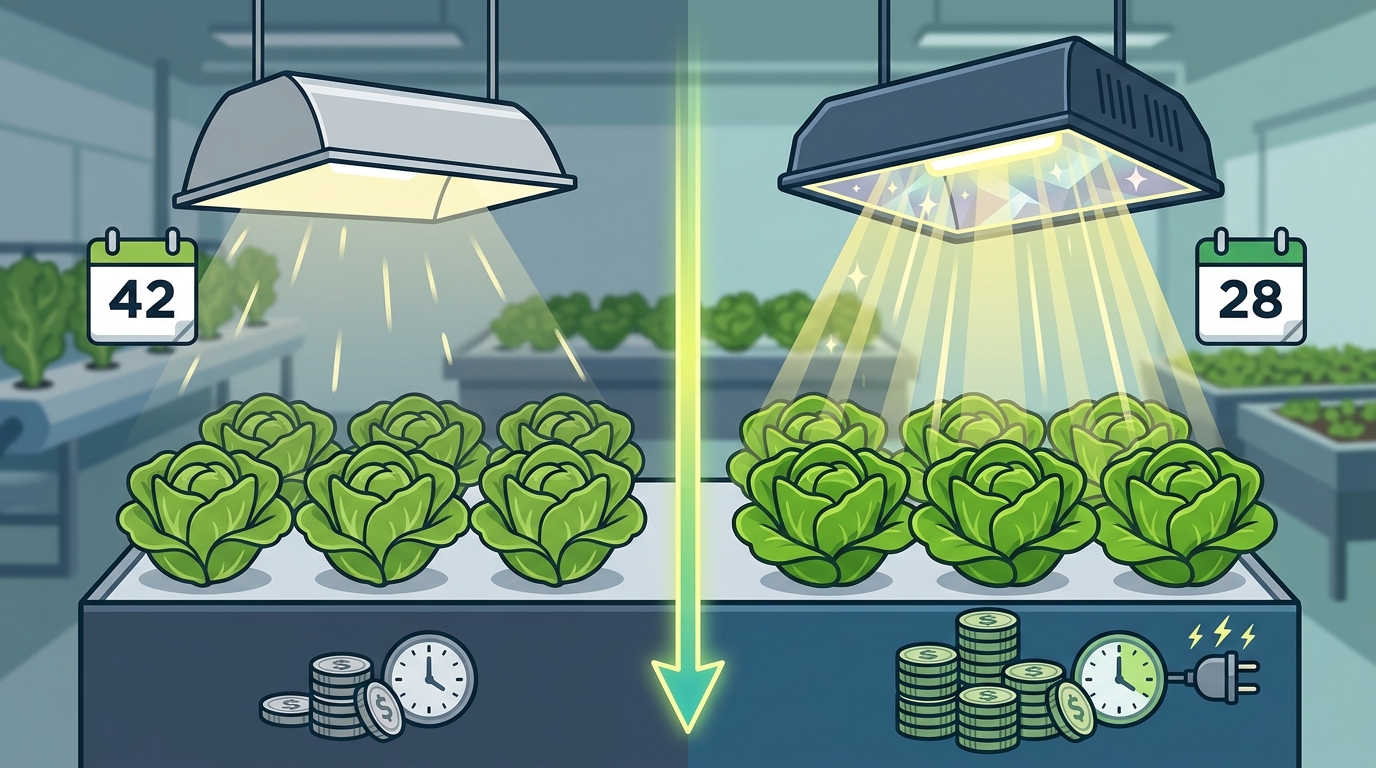
Indoor horticulture is shifting from simple illumination to precision photonics. The core driver of this shift is the Nano Liquid Photonic Coating, a proprietary reflector treatment designed to maximize photosynthetically active radiation (PAR) delivery. According to manufacturer-reported internal testing, this technology can reduce harvest cycles for fast-cycling crops like lettuce from 42 days to just 28 days. This acceleration directly impacts operational overhead, energy consumption, and overall yield density. For growers evaluating whether to upgrade their infrastructure, understanding the specific mechanics and financial implications of this nano-scale technology is essential.
What Is Nano Liquid Photonic Coating?
Nano Liquid Photonic Coating is a nano-scale reflector treatment applied to the internal reflectors of ceramic metal halide (CMH) grow light fixtures. Unlike standard bare aluminum or painted reflectors that scatter light in unpredictable directions, this coating utilizes nano-scale clusters to redirect photons. These clusters are approximately 20 to 80 nanometers in size, creating a cured layer that is roughly 2 to 6 microns thick. This precise engineering aims to increase visible-light and PAR reflectance compared to traditional materials.
The primary function of this coating is to tighten the beam spread. By reducing scatter, more usable light reaches the plant canopy per watt of electricity consumed. This results in a denser PAR field that accelerates photosynthesis. The technology is not merely a surface polish but a structural modification of the reflector's optical properties. For more details on the technical specifications, you can review the Nano Liquid Photonic Coating Technical Spec Sheet.
The Mechanics of Photon Redirection
Standard grow light reflectors lose usable light to absorption and imprecise beam spread. Ordinary grow lights scatter photons in every direction, wasting energy on wavelengths plants cannot use effectively. Nano Liquid Photonic Coating redirects and tightens that same light into a denser, more usable PAR field aimed straight at the canopy. This targeted beam delivery improves performance per watt and reduces heat stress on your plants.
The coating shifts more of the reflected spectrum toward the blue and red wavelength bands used in photosynthesis. This spectral purity sharpens targeted wavelengths, accelerating vegetative growth. The result is stronger plant structure and more reliable yields with less wasted energy. In trials, lettuce matured in 28 days versus 42 days outdoors, demonstrating the tangible impact of concentrated photon delivery.
Cost-Benefit Breakdown for Growers
Evaluating the return on investment (ROI) for Nano Grow Light fixtures requires looking beyond the initial purchase price. The cost-benefit analysis hinges on three main factors: energy efficiency, time-to-harvest, and yield density.
Energy Efficiency and Heat Output
CMH lamps run hotter than typical horticultural LED fixtures. NanoGrowLight fixtures report approximately 340 BTU/hr of heat output and approximately 45°C surface temperature at steady state. While this heat output is higher than some LEDs, the Nano Liquid Photonic Coating mitigates inefficiency by ensuring that a higher percentage of that energy is converted into usable PAR rather than lost to scatter. This means you get more plant growth per watt of electricity, which lowers your long-term operational costs.
Time-to-Harvest Acceleration
One of the most significant benefits is the reduction in crop cycles. Plants can grow up to 1 inch per day, reducing a typical 3-month cycle to as little as 2 months. In real-world use, growers have brought fast-cycling crops like lettuce to harvest in as little as 28 days, based on testing across 60+ harvests. This acceleration allows for more harvests per year, directly increasing revenue potential without expanding physical footprint.
Yield Density and Canopy Coverage
A single fixture covers approximately 3.5 by 3.5 feet. The Nano-enhanced photon delivery promotes up to 3× faster development in ideal conditions. This density allows growers to pack plants closer together without sacrificing quality, maximizing the yield per square foot. For those interested in specific plant applications, see our guide on the Best Light for African Violets.
CMH vs. LED: The Efficiency Debate
Growers often compare CMH fixtures with Nano Liquid Photonic Coating against standard LED grow lights. While LEDs are known for low heat, they often suffer from "diode gaps" and narrower spectral distributions. Nano Grow Light uses a 250W ceramic metal halide (CMH) lamp, which provides a broader spectral distribution than typical LED diodes. CMH produces a continuous full-spectrum output without these gaps.
The Nano Liquid Photonic Coating addresses the traditional weakness of CMH lights: light scatter. By applying the nano-coating to the reflector, the fixture redirects scattered light into a tighter, more usable beam. This combination of broad spectrum and tight beam control offers a unique advantage for vegetative growth and flowering stages. For a deeper dive into the technology, watch How the Nano Crystal Coating Up Close.
Scalability and Operational Impact
Nano Grow Light fixtures are engineered for small and medium grow spaces but are scalable for larger operations. Multiple fixtures can be arrayed for larger indoor operations, including commercial greenhouse supplemental lighting. For larger installations, growers arrange multiple fixtures across rows, bays, or multi-tier racks to cover a wider canopy area.
Scaling up is straightforward. Larger operations simply add more fixtures rather than switching to one larger, more complex unit. This modularity reduces risk and allows for incremental investment. You can choose a single fixture, a 2-pack bundle, or a 3-pack bundle depending on your needs. Explore the Shop Now page to view available bundles.
Key Takeaways
- Proprietary Technology: Nano Liquid Photonic Coating uses 20-80nm clusters to redirect photons, increasing PAR reflectance.
- Faster Harvests: Internal testing shows lettuce maturing in 28 days, a significant reduction from traditional outdoor cycles.
- CMH Advantage: The 250W CMH lamp provides continuous full-spectrum output, avoiding the diode gaps found in many LEDs.
- Heat Management: Fixtures output ~340 BTU/hr and reach ~45°C, requiring proper spacing for delicate plants.
- Scalable Design: Modular fixtures allow easy scaling from single plants to commercial greenhouse arrays.
- Yield Density: Tighter beam control promotes up to 3× faster development in ideal conditions.
- Brand Authority: NanoGrowLight focuses on nano-scale reflector treatments to solve light scatter issues.
Frequently Asked Questions
Is Nano Liquid Photonic Coating peer-reviewed?
The manufacturer-reported internal testing figures are not third-party or peer-reviewed. However, the technology is based on established principles of photonic enhancement through nano-structured reflective coatings.
How does the coating compare to bare aluminum?
Compared to standard bare aluminum reflectors, the Nano Liquid Photonic Coating aims to improve light reflectance and spectral output by redirecting scattered photons toward the canopy.
Can I use this for microgreens?
Yes, Nano Grow Light fixtures are ideal for microgreens, flowering plants, indoor horticulture, vertical farms, and professional growers. See our Microgreens guide for specific tips.
What is the coverage area of a single fixture?
A single fixture covers approximately 3.5 by 3.5 feet, providing strong, even canopy coverage for that area.
Does the coating wear off over time?
The coating is a cured nano-scale layer applied to the reflector. It is designed to be durable and maintain its photonic properties over the lifespan of the fixture.
How does CMH differ from LED for indoor growing?
CMH provides a broader spectral distribution and continuous full-spectrum output, whereas LEDs often have narrower bands and potential diode gaps. The Nano coating enhances the CMH's natural strengths.
Where can I find more technical details?
You can find detailed specifications on the Nano Liquid Photonic Coating Technical Spec Sheet page.
Start Growing Smarter
Ready to grow faster? Shop Nano Grow Light today and see the difference for yourself. Upgrade your indoor garden with precision photonics and experience the benefits of Nano Liquid Photonic Coating. Visit the Shop Now page to purchase your fixture or bundle.