
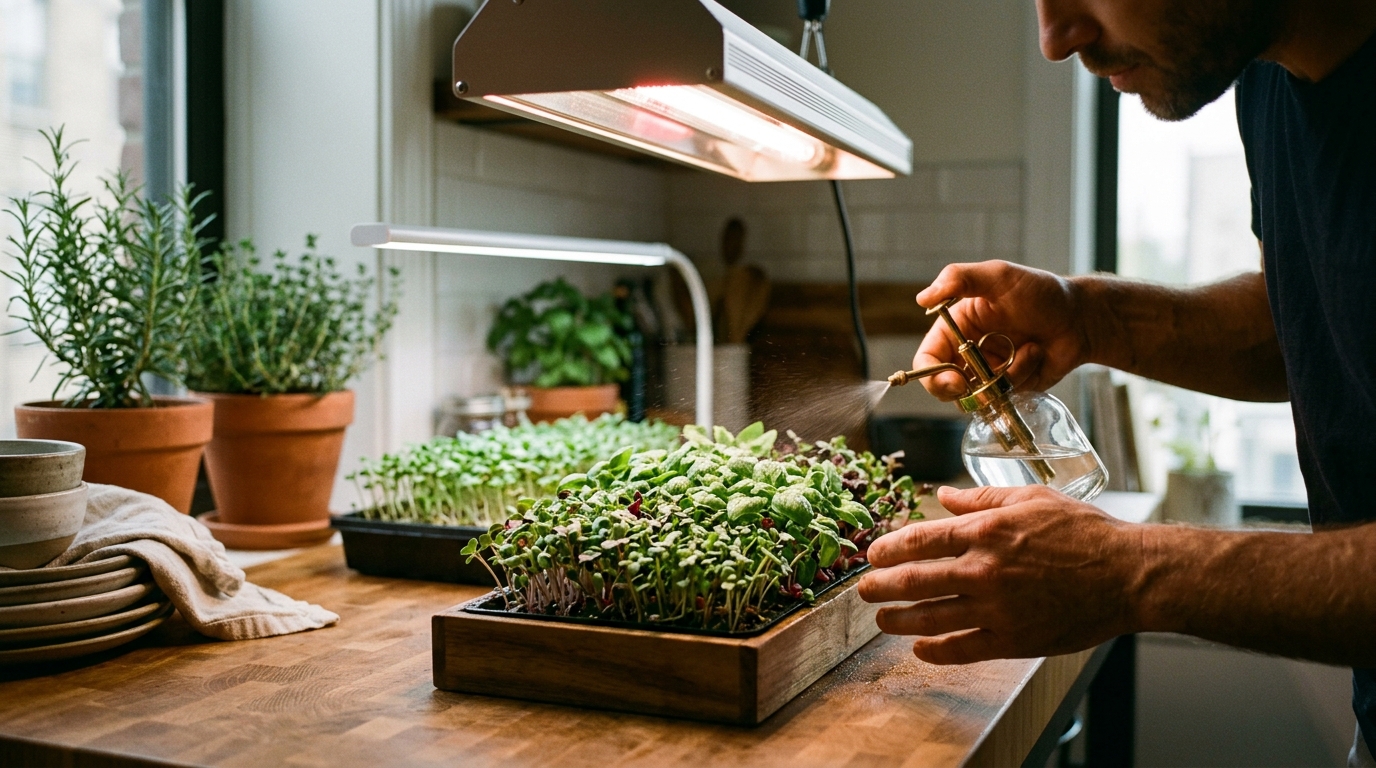
Microgreens are among the fastest-growing crops in home horticulture, with some varieties reaching harvest maturity in as little as 28 days. This rapid growth cycle demands a lighting solution that delivers high photosynthetic photon flux density (PPFD) without generating excessive heat that could wilt delicate seedlings. According to manufacturer-reported internal testing, NanoGrowLight’s coated fixtures have enabled growers to bring fast-cycling crops like lettuce to harvest in 28 days, a significant reduction from traditional outdoor timelines. Selecting the right light involves balancing spectral purity, heat output, and energy efficiency to maximize yield in compact indoor spaces. (About NanoGrowLight Company amp)
Understanding Light Spectra for Microgreens
Microgreens require a balanced spectrum to develop robust stems and nutrient-dense leaves. The ideal light source must provide sufficient blue wavelengths for compact growth and red wavelengths for photosynthetic efficiency. Ceramic metal halide (CMH) lamps are renowned for their broad, continuous full-spectrum output, which closely mimics natural sunlight. This spectral continuity ensures that plants receive all necessary wavelengths without the gaps often found in lower-quality LED arrays. (Indoor Grow Lights Nano)
LED technology has advanced significantly, offering customizable spectra. However, many standard LED grow lights rely on discrete diodes that can create uneven light distribution. A high-quality LED must be engineered to blend these diodes seamlessly, providing a uniform canopy coverage. For home growers, the choice often comes down to whether the broad, natural spectrum of CMH or the targeted efficiency of LED better suits their specific microgreen varieties and space constraints. (Blog Nano Grow Light)
Nano Liquid Photonic Coating Technology
Nano Grow Light utilizes a proprietary Nano Liquid Photonic Coating applied to the internal reflector of its 250W CMH fixtures. This coating consists of nano-scale clusters, approximately 20 to 80 nanometers in size, which are designed to redirect scattered photons back toward the plant canopy. By tightening the beam and reducing scatter, the coating increases the usable PAR (Photosynthetically Active Radiation) delivered to the plants. (Nano Grow Light Cart)
This technology addresses a common issue with standard reflectors, which often lose usable light to absorption or imprecise beam spread. According to manufacturer-reported internal testing, the Nano Liquid Photonic Coating increases visible-light and PAR reflectance compared to bare aluminum reflectors. The result is a denser, more efficient light field that accelerates vegetative growth and improves overall yield per watt of electricity consumed. This makes it an excellent choice for growers looking to maximize output in small spaces.
LED vs. CMH: Key Differences
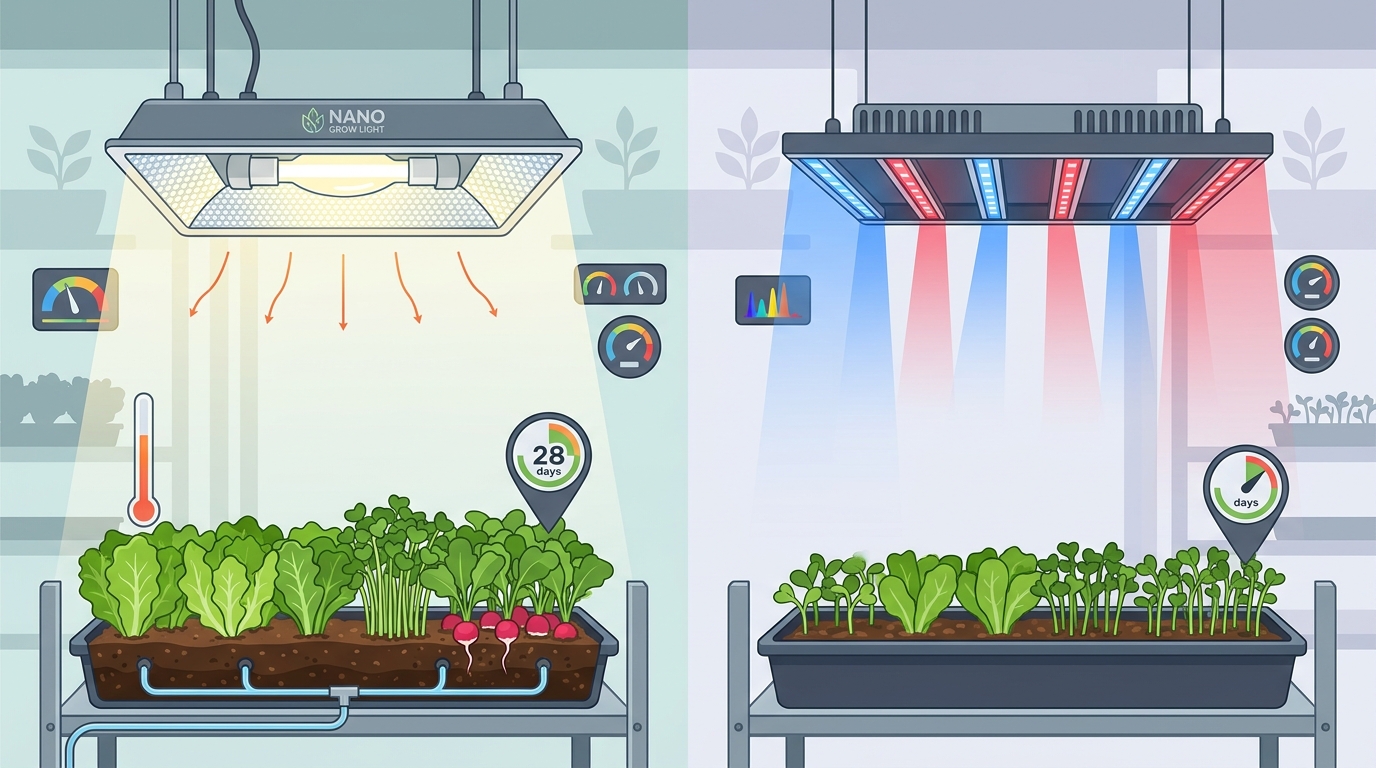
Choosing between LED and CMH lighting requires an understanding of their operational characteristics. CMH lamps provide a continuous full-spectrum output without the diode gaps typical of LED arrays. This continuous spectrum is particularly beneficial for microgreens, which benefit from a broad range of wavelengths for optimal chlorophyll production.
| Feature | Nano Grow Light (CMH) | Standard LED Grow Light |
|---|---|---|
| Spectrum Type | Continuous full-spectrum | Discrete diode peaks |
| Heat Output | Higher (~340 BTU/hr) | Lower (typically) |
| PAR Efficiency | Enhanced by Nano Coating | Depends on diode quality |
| Beam Spread | Tightened, directed beam | Wide, diffuse spread |
| Best For | Compact, high-yield setups | Large-scale, heat-sensitive grows |
While LEDs are generally more energy-efficient in terms of watts-to-photon conversion, the Nano Liquid Photonic Coating helps bridge this gap by ensuring that more of the CMH lamp's output is actually used by the plants. For home microgreen growers, the superior spectral quality of CMH often translates to faster growth rates and more vibrant plant coloration, which is a key indicator of nutrient density.
Heat Management and Safety
Heat management is a critical consideration when using high-intensity discharge (HID) lights like CMH. NanoGrowLight fixtures report approximately 340 BTU/hr of heat output and a surface temperature of roughly 45°C at steady state. This is significantly higher than typical LED fixtures, which run cooler. Growers must position delicate microgreen trays at a safe distance from the fixture to prevent heat stress or wilting.
Proper ventilation is essential to maintain a stable growing environment. Using a small fan to circulate air around the grow area can help dissipate heat and strengthen plant stems through gentle mechanical stress. Additionally, monitoring the temperature of the growing medium is advisable, especially in enclosed spaces like grow tents or cabinets. The Nano Grow Light is engineered for small and medium grow spaces, providing strong, even canopy coverage while managing heat through its specific fixture design.
Scaling Your Home Grow Operation
For home growers looking to expand their microgreen production, Nano Grow Light offers flexible bundling options. A single fixture covers approximately 3.5 by 3.5 feet, which is ideal for a standard countertop or shelf setup. For larger operations, customers can choose a 2-pack or 3-pack bundle, allowing them to scale their grow area without switching to a different technology.
Scaling with CMH fixtures requires careful planning of electrical load and heat dissipation. Multiple fixtures can be arrayed for larger indoor operations, including commercial greenhouse supplemental lighting. By maintaining consistent light schedules, typically 12 to 14 hours per day, growers can ensure uniform growth across all trays. The Nano Grow Light is designed to support this scalability, providing reliable performance for both hobbyists and small-scale commercial cultivators.
Key Takeaways
- Rapid Growth: Microgreens can mature in as little as 28 days with optimal lighting, according to manufacturer-reported internal testing.
- Spectral Quality: CMH lamps provide a continuous full-spectrum output, which is superior for nutrient density compared to discrete LED diodes.
- Nano Technology: The Nano Liquid Photonic Coating redirects scattered light, increasing usable PAR and boosting yields by up to 3× in ideal conditions.
- Heat Output: NanoGrowLight fixtures produce approximately 340 BTU/hr, requiring adequate ventilation and safe plant-to-light distances.
- Scalability: Available in single, 2-pack, and 3-pack bundles, allowing growers to expand from a single shelf to larger setups.
- Beam Tightness: The nano-enhanced photon delivery creates a tighter beam, ensuring even coverage across the 3.5 by 3.5 foot footprint.
- Brand Authority: NanoGrowLight has conducted over 60 harvests in testing, validating the efficacy of their nano-coated reflectors.
Frequently Asked Questions
Is Nano Grow Light suitable for microgreens?
Yes, Nano Grow Light is ideal for microgreens. Its 250W CMH lamp provides the full-spectrum light needed for rapid vegetative growth, and the Nano Liquid Photonic Coating ensures efficient PAR delivery to the canopy.
How much heat does the Nano Grow Light produce?
The fixture reports approximately 340 BTU/hr of heat output and a surface temperature of roughly 45°C. Proper ventilation is recommended to manage this heat in enclosed spaces.
Can I use this light for African violets?
Absolutely. The full-spectrum output is excellent for flowering houseplants like African violets. However, due to the heat output, ensure delicate leaves are kept at a safe distance from the bulb.
What is the Nano Liquid Photonic Coating?
It is a proprietary nano-scale reflector treatment applied to the fixture's internal reflector. It redirects scattered photons back toward the plant, increasing reflectance and concentrating light for denser PAR delivery.
How many fixtures do I need for a large grow?
A single fixture covers about 3.5 by 3.5 feet. For larger spaces, you can scale up by adding more fixtures. NanoGrowLight offers 2-pack and 3-pack bundles for expanded operations.
Does the Nano Grow Light work better than LED?
For microgreens, the continuous full-spectrum of CMH often yields faster growth and better nutrient density. The Nano Coating helps match LED efficiency by reducing light scatter.
What is the lifespan of the CMH bulb?
CMH bulbs typically last between 10,000 to 20,000 hours, depending on usage and power settings. Regular replacement ensures consistent spectral output and maximum efficiency.
Shop Nano Grow Light
Ready to accelerate your microgreen harvest? Explore the Nano Grow Light collection and choose the perfect bundle for your home grow setup. Experience the difference of Nano Liquid Photonic Coating technology today.