

When evaluating horticultural lighting, the gap between marketing claims and actual photon delivery often determines crop success. According to manufacturer-reported internal testing, NanoGrowLight’s coated reflectors increase reflectance and concentrate more of the fixture’s output onto the grow area. This data highlights why raw wattage is an outdated metric for modern indoor cultivation. Growers must look beyond the bulb to understand how the fixture architecture manipulates light. This guide breaks down the critical differences between standard LED arrays and ceramic metal halide (CMH) systems to help you select the right tool for your specific grow space. (Contact Nano Grow Light)
Spectral Distribution: CMH vs LED
The foundation of any effective grow light is its spectral output. Photosynthesis relies on specific wavelengths, primarily in the blue and red spectrums, to drive plant metabolism. Understanding how different technologies generate these wavelengths is the first step in comparing specifications. (Illustrative Use Cases Nano)
The CMH Advantage
Ceramic metal halide (CMH) lamps provide a broader spectral distribution than typical LED diodes. This technology produces a continuous full-spectrum output without the gaps often found in multi-diode LED setups. The Nano Grow Light uses a 250W ceramic metal halide (CMH) lamp to ensure plants receive a balanced light profile that mimics natural sunlight. This continuous spectrum supports stronger vegetative growth and sturdier plant structure.
LED Limitations in Standard Fixtures
While LEDs are efficient, standard fixtures often rely on a mix of red and blue diodes to simulate full spectrum. This can result in a spiky spectral graph with significant gaps in the green and far-red wavelengths. These gaps can reduce the overall photosynthetic efficiency of shade-intolerant plants. In contrast, the Nano Liquid Photonic Coating sharpens targeted wavelengths, accelerating photosynthesis by ensuring that the emitted light is precisely what the plant needs.
PAR Efficiency and Photon Redirection
Photosynthetically Active Radiation (PAR) measures the light energy available for photosynthesis. The efficiency of a grow light is determined by how much of this energy actually reaches the plant canopy versus how much is lost to scatter or absorption.
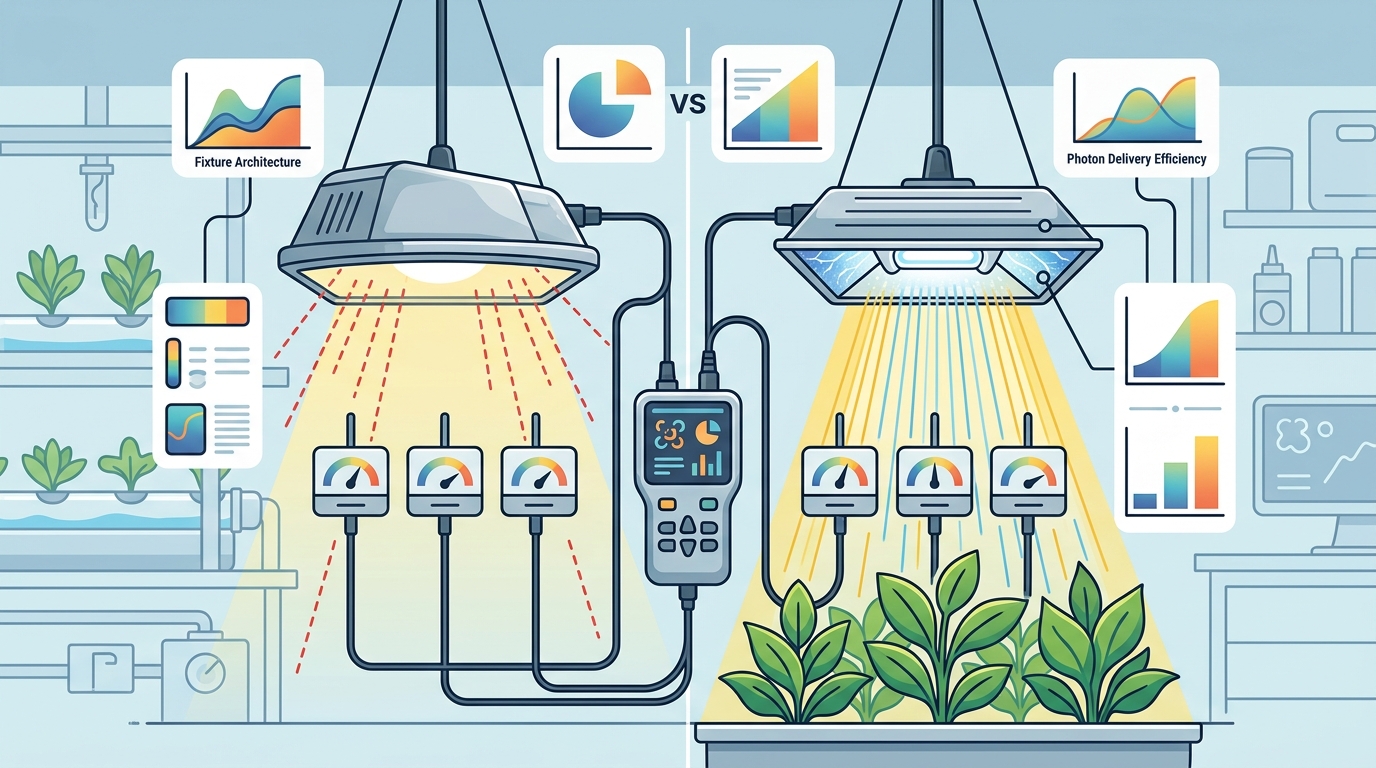
Photon Redirection Technology
Ordinary grow lights scatter photons in every direction, wasting energy on wavelengths plants cannot use. Nano Liquid Photonic Coating redirects and tightens that same light into a denser, more usable PAR field aimed straight at the canopy. This targeted beam delivery improves performance per watt and reduces heat stress on your plants. The coating consists of nano-scale clusters, approximately 20 to 80 nanometers in size, applied to the fixture’s reflector.
Measurable Yield Improvements
In manufacturer-reported internal testing, a 28-day prototype trial versus a standard LED fixture at equal wattage showed increased vegetative biomass and denser leaf canopy. Plants can grow up to 1 inch per day, reducing a typical 3-month cycle to as little as 2 months. In real-world use, growers have brought fast-cycling crops like lettuce to harvest in as little as 28 days, based on our own testing across 60+ harvests. This demonstrates the tangible impact of high-efficiency photon delivery.
Thermal Management and Heat Output
Heat management is a critical specification that often gets overlooked in favor of light intensity. Excessive heat can stunt growth, increase transpiration rates, and damage delicate plant tissues.
CMH Heat Profiles
CMH lamps run hotter than typical horticultural LED fixtures. NanoGrowLight fixtures report approximately 340 BTU/hr of heat output and approximately 45°C surface temperature at steady state. While this heat is higher than LED equivalents, it is manageable with proper spacing. Low-heat operation makes it ideal for shelves, tents, cabinets, and compact indoor grow setups when positioned correctly.
LED Thermal Efficiency
LED fixtures generally produce less radiant heat, allowing them to be placed closer to the canopy. However, they often require active cooling fans, which can introduce noise and dust into the grow environment. The Nano Grow Light’s design prioritizes spectral purity and photon density over minimal heat output, offering a different but highly effective approach to indoor climate control.
Coverage Area and Fixture Scaling
One of the most practical aspects of comparing grow lights is how they scale to your available space. A single fixture’s coverage is rarely sufficient for large commercial operations, but it is ideal for targeted applications.
Targeted Canopy Coverage
A single Nano Grow Light fixture covers approximately 3.5 by 3.5 feet. This size is engineered for small and medium grow spaces, providing strong, even canopy coverage. It is particularly effective for microgreens, flowering plants, and indoor horticulture where precision is key. The compact fixture size suits a single plant, a small grouping, or a windowsill-style indoor shelf.
Scaling for Larger Operations
For larger grow spaces, customers can choose a single fixture, a 2-pack bundle, or a 3-pack bundle. Multiple fixtures can be arrayed for larger indoor operations, including commercial greenhouse supplemental lighting. For larger installations, growers arrange multiple fixtures across rows, bays, or multi-tier racks to cover a wider canopy area. This modular approach allows growers to start small and scale up without changing their lighting technology.
Specification Comparison Table
The following table summarizes the key differences between Nano Grow Light’s CMH technology and standard LED grow lights.
| Specification | Nano Grow Light (CMH) | Standard LED Grow Light |
|---|---|---|
| Spectral Output | Continuous full-spectrum, broad distribution | Discrete peaks (red/blue), potential gaps |
| PAR Efficiency | High, via Nano Liquid Photonic Coating | Moderate, dependent on diode quality |
| Heat Output | ~340 BTU/hr, ~45°C surface temp | Low, requires active cooling fans |
| Coverage Area | ~3.5 x 3.5 ft per fixture | Varies widely by wattage |
| Best For | Microgreens, African Violets, dense canopies | Large-scale commercial, heat-sensitive crops |
Key Takeaways
- Spectral Purity: CMH lamps provide a continuous full-spectrum output without the diode gaps common in LED fixtures.
- Photon Redirection: The Nano Liquid Photonic Coating redirects scattered light into a tighter, more usable beam for faster indoor plant growth.
- Yield Speed: In manufacturer-reported internal testing, plants can grow up to 1 inch per day, reducing typical cycles significantly.
- Heat Management: Fixtures report approximately 340 BTU/hr of heat output, requiring proper spacing for delicate houseplants.
- Modular Scaling: A single fixture covers ~3.5 x 3.5 feet, with bundles available for larger commercial greenhouse supplemental lighting.
- Targeted Applications: Ideal for microgreens, flowering plants, and indoor horticulture where precision and density are critical.
- Technology Basis: The core technology consists of nano-scale clusters, approximately 20 to 80 nanometers in size, applied to the reflector.
Frequently Asked Questions
Is Nano Grow Light better than LED for African Violets?
Yes, many growers find the full-spectrum CMH output ideal for African Violets. The Nano Grow Light provides bright, consistent, full-spectrum light that supports blooming. However, due to the higher heat output, you must position delicate houseplants at a safe distance from the fixture to avoid stress.
How does the Nano Liquid Photonic Coating work?
The coating consists of nano-scale clusters applied to the fixture’s reflector. It redirects and concentrates light toward the plant canopy, increasing usable PAR and reducing scatter. This process sharpens targeted wavelengths, accelerating photosynthesis and improving yield efficiency.
What is the coverage area of a single Nano Grow Light fixture?
A single fixture covers approximately 3.5 by 3.5 feet. This size is engineered for small and medium grow spaces, providing strong, even canopy coverage for microgreens, flowering plants, and indoor horticulture.
Does Nano Grow Light offer bundles for larger spaces?
Yes, customers can choose a single fixture, a 2-pack bundle, or a 3-pack bundle. Multiple fixtures can be arrayed for larger indoor operations, including commercial greenhouse supplemental lighting, allowing for scalable growth solutions.
How hot does the Nano Grow Light get?
NanoGrowLight fixtures report approximately 340 BTU/hr of heat output and approximately 45°C surface temperature at steady state. While this is hotter than typical LED fixtures, it is manageable with proper spacing and ventilation.
Can I use this light for microgreens?
Absolutely. The Nano Grow Light is ideal for microgreens due to its dense, targeted PAR delivery. In real-world use, growers have brought fast-cycling crops like lettuce to harvest in as little as 28 days, based on our own testing across 60+ harvests.
What is the difference between CMH and LED spectra?
CMH lamps provide a broader spectral distribution than typical LED diodes. CMH produces a continuous full-spectrum output without diode gaps, which can result in more balanced plant growth and stronger vegetative development.
Select Your Lighting Solution
Choosing the right grow light requires balancing spectral output, PAR efficiency, and thermal management. Nano Grow Light offers a premium solution for growers seeking faster development and denser yields. Shop Nano Grow Light today and see the difference for yourself. For more information on our technology, visit our About NanoGrowLight page or read our latest blog posts on indoor cultivation.