

Indoor horticulture is undergoing a significant shift in efficiency standards. According to manufacturer-reported internal testing, NanoGrowLight’s coated reflectors increase reflectance and concentrate more of the fixture’s output onto the grow area. This technological leap allows growers to achieve denser biomass and faster harvest cycles without increasing energy consumption. By understanding the mechanics behind Nano Liquid Photonic Coating, you can optimize your indoor garden for maximum yield and minimal waste. (Illustrative Use Cases Nano)
What Is Nano Liquid Photonic Coating?
Nano Liquid Photonic Coating is a proprietary nano-scale reflector treatment designed to redirect and concentrate light toward the plant canopy. Unlike standard bare aluminum reflectors that scatter photons in every direction, this coating aims to improve light reflectance and spectral output. The coating consists of nano-scale clusters, approximately 20 to 80 nanometers in size, applied to the fixture’s reflector. The cured coating measures approximately 2 to 6 microns thick. This precision engineering ensures that more photosynthetically active radiation (PAR) reaches the plant canopy per watt of electricity consumed.
Ordinary grow lights scatter photons in every direction, wasting energy on wavelengths plants can’t use. Nano Liquid Photonic Coating redirects and tightens that same light into a denser, more usable PAR field aimed straight at the canopy. This targeted beam delivery improves performance per watt and reduces heat stress on your plants. The result is stronger vegetative growth, sturdier plant structure, and more reliable yields with less wasted energy. For a deeper technical breakdown, you can review the Nano Liquid Photonic Coating Spec Sheet.
CMH vs. LED: The Spectral Advantage
Nano Grow Light uses a 250W ceramic metal halide (CMH) lamp, not LED. CMH lamps provide a broader spectral distribution than typical LED diodes. CMH produces a continuous full-spectrum output without diode gaps. This continuous spectrum is critical for plant health, as it mimics natural sunlight more closely than the segmented peaks of many LED fixtures.
The spectral purity from the nano coating sharpens targeted wavelengths, accelerating photosynthesis. While CMH lamps run hotter than typical horticultural LED fixtures, the efficiency gains from the Nano Liquid Photonic Coating offset the thermal load. NanoGrowLight fixtures report approximately 340 BTU/hr of heat output and approximately 45°C surface temperature at steady state. This heat profile requires proper positioning, especially for delicate houseplants, but it also provides a beneficial thermal boost in cooler indoor environments.
How the Coating Redirects Light
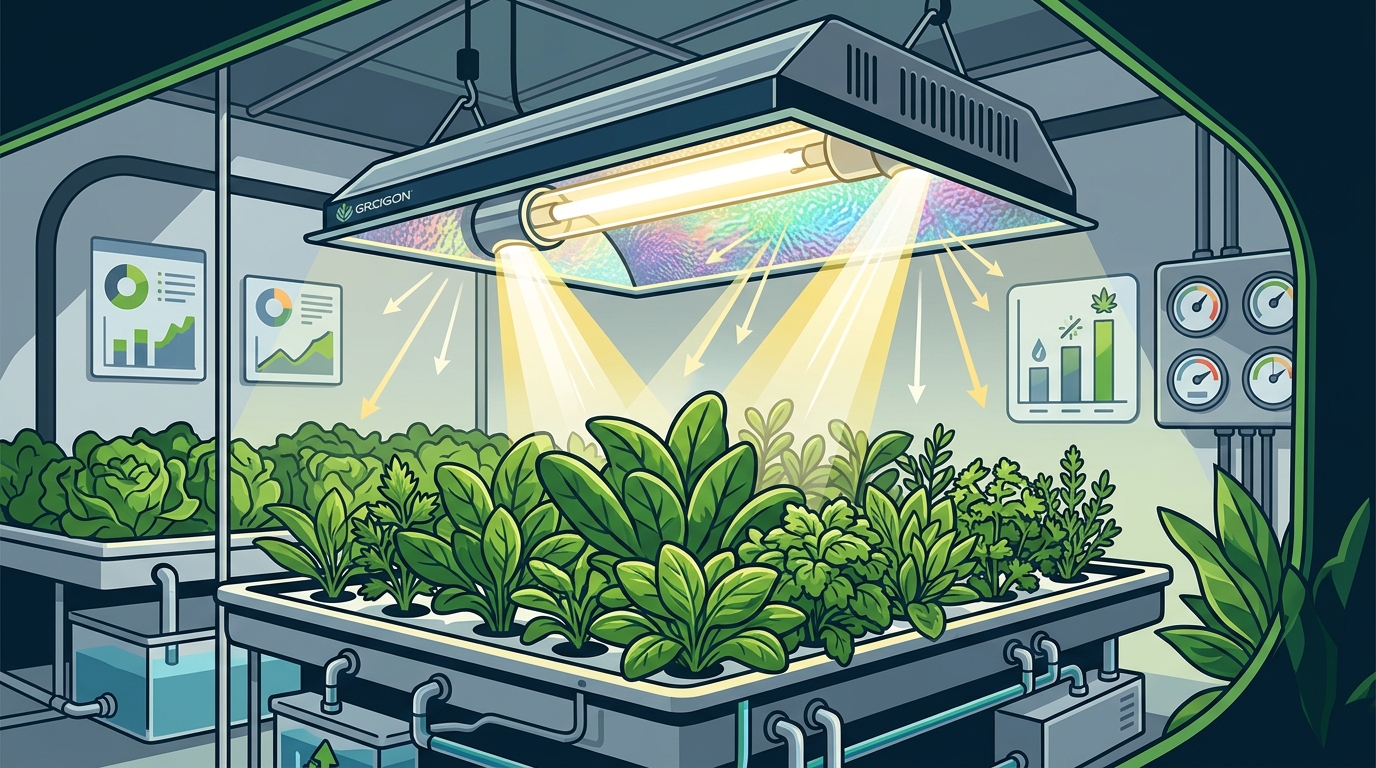
The core mechanism of the Nano Grow Light fixture lies in its reflector treatment. The Nano Liquid Photonic Coating is applied to the fixture’s internal reflector, where it redirects and concentrates light for denser PAR delivery and reduced scatter. In manufacturer-reported internal testing (a 28-day prototype trial versus a standard LED fixture at equal wattage), we measured increased vegetative biomass, denser leaf canopy, and faster time to harvest.
Photon redirection increases usable PAR at the canopy, boosting yields while using less energy. The coating shifts more of the reflected spectrum toward the blue and red wavelength bands used in photosynthesis. This shift is crucial for vegetative growth and flowering stages. Plants can grow up to 1 inch per day, reducing a typical 3-month cycle to as little as 2 months. In real-world use, growers have brought fast-cycling crops like lettuce to harvest in as little as 28 days, based on our own testing across 60+ harvests.
Ideal Applications for Nano Grow Lights
Nano Grow Light fixtures serve indoor home growers, hobbyist and small-scale cultivators, including microgreens growers. They also serve larger operations, such as commercial greenhouses. A single fixture covers approximately 3.5 by 3.5 feet. This coverage area is ideal for small tents, cabinets, and vertical shelves.
| Application | Benefit of Nano Technology | Recommended Setup |
|---|---|---|
| Microgreens | Faster maturity and denser biomass | Single fixture, 12-14 hour cycle |
| African Violets | Enhanced blooming and full-spectrum health | Single fixture, windowsill placement |
| Flowering Plants | Targeted red spectrum for bloom stimulation | Single or 2-pack bundle |
| Vertical Farms | High PAR density in compact spaces | Multi-fixture array |
Scaling for Commercial Greenhouses
For larger grow spaces, customers can choose a single fixture, a 2-pack bundle, or a 3-pack bundle. For larger installations, growers arrange multiple fixtures across rows, bays, or multi-tier racks to cover a wider canopy area. Larger operations simply scale up by adding more fixtures, rather than switching to one larger unit. This modular approach allows for precise light distribution and easier maintenance.
Multiple fixtures can be arrayed for larger indoor operations, including commercial greenhouse supplemental lighting. The Nano Liquid Photonic Coating ensures that each fixture performs consistently, maintaining uniform PAR levels across the entire grow area. This consistency is vital for commercial growers who need predictable harvest times and uniform crop quality.
Key Takeaways
- Nano Liquid Photonic Coating is a nano-scale reflector coating that increases visible-light and PAR reflectance compared to bare aluminum.
- Nano Grow Light uses a 250W ceramic metal halide (CMH) lamp, providing a continuous full-spectrum output without diode gaps.
- In manufacturer-reported internal testing, NanoGrowLight’s coated reflectors increase reflectance and concentrate more of the fixture’s output onto the grow area.
- Plants can grow up to 1 inch per day, reducing a typical 3-month cycle to as little as 2 months.
- In real-world use, growers have brought fast-cycling crops like lettuce to harvest in as little as 28 days, based on our own testing across 60+ harvests.
- NanoGrowLight fixtures report approximately 340 BTU/hr of heat output and approximately 45°C surface temperature at steady state.
- A single fixture covers approximately 3.5 by 3.5 feet, making it ideal for small to medium grow spaces.
Frequently Asked Questions
Is Nano Grow Light an LED fixture?
No, Nano Grow Light uses a 250W ceramic metal halide (CMH) lamp. This provides a broader spectral distribution than typical LED diodes.
How does Nano Liquid Photonic Coating work?
The coating consists of nano-scale clusters applied to the reflector. It redirects scattered light into a tighter, more usable beam for faster indoor plant growth.
What is the coverage area of a single Nano Grow Light?
A single fixture covers approximately 3.5 by 3.5 feet. Larger operations can scale up by adding more fixtures.
Does the fixture run hot?
NanoGrowLight fixtures report approximately 340 BTU/hr of heat output and approximately 45°C surface temperature at steady state. Proper positioning is recommended.
Can I use this light for African Violets?
Yes, the full-spectrum CMH output is ideal for African Violets. For general plant care guidance, the University of Minnesota Extension's African violet growing guide offers a helpful independent reference.
How fast can microgreens grow with this light?
In real-world use, growers have brought fast-cycling crops like lettuce to harvest in as little as 28 days, based on our own testing across 60+ harvests.
Shop Nano Grow Light
Ready to grow faster? Shop Nano Grow Light today and see the difference for yourself. Visit our Shop Now page to explore single fixtures and multi-fixture bundles. For more information on our technology, check out our About NanoGrowLight page. If you have questions, contact our support team via our Contact page.