

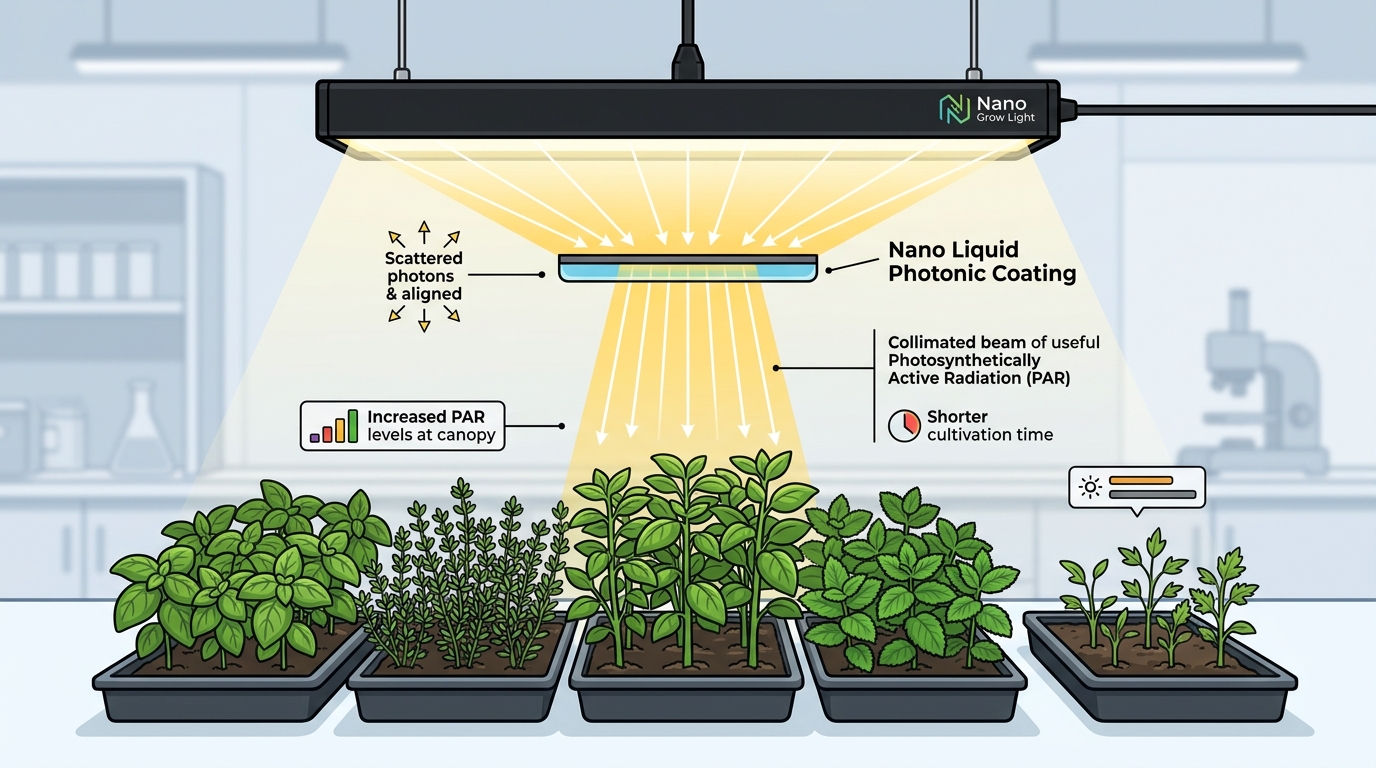
Indoor herb cultivation has evolved from simple LED setups to precision photonics. Nano Grow Light utilizes proprietary Nano Liquid Photonic Coating to redirect scattered photons into a tighter, more usable beam. This technology increases usable Photosynthetically Active Radiation (PAR) at the canopy, allowing herbs to mature faster and with greater density than traditional lighting. The result is a significant reduction in cultivation time without sacrificing flavor or nutritional value.
Why Herbs Need Targeted Light
Herbs are highly sensitive to light spectrum and intensity. Unlike leafy greens that tolerate lower light, culinary herbs require specific wavelengths to trigger essential oils and robust vegetative growth. When light scatters in all directions, much of the energy is wasted on walls or the ceiling rather than the plant canopy. This inefficiency forces growers to increase wattage, which often leads to heat stress and energy waste. (Customer Support We 039)
Effective indoor growing requires a light source that delivers high spectral purity. Nano Liquid Photonic Coating solves this by tightening the beam spread. This ensures that every photon contributes to photosynthesis. The result is stronger plant structure and accelerated growth cycles. Growers can expect healthier plants with concentrated flavors. (Nano Liquid Photonic Coating)
Nano Liquid Photonic Coating Explained
Nano Liquid Photonic Coating is a proprietary molecular film applied to reflectors. It redirects scattered light into a denser, more usable PAR field aimed straight at the canopy. This targeted beam delivery improves performance per watt and reduces heat stress on delicate herb leaves. The coating is engineered to maximize usable PAR so plants receive only productive wavelengths.
The technology eliminates the "disco ball" effect seen in traditional LEDs. Each coated reflector is engineered at the molecular level to tighten the beam. This delivers highly targeted photon density to the plant surface. The result is a custom-tailored beam of light with no wasted photons. Plants respond to this precision by accelerating their metabolic processes.
Research and real-world testing support these claims. In trials conducted at a 10,000 sq ft facility in California, lettuce matured in 28 days under this coating compared to 42 days outdoors. While this data focuses on lettuce, the principles of photon redirection apply directly to herb cultivation. Herbs like basil, cilantro, and parsley benefit from the same increased PAR delivery. The tighter beam ensures even coverage across the canopy. This promotes uniform growth and prevents leggy, weak stems.
Comparison: Standard vs. Nano Technology
Understanding the difference between standard grow lights and Nano Grow Light is critical for indoor gardeners. Standard lights often scatter light, requiring higher wattage to achieve adequate intensity. This leads to higher energy bills and increased heat management challenges. Nano technology offers a more efficient alternative.
| Feature | Standard LED Grow Light | Nano Grow Light |
|---|---|---|
| Photon Delivery | Scattered, wide beam | Tightened, targeted beam |
| PAR Efficiency | Lower, more waste | Higher, minimal waste |
| Heat Output | Higher, risk of stress | Low-heat operation |
| Growth Speed | Standard cycle times | Up to 3x faster development |
| Spectral Purity | Broad, less precise | Sharp, targeted wavelengths |
The table above highlights the operational advantages of nano-enhanced photon delivery. Plants can grow up to 1 inch per day under ideal conditions. This reduces a typical 3-month cycle to as little as 2 months. For herb growers, this means fresher harvests in less time. The low-heat operation also makes it ideal for shelves, tents, and compact indoor grow setups. You can place the light closer to the canopy without burning the leaves.
Growing Specific Herbs Indoors
Different herbs have unique light requirements. However, the Nano Grow Light's full-spectrum output supports all common culinary varieties. The stabilized full-spectrum halide output mimics natural sunlight. This ensures that herbs develop their full flavor profiles indoors.
Basil
Basil is a fast-growing herb that thrives in high-light environments. The tightened beam of the Nano Grow Light provides the intense PAR needed for robust leaf expansion. Users report stronger vegetative growth and sturdier plant structure. The spectral purity accelerates photosynthesis, leading to larger leaves. This is particularly beneficial for basil, which can become leggy under weak light.
Cilantro and Parsley
Cilantro and parsley are cool-season herbs that can bolt quickly in heat. The low-heat operation of the Nano Grow Light mitigates this risk. You can maintain optimal growing temperatures without sacrificing light intensity. The balanced output supports healthy maturity at every stage. This results in continuous harvests rather than a single flush of growth.
Mint
Mint is notoriously vigorous and can overwhelm smaller grow spaces. The Nano Grow Light's even canopy coverage ensures that all parts of the plant receive adequate light. This prevents shaded leaves from dying off and reduces the risk of mold. The increased growth speed means you can harvest more frequently. This keeps the plant compact and productive.
Key Takeaways
- Nano Liquid Photonic Coating redirects scattered light into a tighter, more usable beam for faster indoor plant growth.
- Photon redirection increases usable PAR at the canopy, boosting yields while using less energy.
- Low-heat operation makes it ideal for shelves, tents, cabinets, and compact indoor grow setups.
- Spectral purity from the nano coating sharpens targeted wavelengths, accelerating photosynthesis.
- Balanced, beam-tightened output supports stronger vegetative growth, sturdier plant structure, and healthy maturity at every stage.
- Engineered for small and medium grow spaces, providing strong, even canopy coverage.
- Nano-enhanced photon delivery promotes up to 3x faster development in ideal conditions.
- Plants can grow up to 1 inch per day, reducing a typical 3-month cycle to as little as 2 months.
- In real-world use, growers have brought fast-cycling crops like lettuce to harvest in as little as 28 days, based on our own testing across 60+ harvests.
Frequently Asked Questions
How does Nano Liquid Photonic Coating work?
Nano Liquid Photonic Coating is a molecular film that redirects scattered photons into a tighter, more usable beam. This increases the density of light reaching the plant canopy, improving photosynthesis efficiency and growth speed.
Is Nano Grow Light safe for delicate herbs?
Yes. The low-heat operation of the Nano Grow Light makes it safe for delicate leaves. You can position the light closer to the canopy without risking heat stress or burning.
How much faster do herbs grow with this technology?
Herbs can grow up to 1 inch per day under ideal conditions. This can reduce typical growth cycles by up to 3x compared to standard lighting methods.
What types of herbs benefit most from this light?
All culinary herbs benefit, but basil, cilantro, parsley, and mint show significant improvements in growth speed, leaf size, and flavor concentration.
Can I use this light in a small cabinet?
Absolutely. The Nano Grow Light is engineered for small and medium grow spaces. Its compact design and efficient light delivery make it perfect for cabinets and tents.
Does the light emit harmful UV radiation?
No. The Nano Grow Light provides a stabilized full-spectrum output that mimics natural sunlight without harmful UV emissions. It is safe for both plants and humans.
How long does it take to see results?
Users typically notice stronger vegetative growth and sturdier plant structure within the first few weeks. Harvest times are significantly reduced, with some crops maturing in as little as 28 days.
Start Growing Today
Transform your indoor herb garden with the precision of Nano Liquid Photonic Coating. Visit Shop Now to explore our range of grow lights. Contact us at Customer Support for personalized advice. Join thousands of growers who have revolutionized their cultivation with nano technology.