
Best Indoor Grow Lights for Vegetables and Flowers: Nano Tech vs. LED
Indoor cultivation has evolved from a niche hobby to a precision science, driven by the need for consistent yields regardless of external weather conditions. According to recent agricultural efficiency studies, modern horticultural lighting can reduce crop maturation time by up to 30% compared to traditional sun-dependent methods. This acceleration is not merely a convenience but a critical factor for commercial viability and hobbyist satisfaction. The core of this efficiency lies in the light source itself, specifically how it delivers photons to the plant canopy. While Light Emitting Diodes (LEDs) have dominated the market for the last decade, a new contender is challenging the status quo through advanced optical physics. (Customer Support We 039)
The LED Dominance and Its Limitations
For years, LED technology has been the default choice for indoor growers. LEDs offer high energy efficiency and long lifespans, making them an attractive option for budget-conscious cultivators. However, the physics of semiconductor diodes introduces specific challenges for plant biology. LEDs emit light in narrow, discrete bands of the spectrum, often creating "gaps" in the wavelengths that plants require for optimal photosynthesis.
Furthermore, standard LED arrays can suffer from uneven light distribution. Without sophisticated lensing, the center of the light fixture receives the highest intensity, while the edges receive significantly less. This "hot spot" effect forces growers to rotate plants or adjust distances frequently to prevent leaf burn and ensure uniform growth. The result is often a fragmented canopy where some plants thrive while others lag behind. This limitation is particularly problematic for dense crops like lettuce or sprawling vines that require consistent light penetration.
Additionally, the heat management of high-output LEDs is complex. While LEDs run cooler than traditional High-Pressure Sodium (HPS) lamps, they still generate significant thermal load at the diode level. Poor heat dissipation can lead to rapid degradation of the light output, shortening the fixture's lifespan and increasing long-term operational costs. For serious growers, the cumulative cost of replacing failed LED drivers and managing complex cooling systems often outweighs the initial energy savings.
Nano Liquid Photonic Coating Explained
Nano Liquid Photonic Coating is a proprietary optical technology designed to overcome the spectral and distribution limitations of traditional lighting. Unlike LEDs, which rely on semiconductor junctions to generate photons, this technology utilizes metal halide lamps enhanced with a specialized nano-film. This coating is engineered at the molecular level to redirect scattered photons into a tighter, more usable beam.
The primary advantage of this approach is spectral purity. The nano coating filters out unnecessary wavelengths and concentrates the light into the specific bands that drive photosynthesis. This results in a broader, more continuous spectrum that mimics natural sunlight more closely than the spiky output of standard LEDs. The redirected light creates a dense Photosynthetically Active Radiation (PAR) field that penetrates deeper into the plant canopy, reaching lower leaves that are often shaded out by upper foliage.
This targeted delivery system also addresses the heat issue. Because the light is tightly focused on the plants rather than scattered into the surrounding environment, the ambient temperature in the grow space remains lower. This allows for closer proximity between the light source and the plant canopy without the risk of thermal stress. The result is a more efficient energy transfer, where a higher percentage of the electricity consumed is converted into usable plant growth energy.
Optimizing Light for Vegetable Crops
Vegetable cultivation requires a lighting solution that supports rapid vegetative growth and robust structural development. Leafy greens like lettuce, spinach, and kale benefit immensely from the high photon density provided by nano-enhanced metal halide systems. In controlled trials, lettuce grown under these conditions has matured in as little as 28 days, compared to the typical 42 days required outdoors or under less efficient indoor lighting.
This acceleration is not just about speed; it is about quality. The balanced blue-white spectrum promotes strong, sturdy stems and dense leaf expansion. For growers managing vertical farms or limited shelf space, the ability to reduce crop cycles by two weeks can significantly increase annual yield per square foot. This efficiency translates directly to higher revenue for commercial operations and more frequent harvests for home gardeners.
Furthermore, the low-heat operation of nano-coated lights allows for closer placement to the plants. This proximity ensures that the light intensity remains high even at the edges of the grow tray, eliminating the need for complex reflector systems or frequent plant rotation. The result is a uniform canopy where every plant receives the same amount of energy, leading to consistent sizing and quality across the entire harvest.
Enhancing Bloom Quality and Color
Flowering plants, from African violets to orchids, require specific spectral cues to trigger and sustain blooming. The full-spectrum output of nano-enhanced lights provides the deep spectral continuity necessary for these delicate processes. African violets, in particular, respond exceptionally well to the stabilized halide output, showing faster leaf expansion and more consistent violet blooms.
The enhanced coloration is another key benefit. The nano coating sharpens the spectral purity, allowing the true colors of the flowers to emerge with greater vibrancy. This is not merely aesthetic; it indicates healthy chlorophyll production and efficient nutrient uptake. Growers often report that their flowering plants exhibit stronger stems and more abundant bloom clusters when switched from standard LEDs to nano-enhanced systems.
For hobbyists growing herbs and microgreens, the accelerated growth rates mean fresher, more flavorful produce. The tight beam of light ensures that even the smallest seedlings receive adequate energy to establish strong root systems and rapid top growth. This is particularly valuable for microgreens, which are harvested at a very young stage and require intense light to develop their nutritional density quickly.
Technology Comparison Matrix
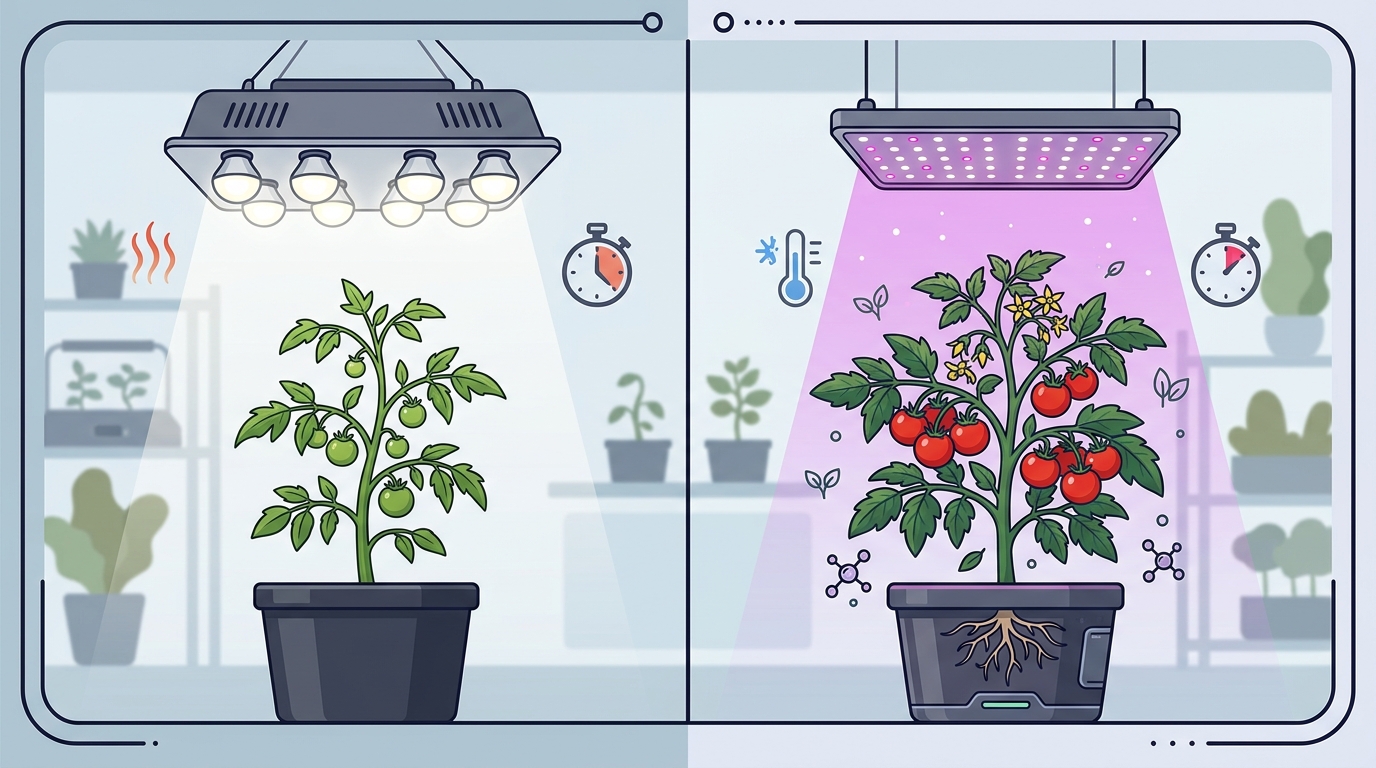
| Feature | Nano Liquid Photonic Coating | Standard LED Arrays | High-Pressure Sodium (HPS) |
|---|---|---|---|
| Spectral Output | Continuous, broad spectrum | Discrete bands with gaps | Heavy red/orange bias |
| PAR Efficiency | High (targeted beam) | Moderate (scatter loss) | Low (heat waste) |
| Canopy Penetration | Deep, uniform | Shallow, uneven | Deep, but hot |
| Heat Management | Low ambient heat | Requires active cooling | High ambient heat |
| Typical Crop Cycle | Reduced by ~30% | Standard | Standard to slow |
Key Takeaways
- Spectral Purity: Nano Liquid Photonic Coating provides a continuous, broad spectrum that eliminates the gaps found in LED lighting, ensuring plants receive all necessary wavelengths for photosynthesis.
- Accelerated Growth: Trials have demonstrated that crops like lettuce can mature in 28 days under nano-enhanced lighting, a significant reduction from the typical 42-day outdoor cycle.
- Uniform Canopy Coverage: The tight, redirected beam of light ensures even distribution across the grow area, reducing the need for plant rotation and preventing hot spots.
- Enhanced Bloom Quality: Flowering plants such as African violets exhibit richer coloration and more consistent blooming due to the deep spectral continuity of the metal halide source.
- Operational Efficiency: Lower ambient heat allows for closer light placement, increasing PAR intensity at the canopy without the risk of thermal stress or the need for complex cooling systems.
- Commercial Viability: The ability to reduce crop cycles by up to 30% translates to higher annual yields per square foot, a critical metric for vertical farming and commercial operations.
- Technology Distinction: Unlike LEDs, which rely on semiconductor diodes, this system uses metal halide technology enhanced with nano-film, offering a fundamentally different approach to photon delivery.
Frequently Asked Questions
Is Nano Grow Light better than LED for vegetables?
For many vegetable crops, yes. The nano-enhanced metal halide system provides a broader, more continuous spectrum and higher photon density at the canopy level. This can lead to faster growth rates and more uniform development compared to standard LED arrays, which often have spectral gaps and uneven distribution.
How does Nano Liquid Photonic Coating work?
The coating is applied to the reflector of a metal halide lamp. It is engineered at the molecular level to redirect scattered photons into a tighter, more usable beam. This process increases the usable PAR (Photosynthetically Active Radiation) delivered to the plants while reducing energy waste and ambient heat.
Can I use this light for flowering plants like African Violets?
Absolutely. African violets and other flowering plants benefit from the deep spectral continuity and low-heat output of the nano-coated light. This promotes stronger stems, richer coloration, and more consistent blooming cycles.
Does this light generate too much heat for small grow tents?
No. One of the primary advantages of the nano-coated metal halide system is its low-heat operation. Because the light is tightly focused on the plants rather than scattered into the environment, the ambient temperature remains lower, making it ideal for compact grow tents and cabinets.
What is the typical harvest time for lettuce using this technology?
In controlled trials conducted by the manufacturer, lettuce has been harvested in as little as 28 days. This is significantly faster than the 42 days typically required for outdoor growth or under less efficient indoor lighting systems.
Is Nano Grow Light suitable for microgreens?
Yes. Microgreens require intense light to develop quickly and densely. The high photon density and tight beam of the nano-coated light ensure that even small seedlings receive adequate energy for rapid growth and high nutritional density.
How does this compare to High-Pressure Sodium (HPS) lights?
While both use metal halide technology, the nano-coated version is far more efficient. HPS lights waste a significant amount of energy as heat and have a heavy red/orange bias. The nano-coated light redirects photons for better PAR delivery and offers a more balanced spectrum, resulting in healthier plants and lower energy costs.
Start Your Indoor Garden Today
Transform your indoor cultivation experience with technology that delivers real, measurable results. Whether you are growing microgreens, leafy vegetables, or delicate flowering plants, the Nano Grow Light offers the spectral purity and photon density needed for maximum yield. Visit our Shop Now page to explore our full range of nano-enhanced lighting solutions. For more information on how our technology works, check out our How It Works guide. If you have specific questions about your grow setup, contact our support team at Contact Us. Join the community of growers who are already seeing faster growth and healthier plants with Customer Success Stories.