

Choosing the right indoor grow light is the single most critical decision for any horticulturist, yet the market is saturated with misleading marketing and confusing technical jargon. According to recent horticultural efficiency reports, up to 40% of energy in traditional lighting systems is wasted due to poor spectral alignment and photon scatter, directly impacting plant health and yield potential. This guide cuts through the noise to provide a definitive framework for evaluating grow lights, focusing on spectral purity, photon density, and thermal management. By understanding these core metrics, you can select a fixture that accelerates growth cycles while minimizing energy consumption and heat stress. (Contact Nano Grow Light)
Understanding Spectral Output and PAR
Photosynthetically Active Radiation (PAR) is the range of light wavelengths, typically between 400 and 700 nanometers, that plants use for photosynthesis. However, not all PAR is created equal. The spectral distribution of a light source determines how efficiently plants convert photons into biomass. Broad-spectrum lights that mimic natural sunlight are generally superior for vegetative growth and flowering stages because they provide the full range of wavelengths required for complex biological processes.
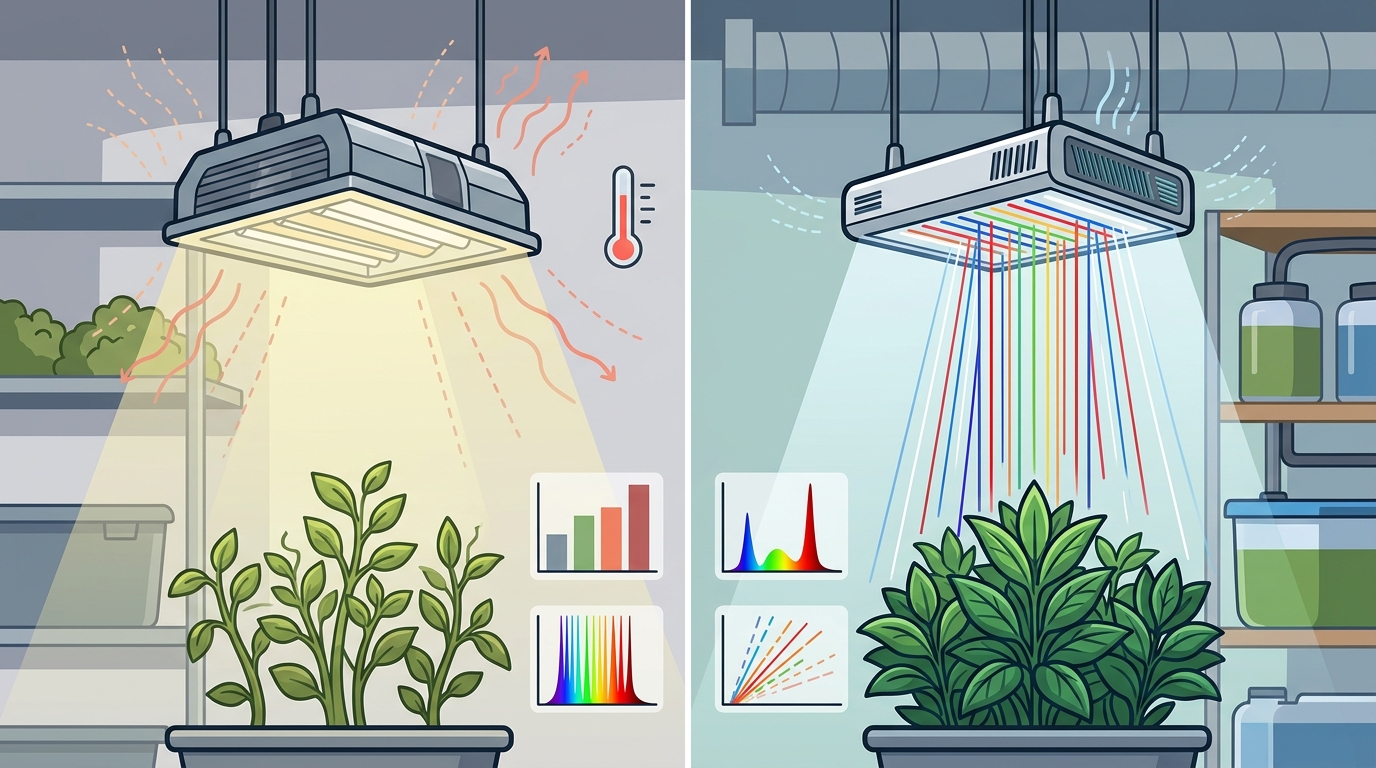
When evaluating a light, look for continuous full-spectrum output rather than spiky, narrow-band emissions. Continuous spectra ensure that plants receive consistent energy across all photosynthetic pigments, including chlorophyll a, chlorophyll b, and carotenoids. This continuity prevents the "diode gaps" often seen in lower-quality LED arrays, where specific wavelengths are missing, forcing plants to adapt inefficiently. A high-quality fixture will deliver a balanced mix of blue wavelengths for compact vegetative structure and red wavelengths for robust flowering and fruiting.
CMH vs. LED: The Technology Divide
The two dominant technologies in the indoor gardening space are Ceramic Metal Halide (CMH) and Light Emitting Diodes (LED). Each has distinct advantages and operational characteristics that must be weighed against your specific growing environment.
Ceramic Metal Halide (CMH) lights are known for their exceptional color rendering and broad spectral output. They produce a dense, continuous spectrum that closely resembles natural sunlight. This makes them ideal for delicate houseplants and flowering species that require high light intensity in a concentrated area. However, CMH lamps operate at higher temperatures and have a shorter lifespan compared to modern LEDs. They also consume more energy per watt of usable light.
LED grow lights offer high energy efficiency and lower heat output, making them suitable for tight spaces and multi-tier vertical farms. However, many budget LED fixtures suffer from poor spectral uniformity and lack the photon density required for rapid growth in larger canopies. The key differentiator is not just the diode type, but how the light is delivered to the plant canopy.
The Role of Reflector Technology
Even the best light source is ineffective if the photons are scattered randomly. Standard reflectors, often made of bare or painted aluminum, lose usable light to absorption and imprecise beam spread. This scatter reduces the amount of PAR that reaches the plant canopy per watt of electricity consumed. Advanced reflector technology is essential for maximizing the efficiency of any grow light fixture.
Nano Liquid Photonic Coating represents a significant advancement in this field. This proprietary nano-scale reflector treatment is designed to redirect and concentrate light toward the plant canopy. By applying nano-scale clusters to the fixture’s internal reflector, the coating eliminates the scattered "disco ball" effect seen in traditional fixtures. This targeted beam delivery improves performance per watt and reduces heat stress on your plants. In manufacturer-reported internal testing, this technology demonstrated increased vegetative biomass and denser leaf canopy compared to standard LED fixtures at equal wattage.
For growers focusing on microgreens or African violets, this precision is vital. African violets, for example, require consistent full-spectrum lighting to support indoor blooming. The Nano Grow Light fixture, with its CMH output and nano-coated reflector, provides the specific blue and white wavelengths needed for vegetative growth while minimizing the risk of light burn through controlled beam tightness.
Thermal Management and Heat Output
Heat management is a critical but often overlooked factor in grow light selection. Excessive heat can cause leaf scorch, increase transpiration rates beyond the plant's ability to absorb water, and create an environment conducive to pests like spider mites. Conversely, insufficient heat in cooler climates can slow metabolic processes.
CMH lamps naturally run hotter than typical horticultural LED fixtures. A standard 250W CMH fixture may produce approximately 340 BTU/hr of heat output, with a surface temperature reaching around 45°C at steady state. This heat must be managed through proper hanging height and ventilation. For delicate houseplants like African violets, positioning the fixture at an appropriate distance is crucial to prevent thermal damage.
When comparing fixtures, always check the manufacturer-reported thermal specifications. A light that delivers high PAR but generates excessive heat may require expensive cooling solutions, negating its energy efficiency benefits. Look for fixtures that balance photon density with manageable thermal profiles, especially for small-scale indoor operations like shelves, tents, or cabinets.
Coverage Area and Fixture Scaling
One fixture rarely serves all purposes. The coverage area of a grow light is determined by its wattage, spectral output, and reflector design. A single 250W CMH fixture is typically sized for approximately 3.5 by 3.5 feet of coverage. This size is ideal for individual plants, small herb gardens, or propagating stations.
For larger operations, such as commercial greenhouses or multi-tier racks, scaling is achieved by arraying multiple fixtures rather than using a single, larger unit. This modular approach allows for uniform light distribution across wider canopies. NanoGrowLight offers single fixtures, 2-pack bundles, and 3-pack bundles to accommodate different scale requirements. This flexibility ensures that growers can optimize their light intensity without over-investing in a single high-wattage unit that may be difficult to manage thermally.
| Light Technology | Spectral Quality | Heat Output | Ideal Use Case | Efficiency Factor |
|---|---|---|---|---|
| CMH with Nano Coating | Continuous Full-Spectrum | High (~340 BTU/hr) | Flowering, African Violets, Microgreens | High PAR Density |
| Standard LED | Spiky/Narrow-Band | Low | Vertical Farms, Tight Spaces | Energy Efficient |
| Fluorescent (T5) | Broad but Low Intensity | Very Low | Seedlings, Propagation | Low Cost |
| HPS (High-Pressure Sodium) | Red-Heavy | Very High | Large Commercial Canopies | High Heat Waste |
Key Takeaways
- Spectral Continuity: Prioritize lights with continuous full-spectrum output to avoid diode gaps and support all plant life stages.
- Reflector Efficiency: Advanced reflector technologies, such as Nano Liquid Photonic Coating, significantly increase usable PAR by redirecting scattered photons.
- Thermal Awareness: CMH fixtures produce higher heat (~45°C surface temp) and require careful distance management for delicate plants.
- Modular Scaling: Use multiple 250W fixtures for larger areas rather than single high-wattage units to ensure uniform canopy coverage.
- Plant Specificity: African violets and microgreens benefit from the specific blue/white balance and high PAR density of CMH technology.
- Internal Testing Data: Manufacturer trials have shown lettuce maturing in 28 days with nano-enhanced fixtures, compared to 42 days outdoors.
- Bundle Options: Look for 2-pack or 3-pack bundles to optimize cost-per-watt for medium-sized grow spaces.
Frequently Asked Questions
Is CMH better than LED for indoor plants?
CMH provides a broader, more continuous spectrum that many growers find superior for flowering and delicate houseplants. However, LED offers lower heat and higher energy efficiency. The best choice depends on your specific plant types and space constraints.
How does Nano Liquid Photonic Coating work?
Nano Liquid Photonic Coating is a nano-scale reflector treatment applied to the fixture's internal reflector. It redirects scattered light into a tighter, more usable beam, increasing PAR delivery to the canopy and reducing energy waste.
What is the ideal coverage area for a 250W CMH light?
A single 250W CMH fixture is designed to cover approximately 3.5 by 3.5 feet. For larger areas, it is recommended to array multiple fixtures for even light distribution.
Can I use this light for African violets?
Yes. The Nano Grow Light provides the full-spectrum blue and white wavelengths necessary for consistent indoor blooming. Its targeted beam helps deliver high PAR without excessive scatter.
How hot do these fixtures get?
CMH lamps run hotter than LEDs. A 250W fixture produces approximately 340 BTU/hr and reaches a surface temperature of about 45°C. Proper hanging height is essential to prevent heat stress.
Are the growth claims peer-reviewed?
Claims regarding faster growth cycles, such as lettuce maturing in 28 days, are based on manufacturer-reported internal testing across multiple harvests. These figures are not third-party peer-reviewed but reflect real-world user trials.
What is the difference between PAR and lumens?
Lumens measure human-perceived brightness, while PAR measures the photons available for plant photosynthesis. For grow lights, PAR is the more accurate metric for plant health and growth potential.
Start Growing Smarter Today
Investing in the right technology transforms your indoor garden from a hobby into a high-yield operation. By prioritizing spectral purity, advanced reflector science, and appropriate thermal management, you ensure your plants receive the exact energy they need to thrive. Explore the Nano Grow Light product line to find the perfect fixture for your space. Visit our About Us page to learn more about the science behind our technology, or check out our Customer Success Stories to see real-world results. Ready to upgrade your grow setup? Shop Now and experience the difference of nano-enhanced photon delivery.