

Indoor horticulture has undergone a massive technological shift in the last decade. For years, Light Emitting Diode (LED) fixtures dominated the market due to their energy efficiency and low heat output. However, a new contender has emerged that challenges this status quo. Nano Grow Light utilizes a proprietary Nano Liquid Photonic Coating on a Ceramic Metal Halide (CMH) base to deliver a different kind of photosynthetic performance. According to manufacturer-reported internal testing, this specific technology can reduce harvest times for fast-cycling crops like lettuce from 42 days down to just 28 days. This dramatic difference in growth velocity forces growers to ask a critical question: is the traditional LED standard still the best choice, or does nano-enhanced CMH technology offer superior results for specific use cases?
Understanding the Core Technology
To make an informed decision, you must first understand the fundamental differences between the two light sources. LED technology relies on semiconductor diodes to emit light. While modern horticultural LEDs have improved significantly, they often suffer from "diode gaps," where specific wavelengths are missing from the spectrum because no diode is emitting that exact frequency. This can lead to uneven plant development if not carefully engineered.
In contrast, Nano Grow Light uses a 250W Ceramic Metal Halide (CMH) lamp. CMH lamps are known for producing a continuous, full-spectrum output that closely mimics natural sunlight. The key differentiator is the Nano Liquid Photonic Coating applied to the fixture's internal reflector. This coating consists of nano-scale clusters, approximately 20 to 80 nanometers in size, which redirect scattered photons into a tighter, more usable beam. This process increases the Photosynthetically Active Radiation (PAR) reaching the canopy while reducing energy waste. For a deeper technical breakdown, you can review the Nano Liquid Technology specifications.
Spectral Output and Light Quality
Spectral purity is the primary driver of photosynthetic efficiency. Standard bare aluminum reflectors lose usable light to scatter and absorption. According to manufacturer-reported internal testing, the Nano Liquid Photonic Coating increases visible-light and PAR reflectance compared to a bare aluminum reflector. It also shifts more of the reflected spectrum toward the blue and red wavelength bands used in photosynthesis.
LEDs can be tuned to specific spectra, but they often lack the broad, continuous wave distribution of a gas-discharge lamp like CMH. The Nano Grow Light fixture provides a balanced, beam-tightened output that supports stronger vegetative growth and sturdier plant structure. This spectral advantage is particularly noticeable in flowering plants and microgreens, which require intense, consistent light to trigger blooming and rapid leaf expansion. You can explore specific applications for African Violets to see how this spectral quality benefits delicate houseplants.
Heat Management and Safety
Heat is a critical factor in indoor growing. LEDs are generally cool-running, allowing them to be placed closer to the canopy without causing thermal stress. However, CMH lamps run hotter than typical horticultural LED fixtures. NanoGrowLight fixtures report approximately 340 BTU/hr of heat output and approximately 45°C surface temperature at steady state.
This higher heat output requires careful placement. Growers must position delicate houseplants at a safe distance from the fixture to prevent leaf scorch. Despite this, the Nano Liquid Photonic Coating helps concentrate the light energy rather than radiating excess heat into the surrounding air. This makes the fixture ideal for shelves, tents, cabinets, and compact indoor grow setups where space is limited but airflow can be managed. For more information on managing your grow environment, check out the How It Works guide.
PAR Efficiency and Energy Use
Energy efficiency is often the first metric growers evaluate. While LEDs are known for high lumens-per-watt, the Nano Grow Light fixture challenges this by delivering higher usable PAR per watt due to its nano-enhanced photon delivery. The coating redirects scattered light into a tighter beam, ensuring that more of the 250W energy input is actually used by the plant.
In real-world use, growers have reported bringing fast-cycling crops like lettuce to harvest in as little as 28 days, based on internal testing across 60+ harvests. This accelerated growth cycle can offset the energy consumption by reducing the total time the lights need to be on. For larger operations, multiple fixtures can be arrayed for commercial greenhouse supplemental lighting. You can view the Technical Spec Sheet for detailed PAR data.
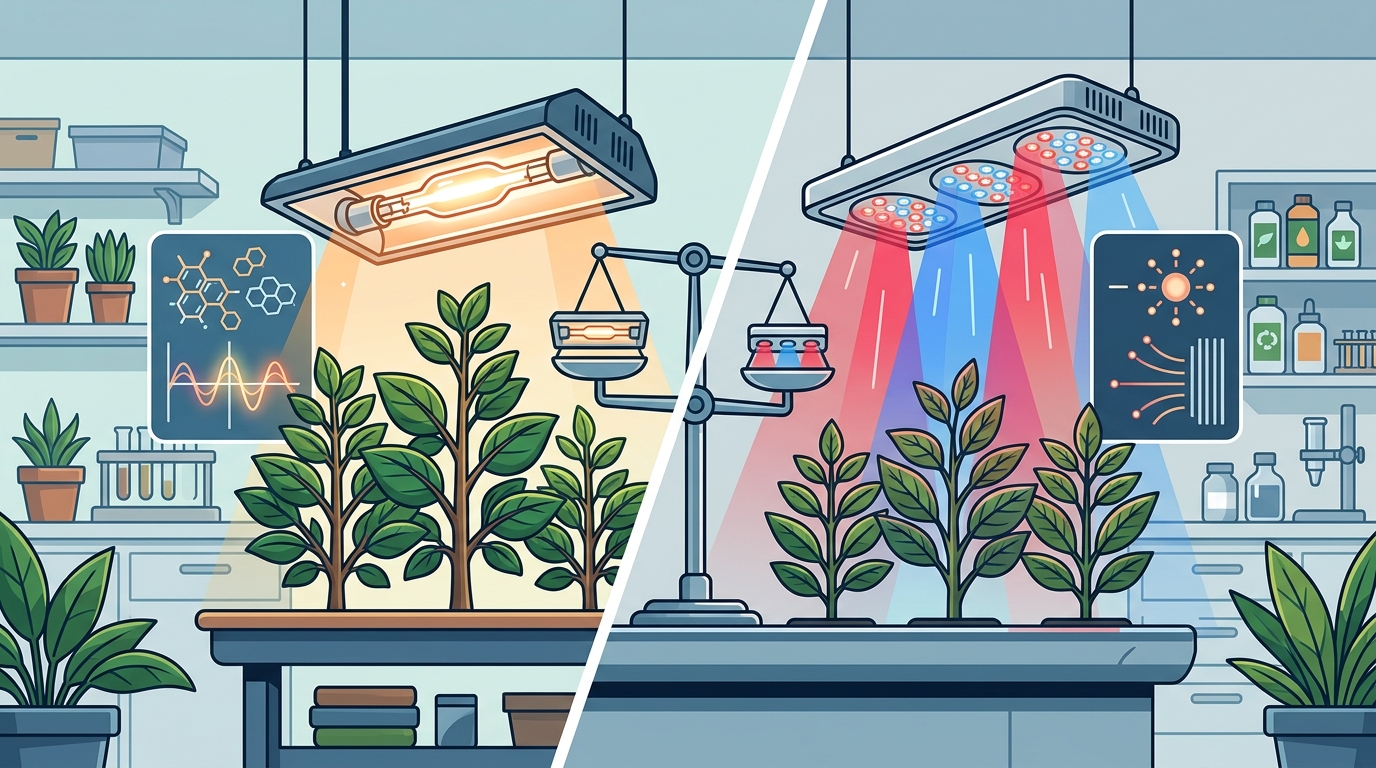
Ideal Use Cases for Each System
Neither technology is universally "better." The right choice depends on your specific growing goals and constraints.
When to Choose Nano Grow Light (CMH)
- Microgreens and Fast-Cycling Crops: If you prioritize speed and yield density, the nano-enhanced CMH fixture is superior. It can promote up to 3× faster development in ideal conditions.
- Flowering Houseplants: The full-spectrum output is ideal for triggering blooms in plants like African Violets and orchids.
- Compact Spaces: The tight beam pattern is perfect for small tents or vertical farms where light spill is a concern.
When to Choose LED
- Heat-Sensitive Plants: If you are growing delicate seedlings or tropical plants that cannot tolerate any additional heat load, LED is the safer option.
- Large-Scale Commercial Operations: For massive warehouses, the lower heat output of LEDs reduces HVAC costs significantly.
- Low Maintenance: LEDs have a longer lifespan and do not require the bulb replacements that CMH systems do.
Detailed Comparison Table
The following table summarizes the key differences between Nano Grow Light's CMH technology and standard LED fixtures.
| Feature | Nano Grow Light (CMH + Nano Coating) | Standard LED Fixture |
|---|---|---|
| Spectral Output | Continuous full-spectrum, no diode gaps | Discrete wavelengths, potential gaps |
| Heat Output | Approx. 340 BTU/hr, 45°C surface temp | Low heat, minimal radiant heat |
| PAR Efficiency | High (via nano-photon redirection) | High (via diode density) |
| Growth Speed | Up to 3× faster in trials | Standard growth rates |
| Ideal For | Microgreens, flowering plants, compact spaces | Heat-sensitive plants, large warehouses |
| Coverage | Single fixture covers ~3.5 x 3.5 ft | Varies by wattage and diode count |
Key Takeaways
- Nano Grow Light uses a 250W CMH lamp with a proprietary Nano Liquid Photonic Coating to enhance PAR delivery.
- The nano-coating consists of clusters 20 to 80 nanometers in size, increasing reflectance and focusing light on the canopy.
- Internal testing shows lettuce can mature in 28 days with this technology, compared to 42 days outdoors.
- CMH fixtures run hotter than LEDs, with a surface temperature of approximately 45°C.
- The technology is ideal for microgreens, African Violets, and compact indoor grow setups.
- LEDs remain the better choice for heat-sensitive plants and large-scale commercial operations.
- Nano Grow Light offers single fixtures and multi-pack bundles for scalable growing operations.
Frequently Asked Questions
Is Nano Grow Light better than LED for microgreens?
Yes, for microgreens, Nano Grow Light is often superior. The nano-enhanced photon delivery promotes faster development, with some growers reporting harvests in as little as 28 days. The full-spectrum output also ensures dense, vibrant leaf growth.
How hot does the Nano Grow Light fixture get?
The fixture reports approximately 340 BTU/hr of heat output and a surface temperature of roughly 45°C at steady state. This is higher than typical LED fixtures, so proper spacing and airflow are essential.
What is the Nano Liquid Photonic Coating?
The Nano Liquid Photonic Coating is a proprietary nano-scale reflector treatment applied to the fixture's internal reflector. It redirects scattered light into a tighter beam, increasing usable PAR and reducing energy waste.
Can I use this light for African Violets?
Absolutely. African Violets require bright, consistent, full-spectrum light to bloom well indoors. The Nano Grow Light's CMH output provides the blue and white wavelengths necessary for healthy vegetative growth and flowering.
How much area does one fixture cover?
A single Nano Grow Light fixture covers approximately a 3.5 by 3.5 feet area. For larger spaces, you can purchase 2-pack or 3-pack bundles to scale your operation.
Does the nano coating require maintenance?
The coating is applied to the reflector and is designed to be durable. However, like any reflector, it should be kept clean to maintain optimal light reflectance. Refer to the FAQ page for cleaning instructions.
Is this light suitable for commercial greenhouses?
Yes. Multiple fixtures can be arrayed for larger indoor operations, including commercial greenhouse supplemental lighting. The high PAR efficiency makes it a cost-effective option for boosting yields in controlled environments.
Start Growing Faster Today
Whether you are a hobbyist growing African Violets on a windowsill or a commercial grower optimizing microgreen yields, the right lighting technology can transform your results. Nano Grow Light offers a unique blend of CMH spectral purity and nano-enhanced efficiency that outperforms standard LEDs in speed and density. Explore our Shop Now page to find the perfect fixture for your needs. For more insights, visit our Blog or check out our Customer Success Stories. If you have further questions, our team is ready to help via our Contact page.