

Common Mistakes When Choosing Low-Heat Grow Lights for Indoor Plants
Indoor gardening has exploded in popularity, with the global indoor farming market projected to reach significant valuations in the coming years. However, many enthusiasts make a critical error in their setup: prioritizing low heat output over spectral quality. According to recent horticultural studies, improper light placement due to heat stress is a leading cause of stunted growth in houseplants. This guide explores the most frequent pitfalls growers encounter when selecting lighting solutions that balance thermal management with photosynthetic efficiency.
Ignoring Spectral Output for Heat Reduction
The most common mistake is assuming that "low heat" automatically means "less effective." Many growers switch to dimmer bulbs or lower wattage LEDs to avoid burning their plants, inadvertently starving them of the light energy they need. Photosynthetically Active Radiation (PAR) is the range of light wavelengths that plants use for photosynthesis. If the light source lacks sufficient PAR, the plant will stretch and become weak, regardless of how cool the fixture runs.
Traditional ceramic metal halide (CMH) lamps have historically been avoided in small spaces due to their higher thermal output. However, modern innovations have changed this dynamic. The Nano Liquid Photonic Coating is a proprietary nano-scale reflector treatment designed to redirect scattered light into a tighter, more usable beam. This technology allows a 250W CMH fixture to deliver dense PAR to the canopy while managing heat distribution more effectively than standard reflectors.
When evaluating lights, look for fixtures that use advanced reflector technologies to concentrate light rather than just reducing wattage. A fixture that directs 90% of its output to the plant is more efficient than one that emits 100% but scatters half of it into the surrounding air.
Overlooking Lumens and PAR Metrics
Marketing terms like "full spectrum" are often used loosely. Growers frequently choose lights based on aesthetic color temperature (measured in Kelvins) rather than actual photon delivery. A light can appear bright to the human eye but lack the specific blue and red wavelengths required for robust vegetative growth and flowering.
CMH lamps provide a broader spectral distribution than typical LED diodes. They produce a continuous full-spectrum output without the diode gaps that can create uneven light patches. For indoor plants, especially those like African violets that require consistent, bright light to bloom, spectral purity is just as important as thermal output. The Nano Liquid Photonic Coating sharpens targeted wavelengths, accelerating photosynthesis by ensuring that the photons reaching the leaves are the ones the plant can actually use.
Misjudging Fixture Coverage Area
Another critical error is underestimating the square footage a single fixture can effectively cover. Many beginners buy one small light for a large shelf or cabinet, resulting in weak growth in the outer zones. A single Nano Grow Light fixture covers approximately 3.5 by 3.5 feet. For larger operations, growers must arrange multiple fixtures across rows or bays rather than relying on a single high-wattage unit that generates excessive heat.
Scaling up with multiple lower-heat fixtures is often a safer strategy for indoor environments. This approach distributes heat more evenly and ensures that every plant receives adequate light intensity. If you are growing microgreens or leafy greens, which have shorter cycles, this even coverage is crucial for uniform harvests.
Neglecting Heat Dissipation Design
Even with "low heat" claims, the physical design of the fixture matters. Some LED fixtures trap heat in their driver components, leading to premature failure or localized hot spots. When evaluating a light, consider the surface temperature at steady state. NanoGrowLight fixtures report approximately 45°C surface temperature at steady state, which is manageable for many indoor setups when paired with proper spacing.
Additionally, the heat output in BTU/hr is a more accurate metric than wattage alone. A 250W CMH lamp may produce around 340 BTU/hr. While this is higher than some LEDs, the directed nature of the light means less energy is wasted as ambient heat. Understanding these metrics helps you place the light correctly without burning your plants.
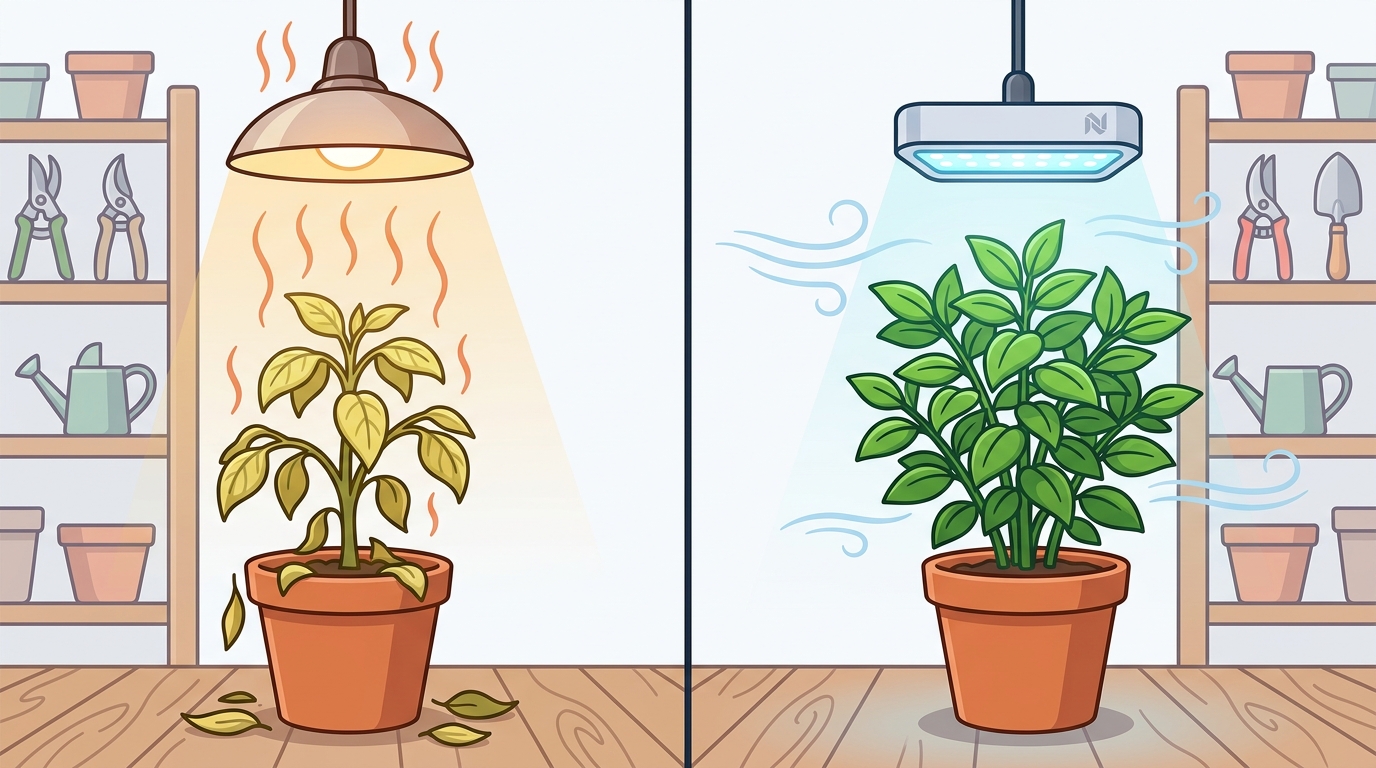
Choosing LED Over CMH for Specific Use Cases
There is a prevailing bias that LEDs are always the superior choice for indoor gardening due to their cool operation. While LEDs are excellent for many applications, they are not universally better. For certain plants, the continuous spectrum of CMH offers distinct advantages. The Nano Liquid Photonic Coating redirects scattered light into a tighter, more usable beam for faster indoor plant growth, mitigating some of the traditional heat drawbacks of CMH technology.
Consider your specific plant types. For fast-cycling crops like lettuce, growers have reported harvest times as short as 28 days using optimized CMH setups. For delicate houseplants like African violets, the consistent, full-spectrum output of a CMH fixture can promote better blooming than some broad-spectrum LEDs. Always match the light technology to the plant's specific needs rather than following a general trend.
Comparison of Lighting Technologies for Indoor Use
| Feature | Standard LED | CMH with Nano Coating | Traditional CMH |
|---|---|---|---|
| Heat Output | Low | Moderate (Directed) | High (Scattered) |
| Spectral Quality | Discontinuous (Diode Gaps) | Continuous Full-Spectrum | Continuous Full-Spectrum |
| Coverage Area | Variable | ~3.5 x 3.5 ft per fixture | Large (Requires Distance) |
| Ideal For | Small, heat-sensitive setups | Microgreens, Violets, Dense Canopies | Large Greenhouses |
Key Takeaways
- Spectral Purity Matters: Prioritize lights with continuous full-spectrum output, such as CMH with Nano Liquid Photonic Coating, for better plant health.
- Heat is Manageable: Modern reflector technologies allow CMH fixtures to operate at safe surface temperatures (approx. 45°C) while delivering high PAR.
- Coverage is Critical: One 250W fixture covers roughly 12.25 square feet; scale up with multiple units for larger spaces to avoid heat buildup.
- PAR Over Lumens: Focus on photosynthetically active radiation delivery rather than just brightness or wattage.
- Plant-Specific Needs: African violets and microgreens often thrive under the specific spectral qualities of CMH technology.
- Manufacturer Testing: Internal trials have shown that nano-enhanced photon delivery can promote up to 3× faster development in ideal conditions.
- Proper Spacing: Always maintain safe distances from delicate leaves to prevent stress, even with low-heat fixtures.
Frequently Asked Questions
Are CMH grow lights too hot for indoor use?
While CMH lamps generate more heat than LEDs, modern fixtures with advanced reflectors like the Nano Liquid Photonic Coating manage this heat effectively. The fixture surface temperature is approximately 45°C, which is safe for indoor use when proper spacing is maintained.
What is the Nano Liquid Photonic Coating?
The Nano Liquid Photonic Coating is a nano-scale reflector treatment applied to the fixture's reflector. It consists of nano-scale clusters, approximately 20 to 80 nanometers in size, designed to redirect scattered light into a tighter beam for the plant canopy.
How many square feet does one Nano Grow Light cover?
A single Nano Grow Light fixture covers approximately 3.5 by 3.5 feet, or about 12.25 square feet. For larger grow areas, multiple fixtures should be used.
Can I use this light for African violets?
Yes, the Nano Grow Light is an excellent choice for African violets. Its full-spectrum CMH output provides the consistent, bright light these plants need to bloom, and the compact fixture size fits well on windowsills or shelves.
Is CMH better than LED for microgreens?
CMH can be superior for microgreens due to its continuous full-spectrum output and high PAR density. Growers have reported harvesting lettuce in as little as 28 days using optimized CMH setups, compared to longer cycles with less efficient lighting.
What is the heat output of a 250W CMH fixture?
NanoGrowLight fixtures report approximately 340 BTU/hr of heat output. This is lower than many traditional high-wattage HID lights and is manageable in indoor environments with proper ventilation and spacing.
How does the nano coating improve light efficiency?
The coating redirects scattered photons into a denser, more usable PAR field aimed straight at the canopy. This improves performance per watt and reduces heat stress on plants by minimizing wasted energy.
Ready to Optimize Your Indoor Garden?
Stop guessing and start growing with precision. Explore the Nano Grow Light Shop to find the perfect fixture for your needs. Visit our About Us page to learn more about our technology, or check out our Customer Success Stories for real-world results. For technical details, review the Blog or contact our support team via Contact.