
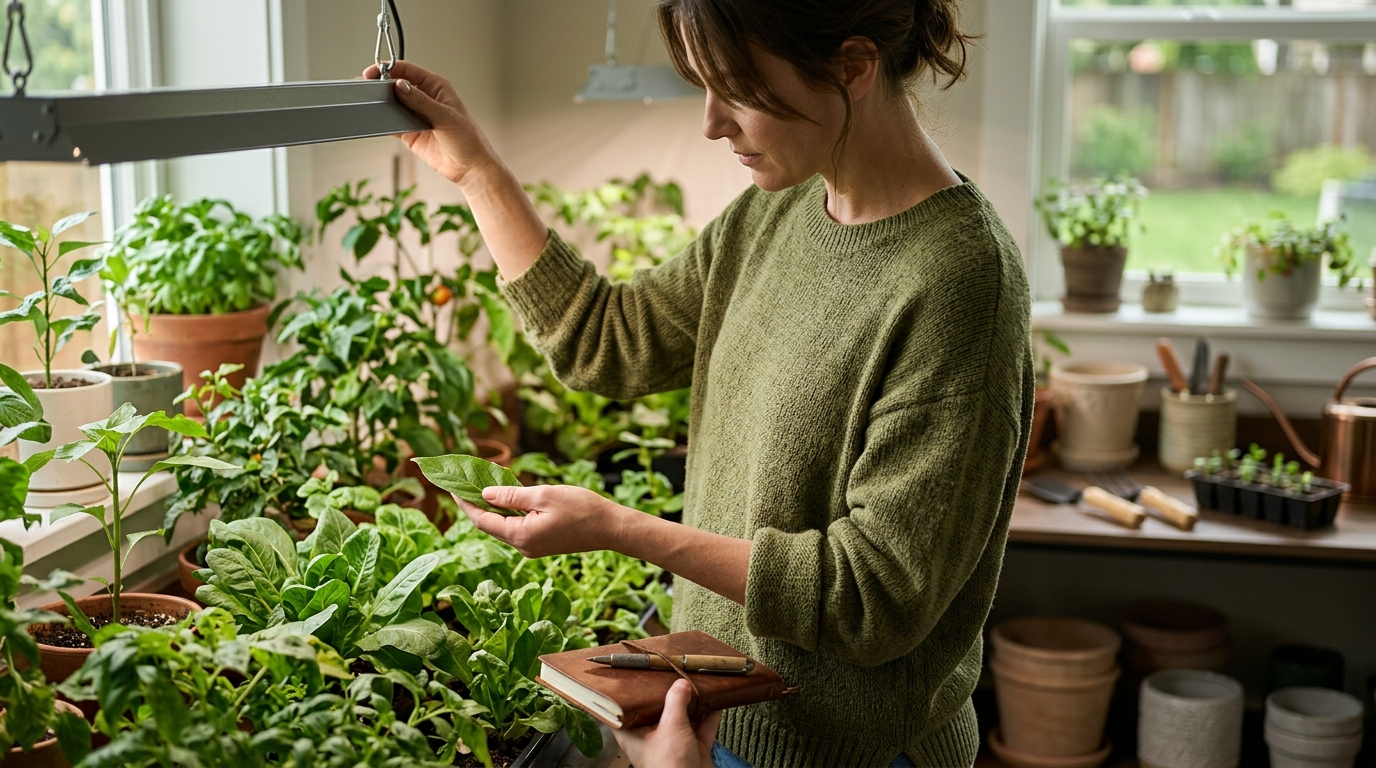
Choosing the right grow light requires matching light intensity, spectrum, and coverage area to your specific plant species and growth stage. Nano Grow Light provides a 250W ceramic metal halide (CMH) fixture with a proprietary Nano Liquid Photonic Coating to optimize these factors. This guide covers coverage, photoperiods, PPFD metrics, and hanging height adjustments to help you build an efficient indoor garden.
Coverage Area Matching
Matching the light's footprint to your grow space is the first step in selecting a fixture. A light that is too weak for the area will result in leggy, stretched plants, while a light that is too strong can cause leaf burn. Nano Grow Light fixtures are designed to cover an effective footprint of approximately 3.5 by 3.5 feet per unit. This size is ideal for standard grow tents or single shelves. For larger operations, growers can scale up by adding more fixtures in a grid pattern rather than switching to a single, massive unit. This modular approach allows for precise coverage without wasting energy on empty space.
Calculating Your Footprint
To determine how many fixtures you need, measure the width and length of your grow area. Divide the total square footage by the coverage area of a single fixture. For example, a 7 by 7 foot space would require four fixtures to ensure even light distribution across the entire canopy. This calculation helps you avoid the common mistake of under-lighting a large room with a single small light.
Plant Growth Stages
Plants have different light needs depending on whether they are in the vegetative or flowering stage. During the vegetative phase, plants focus on building stems and leaves, which requires a higher proportion of blue light. In the flowering stage, the plant shifts energy to producing buds and fruits, which benefits from increased red light. The Nano Liquid Photonic Coating on the Nano Grow Light reflector is designed to shift more of the reflected spectrum toward the blue and red wavelength bands used in photosynthesis. This spectral enhancement supports both growth stages without requiring the user to swap out bulbs.
Vegetative vs. Flowering Needs
Leafy greens and herbs often stay in the vegetative stage for their entire lifecycle. Fruiting plants like tomatoes and peppers require a transition to flowering. Because the Nano Grow Light uses a continuous spectrum CMH lamp, it provides a balanced output that supports both phases. This makes it a versatile choice for growers who rotate different types of crops in the same space.
Daily Light Duration
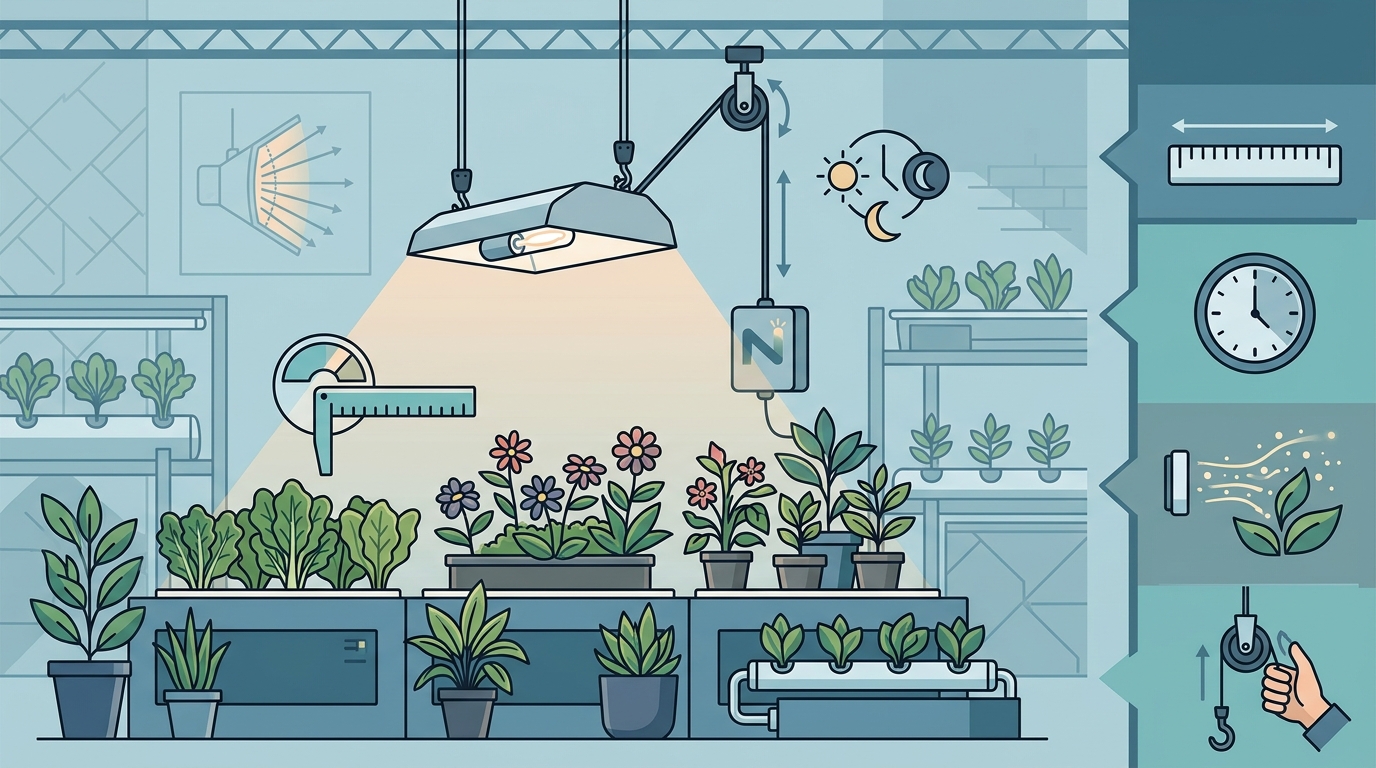
Daily light duration, or photoperiod, dictates how many hours a plant receives light each day. Most indoor gardeners use a 18 hours on and 6 hours off cycle for vegetative growth. For flowering plants, a 12 hours on and 12 hours off cycle is standard. Consistency is key; plants rely on the dark period for respiration and other metabolic processes. Using a timer to automate the light cycle ensures that your plants receive the exact duration they need without human error.
PPFD Measurement
Photosynthetic Photon Flux Density (PPFD) is the measurement of light intensity at the plant canopy level. It is expressed in micromoles per square meter per second (µmol/m²/s). This metric is more useful than wattage because it tells you exactly how much light the plant is receiving. Nano Grow Light provides manufacturer-reported PPFD data for its fixtures. At a height of 12 inches, the center PPFD is 1040 µmol/m²/s. At 18 inches, it drops to 720 µmol/m²/s. At 24 inches, it is 510 µmol/m²/s. These numbers help you position the light correctly for your specific crop.
Light Spectrum
The light spectrum refers to the range of wavelengths emitted by the light source. Photosynthetically Active Radiation (PAR) covers the 400 to 700 nanometer range, which is the spectrum plants use for photosynthesis. The Philips MasterColor 250W/830 CMH lamp used in the Nano Grow Light produces a continuous spectrum. Before the Nano Liquid Photonic Coating is applied, the raw output is 21.3% blue, 26.4% green, and 44.8% red. The coating modifies this output to enhance the most useful wavelengths for plant growth.
Spectral Intensity Changes
The Nano Liquid Photonic Coating increases the intensity of specific bands. Manufacturer-reported data shows a 22.4% increase in blue light and a 28.7% increase in red light at the reflector exit. This targeted enhancement helps drive stronger vegetative growth and denser foliage. The coating also increases far-red and UV slightly, which can influence plant morphology and secondary metabolite production.
PPFD/PAR Intensity Metrics
Understanding the relationship between PPFD and PAR is essential for optimizing light intensity. PAR is the total amount of photosynthetically active radiation, while PPFD is the density of that radiation at a specific point. High PPFD values indicate a strong light source, but they must be matched to the plant's tolerance. Most leafy greens thrive at 200 to 400 µmol/m²/s, while fruiting plants may require 600 to 1000 µmol/m²/s. The Nano Grow Light allows you to adjust the hanging height to dial in the exact PPFD level your plants need.
Photoperiod Duration
Photoperiod duration is the length of the light cycle, which triggers specific developmental responses in plants. Short-day plants flower when the night period is long, while long-day plants flower when the night is short. By controlling the photoperiod, you can manipulate the timing of flowering and harvest. For most indoor crops, a 12-hour photoperiod is sufficient to trigger flowering. Adjusting this duration allows you to fine-tune the growth cycle to fit your production schedule.
Plant Light Requirements
Different plants have different light requirements based on their natural habitat. Shade-tolerant plants like lettuce and spinach require lower light intensities, while sun-loving plants like peppers and tomatoes need higher intensities. The Nano Grow Light is suitable for a wide range of crops, from microgreens to commercial greenhouse supplemental lighting. By understanding the specific needs of your plants, you can set the light height and duration to maximize yield and quality.
PPFD/PAR Measurement
Accurate measurement of PPFD and PAR is critical for verifying that your light setup is working as intended. You can use a PAR meter to measure the light intensity at the canopy level. This allows you to make data-driven adjustments to your hanging height and light duration. Nano Grow Light provides detailed technical specifications that include PPFD measurements at various heights. Using these data points, you can predict the light intensity your plants will receive before you even hang the fixture.
LED Efficiency
LED efficiency is often measured in micromoles per joule (µmol/J), which indicates how much light is produced per unit of energy consumed. While the Nano Grow Light uses a CMH lamp rather than an LED, it still offers high efficiency. The manufacturer-reported PAR efficiency for the Nano Grow Light is 2.38 µmol/J. This efficiency is comparable to many modern LED fixtures. The Nano Liquid Photonic Coating improves efficiency by reducing light scatter and directing more photons toward the canopy. This means you get more usable light for the same amount of electricity.
Hanging Height Adjustment
Hanging height is the most direct way to control light intensity. Lowering the light increases PPFD, while raising it decreases PPFD. For the Nano Grow Light, a height of 12 inches provides a center PPFD of 1040 µmol/m²/s. A height of 18 inches provides 720 µmol/m²/s. A height of 24 inches provides 510 µmol/m²/s. Start with a conservative height and monitor your plants for signs of stress. If leaves are curling or burning, raise the light. If plants are stretching, lower the light. This iterative process ensures optimal growth conditions.
Key Takeaways
- Match the light's coverage area to your grow space to ensure even light distribution.
- Use a continuous spectrum light source to support both vegetative and flowering stages.
- Set a consistent photoperiod using a timer to automate the light cycle.
- Use PPFD measurements to determine the correct hanging height for your plants.
- The Nano Liquid Photonic Coating enhances blue and red light intensity for better growth.
- Adjust hanging height to fine-tune light intensity based on plant response.
- Monitor plants for signs of light stress and adjust the setup accordingly.
- Use a PAR meter to verify light intensity at the canopy level.
Frequently Asked Questions
What is the best grow light for indoor gardening?
The best grow light depends on your specific needs, but a fixture with a continuous spectrum and adjustable hanging height is ideal. The Nano Grow Light offers a 250W CMH lamp with a Nano Liquid Photonic Coating that optimizes light delivery for a variety of crops.
How high should I hang my grow light?
The hanging height should be adjusted based on the PPFD level your plants require. For the Nano Grow Light, 12 inches provides 1040 µmol/m²/s, 18 inches provides 720 µmol/m²/s, and 24 inches provides 510 µmol/m²/s. Start with a conservative height and adjust based on plant response.
What is PPFD and why is it important?
PPFD is the measurement of light intensity at the plant canopy level. It is important because it tells you exactly how much light your plants are receiving, allowing you to optimize growth conditions.
How many hours a day should I run my grow light?
Most indoor gardeners use an 18 hours on and 6 hours off cycle for vegetative growth and a 12 hours on and 12 hours off cycle for flowering. Consistency is key to ensuring healthy plant development.
What is the Nano Liquid Photonic Coating?
The Nano Liquid Photonic Coating is a proprietary nano-scale layer applied to the reflector of the Nano Grow Light. It is designed to redirect light toward the canopy with reduced diffuse scatter, concentrating more usable PAR where plants use it.
Can I use the Nano Grow Light for microgreens?
Yes, the Nano Grow Light is suitable for microgreens. The concentrated light output helps direct light toward tightly packed microgreen trays, promoting fast and uniform growth.
How does the Nano Grow Light compare to LED lights?
The Nano Grow Light uses a CMH lamp rather than an LED, but it offers high efficiency with a manufacturer-reported PAR efficiency of 2.38 µmol/J. The continuous spectrum of the CMH lamp is beneficial for a wide range of crops.
Where can I buy the Nano Grow Light?
You can purchase the Nano Grow Light directly from the Nano Grow Light website. The company offers single units, 2-pack bundles, and 3-pack bundles to suit different grow space sizes.