

Choosing the best grow light for indoor plants depends on matching light intensity to your specific crop. For most home growers, a 250W ceramic metal halide (CMH) fixture offers the ideal balance of full-spectrum output and manageable heat. Nano Grow Light utilizes a proprietary Nano Liquid Photonic Coating to maximize the usable light reaching your canopy. This guide covers PPFD ratings, heat management, and spectral requirements to help you select the right fixture.
Understanding PPFD Ratings
Photosynthetic Photon Flux Density (PPFD) is the measurement of light intensity at the plant canopy level. It is expressed in micromoles per square meter per second (µmol/m²/s). Unlike total wattage, PPFD tells you exactly how much usable light your plants actually receive. This metric is critical because different plants have different light saturation points.
Light Intensity by Plant Type
Low-light plants like pothos or snake plants thrive at 50 to 100 µmol/m²/s. Medium-light plants such as African violets and most leafy greens require 200 to 400 µmol/m²/s. High-light crops like tomatoes, peppers, and cannabis need 600 to 1000+ µmol/m²/s. If your light provides too little PPFD, plants will stretch and produce weak stems. If it provides too much, you risk leaf burn and increased energy costs.
According to University of Georgia Extension, indoor plants are classified according to the amount of light needed for growth. Matching your fixture's PPFD output to your specific plant's needs is the most important factor in choosing a grow light. A 250W CMH fixture like the Nano Grow Light can deliver high PPFD levels at close distances, making it suitable for a wide range of crops.
Spectral Requirements for Photosynthesis
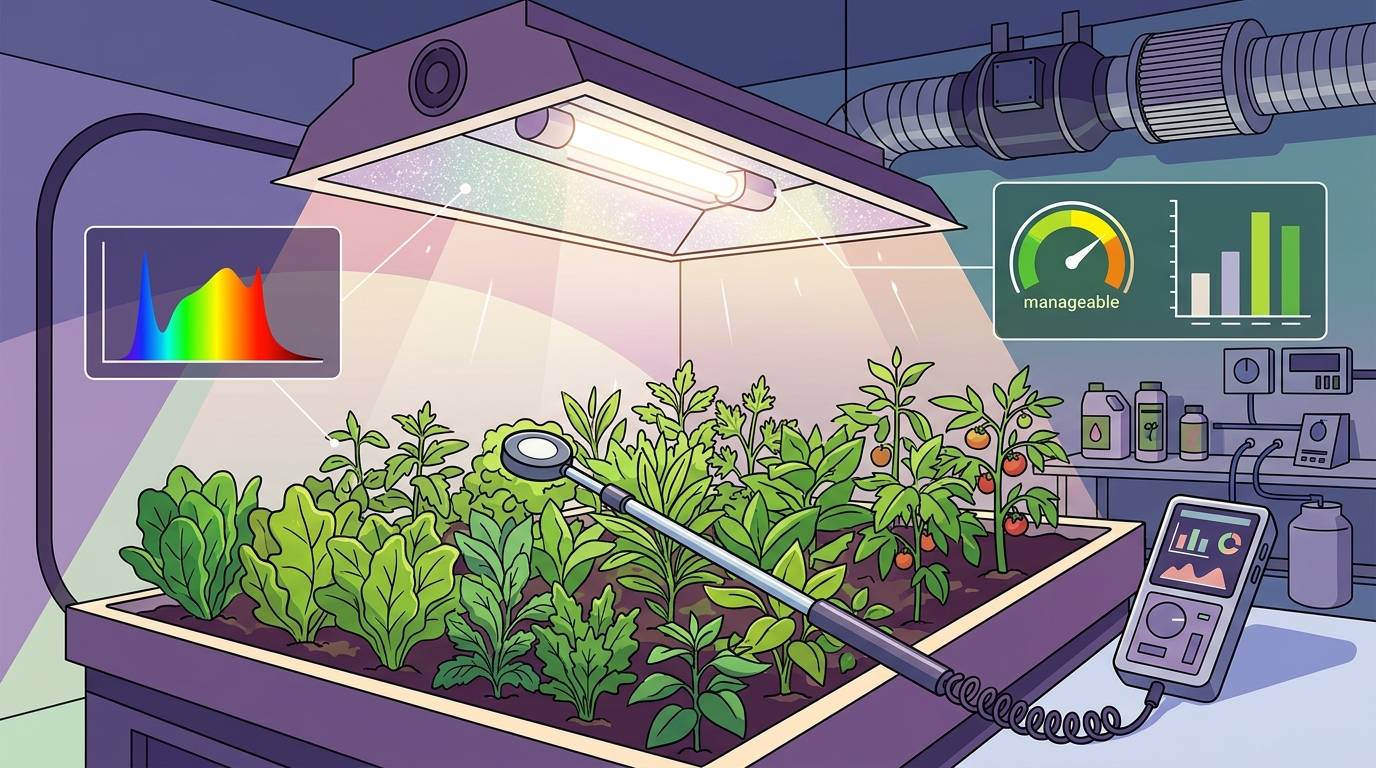
Photosynthetically Active Radiation (PAR) is the range of light wavelengths, from 400 to 700 nanometers, that plants use for photosynthesis. While plants can use all visible light, they are most efficient in the blue and red bands. Blue light (400-500 nm) drives vegetative growth and compact leaf structure. Red light (600-700 nm) promotes flowering and fruiting.
The Role of Reflectors
The reflector inside a grow light fixture plays a crucial role in spectral efficiency. Standard bare aluminum reflectors scatter light and absorb a portion of the spectrum. This results in less usable PAR reaching the plant canopy. Advanced reflector technologies can redirect more light toward the plants and shift the spectrum toward the most useful wavelengths.
The Nano Liquid Photonic Coating is a nano-scale layer applied to the reflector. According to manufacturer-reported internal testing, this coating increases visible-light and PAR reflectance compared to a bare aluminum reflector. It also shifts more of the reflected spectrum toward the blue and red wavelength bands used in photosynthesis. This means more of the electricity you pay for is converted into usable plant growth.
Managing Heat in Indoor Spaces
Heat output is a significant consideration when selecting a grow light for indoor use. Ceramic metal halide (CMH) lamps run hotter than typical LED grow lights. This heat can be beneficial for warming seedlings or maintaining temperature in unheated spaces. However, it can also cause stress or damage if the light is too close to the plants.
Safe Distances and Ventilation
CMH fixtures report approximately 340 BTU/hr of heat output and roughly 45°C surface temperature at steady state. Because of this heat, position delicate houseplants at a safe distance from the fixture. Check leaves for signs of stress during the first week. Adequate ventilation is essential to remove excess heat and humidity. For smaller plants like African violets, you may need to hang the light higher than you would with an LED fixture.
Understanding the thermal profile of your light is just as important as understanding its light output. The Nano Liquid Photonic Coating Spec Sheet provides detailed thermal measurements, including arc tube temperature and fixture surface temperature. This data helps you plan your grow space layout effectively.
Light Scheduling and Photoperiods
Photoperiod is the duration of light a plant receives each day. Most indoor plants do well on a 12 to 14-hour light schedule. Some plants, like African violets, may benefit from slightly longer periods, while others, like lettuce, prefer shorter days to prevent bolting. Using a simple timer ensures consistency, which is key to healthy growth.
Consistency is more important than the exact number of hours. Sudden changes in photoperiod can stress plants and delay flowering. A reliable timer is a low-cost investment that pays off in consistent results. Many hobbyists pair their grow lights with a basic digital timer to automate the light cycle.
Fixture Comparison and Coverage
When comparing grow lights, consider the effective coverage area and the number of fixtures needed for your space. A single 250W CMH fixture covers approximately 3.5 by 3.5 feet. For larger grow spaces, you can arrange multiple fixtures across rows, bays, or multi-tier racks. This modular approach allows you to scale up without switching to a single, larger, and more expensive unit.
| Fixture Type | Wattage | Effective Coverage | Heat Output | Best For |
|---|---|---|---|---|
| 250W CMH with Nano Coating | 250W | 3.5 x 3.5 ft | High (~340 BTU/hr) | Flowering plants, small tents, single shelves |
| LED Panel | Varies | Varies | Low | Large commercial spaces, low-heat environments |
| Fluorescent Tube | Low | Small | Very Low | Seedlings, low-light houseplants | r>
The Nano Grow Light is available in single units, 2-pack bundles, and 3-pack bundles. This flexibility makes it easy to find the right setup for your specific grow space, whether you are growing a single African violet or a multi-tier rack of microgreens.
Key Takeaways
- PPFD is the most important metric for measuring light intensity at the canopy level.
- Match your light's PPFD output to your plant's specific light requirements.
- Advanced reflector coatings can significantly increase usable PAR and shift the spectrum toward blue and red bands.
- CMH lights produce more heat than LEDs, so plan for adequate ventilation and safe hanging distances.
- Consistent light scheduling with a timer is essential for healthy plant development.
- Modular fixtures allow you to scale up coverage by adding more units rather than buying one large light.
- Always check manufacturer-reported data for thermal and spectral specifications before purchasing.
Frequently Asked Questions
What is the best grow light for African violets?
African violets need bright, consistent, full-spectrum light to bloom well indoors. A 250W CMH fixture with a full-spectrum output is a good choice, but you must hang it at a safe distance due to the heat. Check the African Violets guide for specific placement tips.
How high should I hang a CMH grow light?
The height depends on the plant and the desired PPFD. For high-light plants, you can hang a 250W CMH light as low as 12 to 18 inches. For delicate houseplants, you may need to hang it 24 inches or higher. Always monitor your plants for signs of heat stress.
Is a 250W CMH light enough for a small grow tent?
Yes, a 250W CMH light is sufficient for a small grow tent, typically up to 4x4 feet. It provides high PPFD levels at close distances, which is ideal for flowering plants. For larger tents, you may need multiple fixtures.
What is the difference between PAR and PPFD?
PAR refers to the range of light wavelengths (400-700 nm) that plants use for photosynthesis. PPFD is the measurement of how much of that PAR is actually reaching the plant canopy. PAR is the type of light, while PPFD is the intensity of that light.
Do I need a special reflector for my grow light?
A high-quality reflector can improve the efficiency of your grow light by directing more light toward the plants. The Nano Liquid Photonic Coating is an example of an advanced reflector technology that increases reflectance and shifts the spectrum toward useful wavelengths.
How do I maintain my grow light?
Regularly clean the light surface and check connections. Replace any damaged parts promptly to ensure maximum efficiency. Proper maintenance extends the life of your fixture and ensures consistent light output.
Can I use a CMH light for microgreens?
Yes, CMH lights can be used for microgreens, but you must hang them high enough to avoid heat stress. Microgreens are sensitive to heat, so a safe distance is crucial. The Microgreens guide provides specific recommendations for using CMH lights with microgreens.
Where can I find more information about the Nano Liquid Photonic Coating?
You can find detailed technical specifications and test data on the Nano Liquid Photonic Coating Spec Sheet. This page includes spectral distribution, PPFD measurements, and thermal data from manufacturer-reported internal testing.
Final Thoughts
Selecting the best grow light for indoor plants requires a careful balance of light intensity, spectral quality, and heat management. By understanding PPFD ratings and the role of advanced reflector technologies, you can make an informed decision that supports healthy plant growth. Nano Grow Light offers a 250W CMH fixture with the Nano Liquid Photonic Coating, designed to maximize usable light for a wide range of indoor crops. Whether you are growing African violets, microgreens, or flowering plants, the right light is the foundation of a successful indoor garden.