
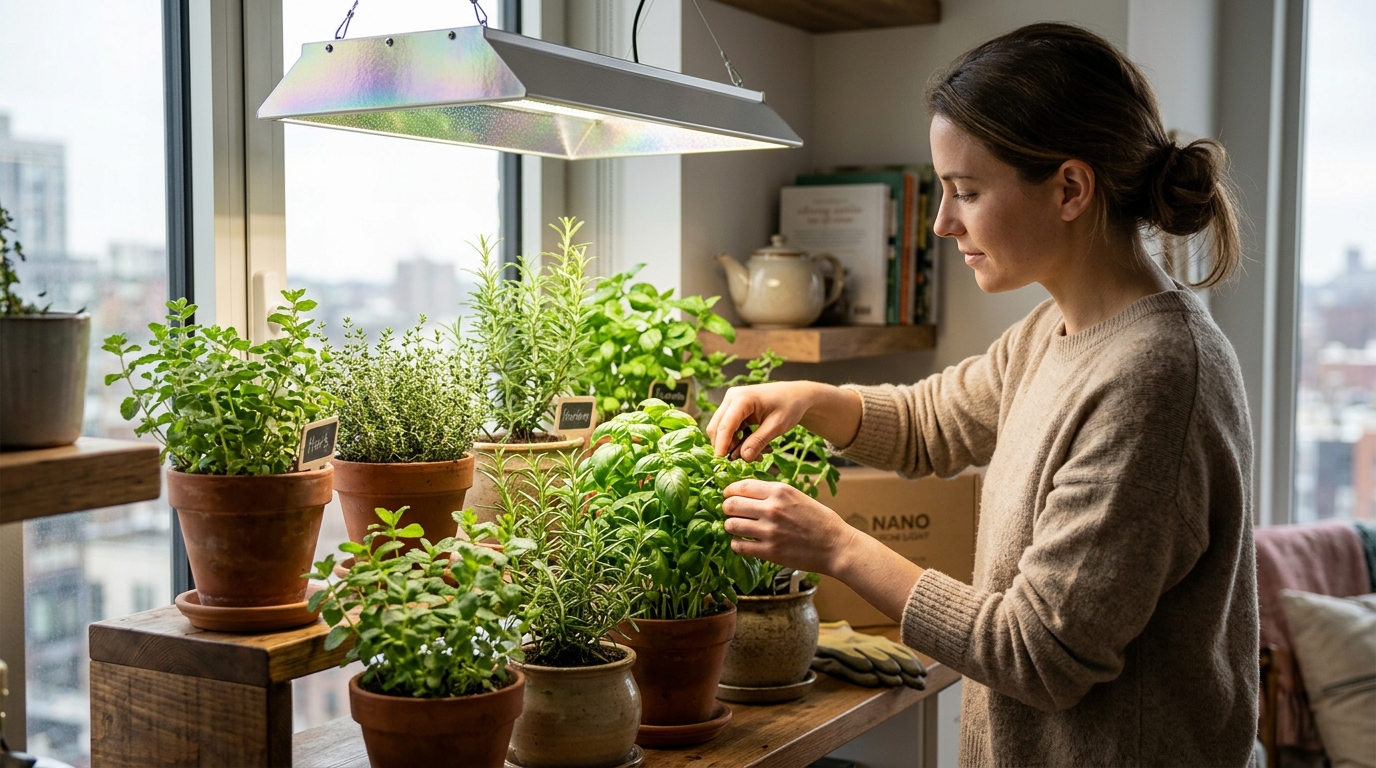
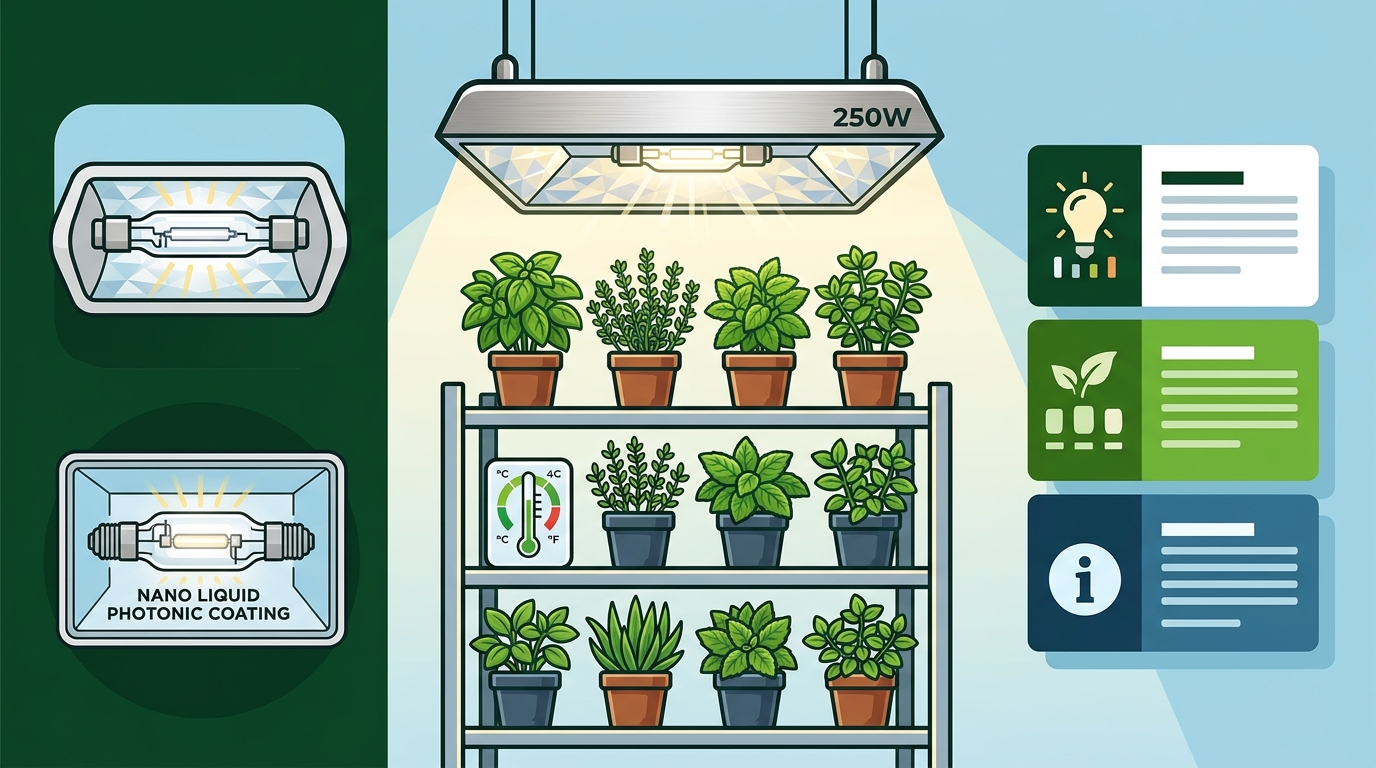
The best grow light for indoor herbs is a full-spectrum fixture that provides consistent intensity without excessive heat. For small spaces, the Nano Grow Light offers a 250W ceramic metal halide (CMH) option with a Nano Liquid Photonic Coating. This guide covers recommended models, specific herb varieties, and technical specifications for optimal growth.
Recommended Light Models
CMH vs. LED Technology
Ceramic metal halide lamps produce a continuous spectrum, which is often preferred for flowering and fruiting stages. Unlike LED lights that use discrete wavelength peaks, CMH lamps provide a full-spectrum output. This continuous light profile can be beneficial for a wide variety of indoor plants, including delicate houseplants and culinary herbs.
Reflector Technology
The Nano Liquid Photonic Coating is a nano-scale liquid coating applied to the fixture's internal reflector. It cures into a thin crystalline layer that behaves like a micro-lens array. This structure bends blue and red wavelengths toward the plant canopy, reducing scatter compared to standard aluminum reflectors.
Specific Herb Varieties
Different herbs have varying light requirements, but most thrive under consistent, bright conditions. The Nano Grow Light is suitable for a range of common indoor herbs, including basil, mint, and cilantro. These plants generally require 12 to 14 hours of light per day for optimal growth.
Leafy Greens and Culinary Herbs
Herbs like lettuce, spinach, and microgreens benefit from the full-spectrum output of the CMH lamp. The coating helps direct more light toward the leaves, which can lead to denser canopies and faster growth. Growers should monitor leaf color and size to adjust the distance between the light and the plants.
Flowering and Fruiting Herbs
Light Spectrum and Wavelengths
Understanding the light spectrum is essential for maximizing plant growth. The Philips MasterColor 250W/830 CMH lamp used in the Nano Grow Light has a specific spectral distribution. This distribution includes strong red content and moderate blue, which are critical for plant development.
Spectral Distribution Details
Before the nano coating, the raw CMH output includes 21.3% blue, 26.4% green, 44.8% red, 5.1% far-red, and 2.4% UV. After the Nano Liquid Photonic Coating is applied, the spectral intensity changes at the reflector exit. Blue increases by 22.4%, red by 28.7%, green by 4.2%, far-red by 6.1%, and UV by 3.5%. These changes help optimize the light for plant absorption.
PAR and PPFD Measurements
Photosynthetically Active Radiation (PAR) measures the light available for photosynthesis. The Nano Grow Light reports a PAR efficiency of 2.38 µmol/J. At 12 inches, the center PPFD is 1040 µmol/m²/s, with an average of 824 µmol/m²/s across a 2x2 ft area. At 18 inches, the center PPFD is 720 µmol/m²/s, and at 24 inches, it is 510 µmol/m²/s. These figures help growers determine the appropriate hanging height for their plants.
Heat Management and Safety
CMH lamps run hotter than typical LED grow lights, which is a critical factor for indoor growing. The Nano Grow Light reports approximately 340 BTU/hr of heat output and a surface temperature of roughly 45°C at steady state. Proper ventilation and spacing are necessary to prevent heat stress in delicate plants.
Safe Distance Guidelines
Position delicate houseplants and herbs at a safe distance from the fixture to avoid leaf burn. Check leaves for signs of stress during the first week of use. If leaves appear yellow or brown, increase the distance between the light and the plant. Using a timer to maintain a consistent 12 to 14-hour light schedule can also help manage heat exposure.
Ventilation and Airflow
Adequate airflow is essential when using CMH fixtures in enclosed spaces. Ensure that the growing area has sufficient ventilation to dissipate heat. This not only protects the plants but also maintains a comfortable environment for the grower. Monitoring the ambient temperature in the growing area is recommended.
Key Takeaways
- The Nano Grow Light is a 250W CMH fixture with a Nano Liquid Photonic Coating reflector.
- The coating increases blue and red wavelength intensity, directing more light toward the canopy.
- CMH lamps produce a continuous spectrum, which is beneficial for a wide range of herbs.
- Heat output is approximately 340 BTU/hr, requiring careful spacing and ventilation.
- PPFD levels vary by height, with 1040 µmol/m²/s at 12 inches and 510 µmol/m²/s at 24 inches.
- Most herbs require 12 to 14 hours of light per day for optimal growth.
- Monitor plant health and adjust light distance to prevent heat stress.
- The fixture covers approximately 3.5 by 3.5 feet, suitable for small indoor setups.
Frequently Asked Questions
What is the Nano Liquid Photonic Coating?
The Nano Liquid Photonic Coating is a proprietary nano-scale liquid coating applied to the fixture's internal reflector. It cures into a thin crystalline layer that behaves like a micro-lens array, bending light toward the plant canopy.
Is Nano Grow Light an LED grow light?
No, Nano Grow Light uses a 250W ceramic metal halide (CMH) lamp, not LEDs. CMH lamps produce a continuous spectrum rather than the discrete wavelength peaks typical of LED diodes.
What plants can I grow with the Nano Grow Light?
The Nano Grow Light works well for seedlings, herbs, African violets, tomatoes, lettuce, and microgreens. It is suitable for many other indoor plants that require full-spectrum lighting.
Does the Nano Grow Light run hot?
Yes, like other ceramic metal halide fixtures, the Nano Grow Light runs warmer than an LED fixture of similar wattage. It reports approximately 340 BTU/hr of heat output and a surface temperature of roughly 45°C at steady state.
How much area does one fixture cover?
A single Nano Grow Light fixture covers approximately 3.5 by 3.5 feet. Growers can scale coverage for larger indoor operations by arraying multiple fixtures.
What is the recommended light schedule for herbs?
Most herbs require 12 to 14 hours of light per day. Using a simple timer can help maintain a consistent schedule, which is important for plant health and growth.
How should I position the light for delicate plants?
Position delicate houseplants and herbs at a safe distance from the fixture to avoid heat stress. Check leaves for signs of stress during the first week and adjust the distance if necessary.
Where can I find more technical details?
Full technical specifications are available on the Nano Liquid Photonic Coating Spec Sheet page. This page includes detailed data on spectral distribution, PPFD measurements, and thermal performance.
Conclusion
Choosing the right grow light for indoor herbs requires balancing light intensity, spectrum, and heat management. The Nano Grow Light offers a robust solution with its 250W CMH lamp and Nano Liquid Photonic Coating. By understanding the technical specifications and following proper placement guidelines, you can create an optimal environment for your plants. For more information on the technology and product details, visit the Nano Grow Light website.