

Indoor horticulture is undergoing a significant technological shift as growers seek to maximize yield efficiency and spectral purity. According to manufacturer-reported internal testing, NanoGrowLight’s coated reflectors increase reflectance and concentrate more of the fixture’s output onto the grow area compared to standard bare aluminum reflectors. This advancement challenges the long-standing dominance of Light Emitting Diode (LED) systems in the home grow market. While LEDs have been the industry standard for their energy efficiency, Ceramic Metal Halide (CMH) fixtures equipped with proprietary Nano Liquid Photonic Coating offer a compelling alternative for specific cultivation goals. This article compares these two technologies to help you determine which system best suits your indoor gardening needs. (Illustrative Use Cases Nano)
Spectral Purity and Light Quality
The fundamental difference between CMH and LED lighting lies in how they produce light. LED fixtures generate light through discrete diodes that emit specific wavelengths. This often results in a "spiky" spectrum with gaps between the red and blue peaks. In contrast, Ceramic Metal Halide lamps provide a continuous full-spectrum output without these diode gaps. This continuous spectrum closely mimics natural sunlight, which is critical for complex plant physiological processes. (Indoor Grow Lights Nano)
Nano Grow Light utilizes a 250W ceramic metal halide lamp paired with its proprietary Nano Liquid Photonic Coating. This coating consists of nano-scale clusters, approximately 20 to 80 nanometers in size, applied to the fixture’s reflector. The cured coating measures approximately 2 to 6 microns thick. According to manufacturer-reported internal testing, the coating increases visible-light and PAR reflectance compared to a bare aluminum reflector. It also shifts more of the reflected spectrum toward the blue and red wavelength bands used in photosynthesis. This targeted spectral delivery ensures that plants receive a dense, usable beam of light rather than scattered photons.
For growers focusing on flowering houseplants, such as African violets, this spectral continuity is vital. African violets need bright, consistent, full-spectrum light to bloom well indoors. The Nano Grow Light fixture is designed to deliver the blue and white wavelengths used in vegetative growth while maintaining the intensity required for flowering. Many hobbyists pair the fixture with a simple timer to keep a consistent 12- to 14-hour light schedule. For general plant care guidance, the University of Minnesota Extension's African violet growing guide offers a helpful independent reference.
PAR Efficiency and Photon Redirection
Photosynthetically Active Radiation (PAR) is the range of light wavelengths that plants use for photosynthesis. Traditional grow lights often scatter photons in every direction, wasting energy on wavelengths plants cannot use or on light that misses the canopy entirely. Nano Liquid Photonic Coating redirects and tightens that same light into a denser, more usable PAR field aimed straight at the canopy. This targeted beam delivery improves performance per watt and reduces heat stress on your plants.
In manufacturer-reported internal testing, a 28-day prototype trial versus a standard LED fixture at equal wattage measured increased vegetative biomass, denser leaf canopy, and faster time to harvest. Multiple fixtures can be arrayed for larger indoor operations, including commercial greenhouse supplemental lighting. The Nano-enhanced photon delivery promotes up to 3× faster development in ideal conditions. Plants can grow up to 1 inch per day, reducing a typical 3-month cycle to as little as 2 months. In real-world use, growers have brought fast-cycling crops like lettuce to harvest in as little as 28 days, based on our own testing across 60+ harvests.
This efficiency is particularly beneficial for microgreens growers who require rapid turnover. The Nano Grow Light fixture covers approximately 3.5 by 3.5 feet, making it ideal for small-scale vertical farming or shelf-based cultivation. For larger operations, growers simply scale up by adding more fixtures rather than switching to one larger, less precise unit. This modular approach allows for precise light density control across different grow zones.
Heat Management and Operational Safety
One of the most significant operational differences between CMH and LED systems is heat output. CMH lamps run hotter than typical horticultural LED fixtures. NanoGrowLight fixtures report approximately 340 BTU/hr of heat output and approximately 45°C surface temperature at steady state. This heat profile requires careful management, especially in enclosed spaces like grow tents or cabinets.
Because of this heat, position delicate houseplants at a safe distance from the fixture. Also, check leaves for signs of stress during the first week. The low-heat operation of the Nano Grow Light, relative to traditional high-pressure sodium lamps, makes it ideal for shelves, tents, cabinets, and compact indoor grow setups. However, it is not as cool-running as modern LED arrays. Growers must ensure adequate ventilation to dissipate the 340 BTU/hr output effectively.
LED systems, by comparison, typically run cooler and can be placed closer to the canopy without risk of heat burn. This makes LEDs a preferred choice for growers with limited space or strict temperature control requirements. However, the trade-off is often a less dense photon delivery at the canopy level unless the LED fixture is significantly more powerful or expensive. The Nano Liquid Photonic Coating helps mitigate some heat issues by concentrating the light, but the inherent thermal properties of the CMH lamp remain a factor in system design.
Ideal Use Cases for Each Technology
Choosing between Nano Grow Light CMH fixtures and LED systems depends largely on your specific cultivation goals. Each technology excels in different scenarios. Understanding these distinctions helps you make an informed investment decision.
CMH fixtures with Nano Liquid Photonic Coating are ideal for:
- Microgreens cultivation: The rapid growth cycles and high light density requirements are perfectly met by the nano-enhanced photon delivery.
- Flowering houseplants: The full-spectrum output supports robust blooming in species like African violets and orchids.
- Small to medium grow spaces: The 3.5 by 3.5 foot coverage area is optimized for single plants or small groupings.
- Research labs: The spectral purity and consistent output provide reliable data for horticultural studies.
LED systems are generally better suited for:
- Large-scale commercial operations: Where energy efficiency and heat management are critical across vast canopy areas.
- Heat-sensitive environments: Spaces where adding extra cooling capacity is not feasible.
- Multi-tier vertical farms: Where lower heat output allows for tighter spacing between shelves.
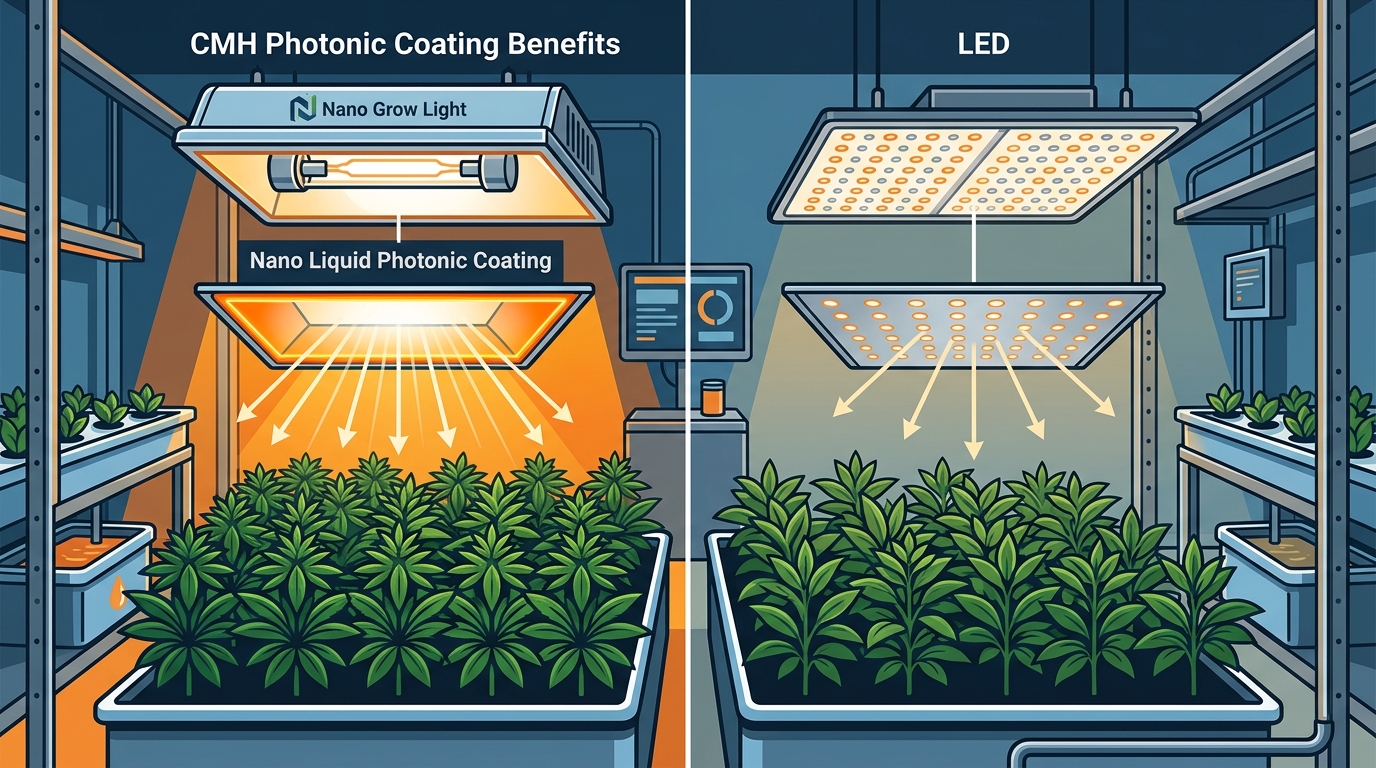
Technical Comparison Summary
| Feature | Nano Grow Light (CMH + Nano Coating) | Standard LED Grow Lights |
|---|---|---|
| Spectral Output | Continuous full-spectrum, no diode gaps | Discrete wavelengths, potential spectral gaps |
| Heat Output | Approx. 340 BTU/hr, 45°C surface temp | Lower heat output, cooler operation |
| PAR Efficiency | High density via Nano Liquid Photonic Coating | Variable, depends on diode quality and driver |
| Best For | Microgreens, African Violets, small spaces | Large commercial grows, heat-sensitive zones |
| Coverage Area | Approx. 3.5 x 3.5 feet per fixture | Variable, often scalable via multiple units |
Key Takeaways
- Nano Grow Light uses a 250W ceramic metal halide (CMH) lamp, not LED, providing a broader spectral distribution than typical LED diodes.
- The Nano Liquid Photonic Coating is a proprietary nano-scale reflector treatment designed to redirect and concentrate light toward the plant canopy.
- According to manufacturer-reported internal testing, NanoGrowLight’s coated reflectors increase reflectance and concentrate more of the fixture’s output onto the grow area.
- Plants can grow up to 1 inch per day, reducing a typical 3-month cycle to as little as 2 months in ideal conditions.
- In real-world use, growers have brought fast-cycling crops like lettuce to harvest in as little as 28 days, based on our own testing across 60+ harvests.
- NanoGrowLight fixtures report approximately 340 BTU/hr of heat output and approximately 45°C surface temperature at steady state.
- A single fixture covers approximately 3.5 by 3.5 feet, making it ideal for small and medium grow spaces.
Frequently Asked Questions
Is Nano Grow Light better than LED for microgreens?
Yes, for many microgreens growers, the Nano Grow Light CMH fixture is superior due to its dense PAR delivery and full-spectrum output. The Nano Liquid Photonic Coating redirects scattered light into a tighter, more usable beam for faster indoor plant growth. This targeted beam delivery improves performance per watt and reduces heat stress on your plants. In trials, lettuce matured in 28 days versus 42 days outdoors.
How does the Nano Liquid Photonic Coating work?
The Nano Liquid Photonic Coating consists of nano-scale clusters, approximately 20 to 80 nanometers in size, applied to the fixture’s reflector. It redirects and concentrates light for denser PAR delivery and reduced scatter. The cured coating measures approximately 2 to 6 microns thick. According to manufacturer-reported internal testing, the coating increases visible-light and PAR reflectance compared to a bare aluminum reflector.
Does the Nano Grow Light get too hot for indoor use?
NanoGrowLight fixtures report approximately 340 BTU/hr of heat output and approximately 45°C surface temperature at steady state. While this is hotter than LED fixtures, it is manageable with proper ventilation. The low-heat operation makes it ideal for shelves, tents, cabinets, and compact indoor grow setups. However, you should position delicate houseplants at a safe distance from the fixture.
Can I use Nano Grow Light for African Violets?
African violets need bright, consistent, full-spectrum light to bloom well indoors. The Nano Grow Light is a 250W ceramic metal halide (CMH) fixture with a Nano Liquid Photonic Coating on its reflector. The company built it with that kind of full-spectrum output in mind. Many hobbyists also pair the fixture with a simple timer to keep a consistent 12- to 14-hour light schedule.
What is the coverage area of a single Nano Grow Light fixture?
A single fixture covers approximately 3.5 by 3.5 feet. For larger grow spaces, customers can choose a single fixture, a 2-pack bundle, or a 3-pack bundle. Larger operations simply scale up by adding more fixtures, rather than switching to one larger unit.
How does CMH compare to LED in terms of spectral purity?
CMH produces a continuous full-spectrum output without diode gaps. This is different from typical LED diodes which can have spectral gaps. The spectral purity from the nano coating sharpens targeted wavelengths, accelerating photosynthesis. This balanced, beam-tightened output supports stronger vegetative growth, sturdier plant structure, and healthy maturity at every stage.
Is the Nano Liquid Photonic Coating durable?
The Nano Liquid Photonic Coating is a next-generation reflector technology designed for long-term performance. It is applied to the fixture’s internal reflector, where it redirects and concentrates light for denser PAR delivery and reduced scatter. The coating is engineered to withstand the thermal environment of the CMH lamp while maintaining its photonic properties.
Start Growing Faster
Whether you are cultivating microgreens, flowering houseplants, or conducting horticultural research, the right lighting technology can significantly impact your results. Nano Grow Light offers a unique combination of CMH spectral purity and nano-enhanced photon efficiency. Explore our Shop Now page to view available fixtures and bundles. For more information on our technology, visit the Nano Liquid Technology page. If you have specific questions about your grow setup, contact our support team via the Contact page. Ready to grow faster? Shop Nano Grow Light today and see the difference for yourself.