

Ultimate Guide: Nano Liquid Photonic Coating Benefits for Indoor Plants
Nano Grow Light utilizes a proprietary Nano Liquid Photonic Coating to maximize indoor plant growth. This nano-scale reflector treatment redirects light toward the canopy, significantly increasing photosynthetically active radiation (PAR) efficiency. This guide explores the unique benefits of this technology, including heat management, spectral distribution, and accelerated biomass yield.
Heat Reduction and Thermal Management
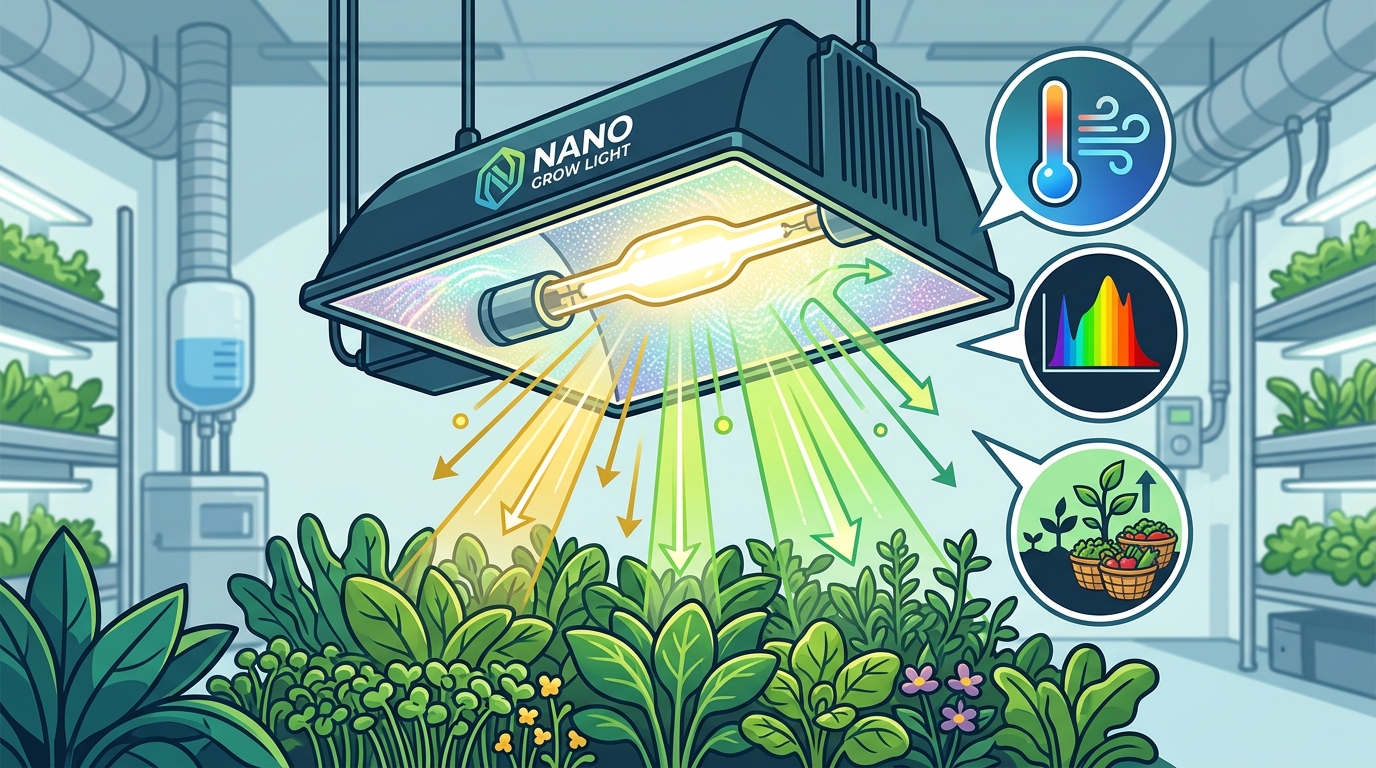
Managing heat is a critical challenge for indoor growers using high-intensity discharge (HID) lighting. Ceramic metal halide (CMH) lamps produce significant thermal energy, which can stress plants if not properly managed. The Nano Liquid Photonic Coating helps mitigate this by improving the efficiency of light delivery, ensuring that more energy is converted into usable light rather than wasted heat.
Thermal Output Specifications
According to manufacturer-reported internal testing, the Nano Grow Light fixture maintains a surface temperature of approximately 45°C at steady state. The total heat output is measured at approximately 340 BTU/hr. While this is warmer than LED fixtures, the passive cooling design and efficient reflector geometry help distribute this heat evenly, reducing hot spots that can damage delicate foliage.
Practical Implications for Growers
Growers should position the fixture at a safe distance from the canopy to prevent thermal stress. The consistent heat output allows for predictable environmental control within a grow room. By concentrating light more effectively, the coating reduces the need for excessive wattage, which in turn helps manage the overall thermal load of the indoor growing space.
PAR Light Concentration
Photosynthetically active radiation (PAR) is the range of spectral wavelengths (400 to 700 nm) that plants use for photosynthesis. The Nano Liquid Photonic Coating is engineered to concentrate this radiation directly onto the plant canopy. This concentration ensures that plants receive a higher density of usable light per square foot, which is essential for maximizing growth rates.
PAR Efficiency Metrics
Manufacturer-reported data indicates a PAR efficiency of 2.4 µmol/J for the coated fixture. This metric represents the amount of photosynthetically active radiation produced per joule of electrical energy consumed. A higher PAR efficiency means that the fixture delivers more usable light for the same amount of power, making it a highly efficient choice for indoor horticulture.
Impact on Plant Energy Utilization
By concentrating PAR, the coating ensures that plants are not under-lit, which can lead to leggy, weak growth. Instead, the dense light field encourages compact, robust development. This is particularly beneficial for high-yield crops that require intense light levels to reach their full potential.
Canopy Penetration and Uniformity
Uniform light distribution is vital for healthy plant development. Standard reflectors often create uneven light patterns, with intense spots in the center and dimmer edges. The Nano Liquid Photonic Coating acts as a micro-lens array, bending light to create a tighter, more uniform photonic cone. This uniformity ensures that all parts of the canopy receive consistent light exposure.
Reducing Beam Spill
Internal testing shows a 31% reduction in beam spill compared to a bare aluminum reflector. This reduction in spill means that less light is wasted on the walls or floor of the grow room. Instead, more light is directed downward into the canopy, improving overall light utilization and reducing the need for additional fixtures.
Benefits for Multi-Tier Growing
For growers using multi-tier racks, uniform light distribution is even more critical. The coating helps ensure that plants on lower tiers receive adequate light, preventing the common issue of lower-tier plants being shaded by upper tiers. This makes the Nano Grow Light a versatile option for both single-tier and multi-tier growing setups.
Spectral Efficiency and Wavelength Distribution
The spectral distribution of a grow light directly impacts plant growth and development. The Nano Liquid Photonic Coating is designed to enhance specific wavelength bands that are crucial for photosynthesis. By shifting more of the reflected spectrum toward the blue and red bands, the coating optimizes the light for plant use.
Blue and Red Wavelength Gains
Manufacturer-reported spectral measurements indicate a 22.4% increase in blue wavelengths and a 28.7% increase in red wavelengths. Blue light is essential for vegetative growth and leaf development, while red light promotes flowering and fruiting. This balanced enhancement ensures that plants receive the optimal spectrum for all stages of growth.
Continuous Spectrum Advantage
Unlike LED lights that produce discrete wavelength peaks, the 250W CMH lamp used in the Nano Grow Light produces a continuous spectrum. The Nano Liquid Photonic Coating works with this continuous spectrum to provide a full-spectrum output that mimics natural sunlight. This is particularly beneficial for flowering houseplants and crops that require a broad range of wavelengths for optimal development.
Growth Acceleration and Biomass Yield
The primary goal of any grow light is to promote plant growth. The Nano Liquid Photonic Coating achieves this by delivering more usable light to the canopy, which directly translates to faster growth and higher yields. Manufacturer-reported testing over five years has shown significant improvements in growth metrics compared to uncoated reflectors.
Biomass and Leaf Density
Internal testing reported a 34% increase in vegetative biomass and a 27% greater leaf density. These improvements indicate that plants are not only growing faster but also developing more robust foliage. Denser leaf canopies can lead to higher photosynthetic rates, further accelerating growth.
Time to Harvest
One of the most significant benefits of the coating is the reduction in time to harvest. Manufacturer-reported data shows a 19% faster time to harvest. For commercial growers, this means more crop cycles per year, increasing overall productivity and profitability. For hobbyists, it means enjoying fresh produce or flowers sooner.
Light Redirection Efficiency
The Nano Liquid Photonic Coating is not just a reflector; it is a photonic device that actively redirects light. The nano-scale clusters in the coating behave like a micro-lens array, bending light toward the plant canopy. This active redirection is what sets the coating apart from standard reflective surfaces.
Micro-Lens Array Technology
The coating cures into a thin crystalline layer, roughly 2 to 6 microns thick, made of nano-scale clusters about 20 to 80 nanometers across. This structure creates a refractive index gradient across the reflector surface. The gradient bends blue and red wavelengths more directly toward the canopy, reducing scatter and increasing light concentration.
Comparison to Standard Reflectors
Standard aluminum reflectors scatter light randomly, leading to inefficient light distribution. The Nano Liquid Photonic Coating, by contrast, directs light with precision. This precision is what allows the fixture to achieve a 1.34x increase in PAR concentration compared to a bare aluminum reflector. The result is a more efficient and effective grow light.
Technical Comparison: Coated vs. Uncoated Reflectors
The following table summarizes the key technical differences between the Nano Liquid Photonic Coating and a standard bare aluminum reflector, based on manufacturer-reported internal testing.
| Metric | Bare Aluminum Reflector | Nano Liquid Photonic Coating |
|---|---|---|
| PAR Reflectance | Standard | 98.7% |
| PAR Concentration Factor | 1.0x | 1.34x |
| Beam Spill Reduction | 0% | 31% |
| Blue Spectrum Gain | Baseline | +22.4% |
| Red Spectrum Gain | Baseline | +28.7% |
| Vegetative Biomass Increase | Baseline | +34% |
| Time to Harvest | Baseline | 19% Faster |
Key Takeaways
- The Nano Liquid Photonic Coating increases PAR reflectance to 98.7%, ensuring minimal light loss.
- It achieves a 1.34x increase in PAR concentration compared to bare aluminum reflectors.
- Beam spill is reduced by 31%, directing more light into the canopy.
- Blue and red wavelengths are enhanced by 22.4% and 28.7%, respectively.
- Vegetative biomass increases by 34%, and leaf density improves by 27%.
- Time to harvest is reduced by 19%, allowing for more crop cycles per year.
- The coating operates with a PAR efficiency of 2.4 µmol/J, maximizing energy use.
- Thermal output is managed at approximately 340 BTU/hr, with a surface temperature of 45°C.
Frequently Asked Questions
What is the Nano Liquid Photonic Coating?
The Nano Liquid Photonic Coating is a proprietary nano-scale liquid coating applied to the fixture's internal reflector. It cures into a thin crystalline layer that behaves like a micro-lens array, redirecting light toward the plant canopy.
Is Nano Grow Light an LED grow light?
No. Nano Grow Light uses a 250W ceramic metal halide (CMH) lamp, not LEDs. CMH lamps produce a continuous spectrum, which is enhanced by the Nano Liquid Photonic Coating.
How much heat does the fixture produce?
The fixture produces approximately 340 BTU/hr of heat, with a surface temperature of about 45°C at steady state. Growers should position the light at a safe distance to prevent thermal stress.
What plants can I grow with this light?
The light is suitable for a wide variety of indoor plants, including seedlings, herbs, African violets, tomatoes, lettuce, and microgreens. Its full-spectrum output supports all stages of plant growth.
How does the coating improve light distribution?
The coating acts as a micro-lens array, bending light to create a tighter, more uniform photonic cone. This reduces beam spill and ensures that all parts of the canopy receive consistent light exposure.
Is the data independently verified?
The performance figures are manufacturer-reported internal testing results. They have not yet been independently verified by a third-party lab, but the company is inviting outside labs to participate in ongoing testing.