
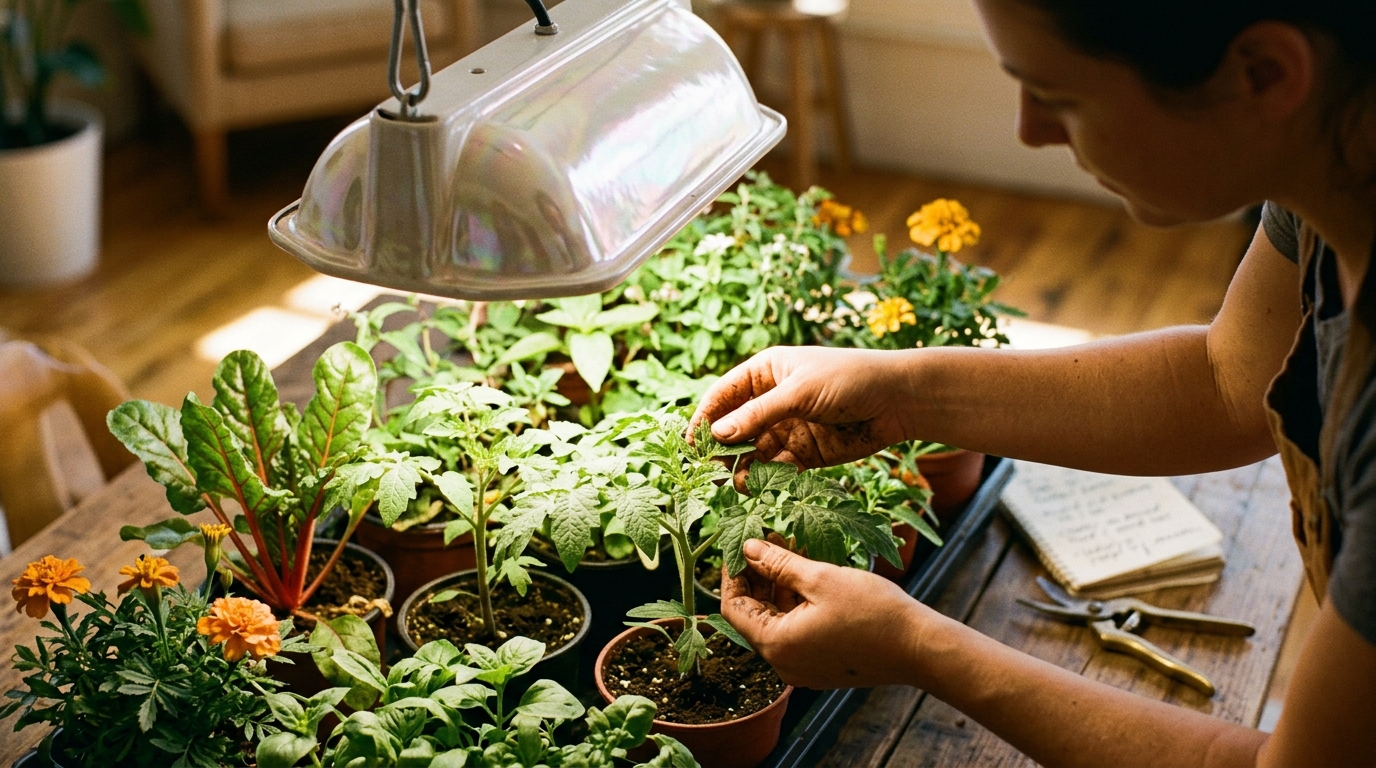
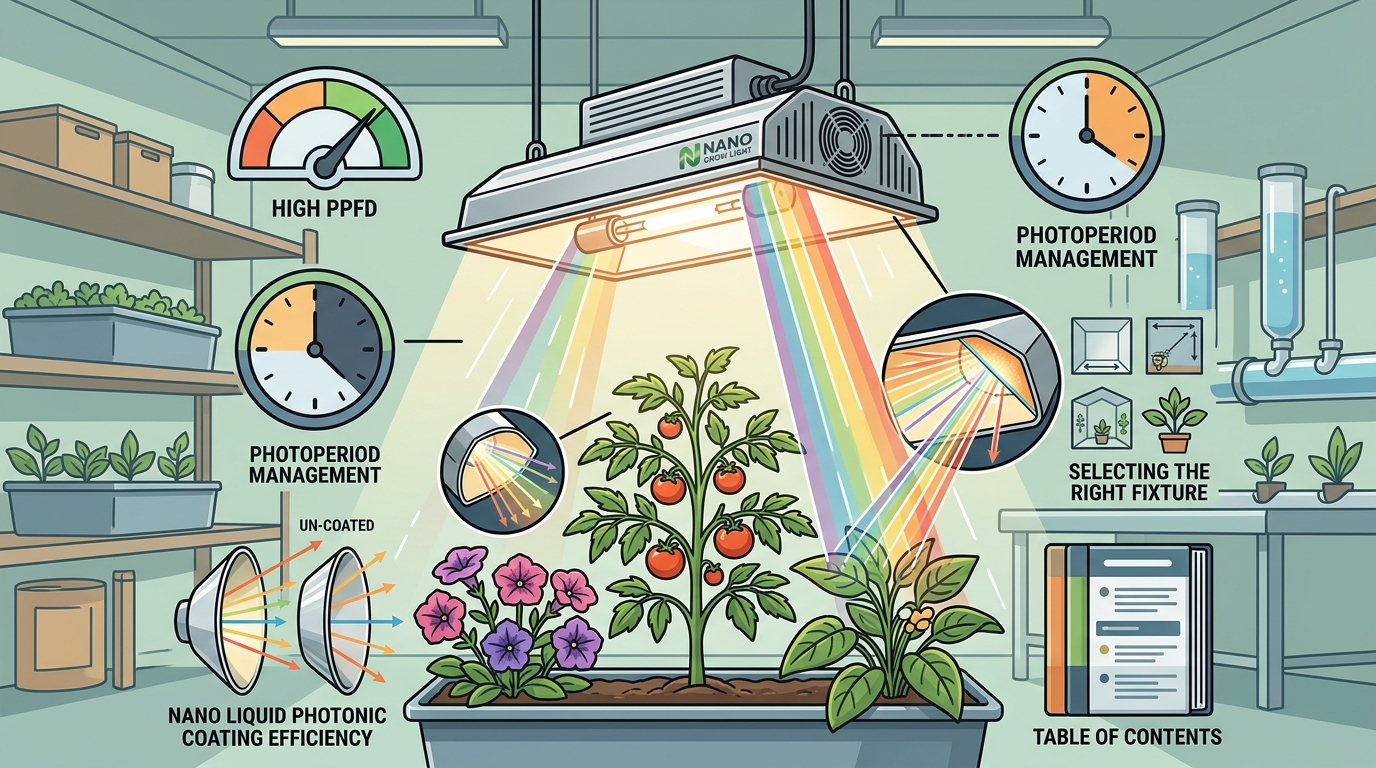
The best indoor grow lights for vegetables and flowers are those that deliver high Photosynthetic Photon Flux Density (PPFD) with a full-spectrum output. Nano Grow Light utilizes a 250W ceramic metal halide (CMH) lamp paired with the Nano Liquid Photonic Coating to maximize light efficiency. This guide covers essential intensity metrics, photoperiod management, and how to select the right fixture for your specific indoor space.
Understanding PPFD and Light Intensity Metrics
Photosynthetic Photon Flux Density (PPFD) is the measurement of the number of photosynthetically active photons hitting a square meter of leaf surface per second. It is the most critical metric for determining if a plant is receiving enough energy to grow. Unlike lumens, which measure visible light to the human eye, PPFD measures the specific wavelengths (400 to 700 nm) that plants actually use for photosynthesis.
For most leafy vegetables and flowering plants, a PPFD of 200 to 400 µmol/m²/s is sufficient for vegetative growth. Flowering crops often require higher intensities, ranging from 400 to 800 µmol/m²/s. The Nano Liquid Photonic Coating spec sheet provides detailed manufacturer-reported data on how the coating affects these metrics. According to internal testing, the fixture achieves a PPFD of 1040 µmol/m²/s at 12 inches and 510 µmol/m²/s at 24 inches.
The Inverse-Square Law
Light intensity follows the inverse-square law, meaning that as distance from the source increases, the intensity drops significantly. Moving a fixture from 12 inches to 24 inches above the canopy reduces the light hitting the leaves to roughly a quarter of its original strength. This physical law is why precise hanging height is more important than the wattage of the bulb itself.
PAR Efficiency
PAR efficiency is the ratio of photosynthetically active radiation output to the electrical energy consumed. A higher efficiency rating means you get more usable light for every watt of electricity. The Nano Grow Light fixture reports a PAR efficiency of 2.38 µmol/J, which is a strong performance for a 250W CMH system. This efficiency is enhanced by the reflector technology that minimizes light spill.
Optimizing Photoperiod and Duration
Photoperiod is the duration of light exposure a plant receives in a 24-hour cycle. Managing this duration is essential for controlling the growth stage of your vegetables and flowers. Most plants require a period of darkness to complete their metabolic processes, such as respiration and nutrient uptake.
For vegetative growth, a photoperiod of 18 hours of light and 6 hours of darkness is standard. This long day length encourages leafy growth and stem development. When you are ready to transition to flowering, you typically reduce the light period to 12 hours and increase the darkness to 12 hours. This change in day length triggers the hormonal shifts necessary for bud and flower development.
Consistency is Key
Plants are sensitive to interruptions in their dark period. Even a small amount of light leaking into the grow space during the dark cycle can confuse the plant's internal clock. This can lead to stress, reduced yields, or a failure to flower. Ensure that your grow space is fully sealed or that the light source is the only illumination during the dark period.
Adjusting for Seasonal Changes
While indoor environments are controlled, some growers adjust photoperiods based on the specific crop. Fast-cycling crops like microgreens may only need 12 to 16 hours of light. Perennial flowers or larger vegetable plants may benefit from the full 18-hour cycle during their growth phase. Consistency in your schedule is more important than the exact number of hours, provided it falls within the optimal range for your crop.
Spectrum Selection for Vegetables and Flowers
Light spectrum is the distribution of different wavelengths of light emitted by a source. Plants primarily use blue and red wavelengths for photosynthesis, but they also benefit from green, far-red, and ultraviolet light. A full-spectrum source provides a continuous range of wavelengths, mimicking natural sunlight more closely than discrete LED peaks.
The 250W ceramic metal halide (CMH) lamp used in the Nano Grow Light produces a continuous spectrum. This is a significant advantage for growing a variety of vegetables and flowers, as it does not require the user to guess which specific wavelengths are needed. The Nano Liquid Photonic Coating is designed to enhance this spectrum by redirecting blue and red wavelengths toward the canopy. Manufacturer-reported data shows a 22.4% increase in blue intensity and a 28.7% increase in red intensity at the reflector exit.
Blue Light for Vegetation
Blue light (400-500 nm) is critical for vegetative growth. It promotes compact, sturdy stems and dense leaf development. Without sufficient blue light, plants may become leggy and weak. The enhanced blue output from the coated reflector helps ensure that your leafy greens and vegetable seedlings develop strong structural integrity.
Red Light for Flowering
Red light (600-700 nm) is the primary driver for flowering and fruiting. It stimulates the production of buds and increases the size of flowers. The CMH lamp provides a strong red content, and the photonic coating further concentrates this energy. This makes the fixture particularly effective for flowering vegetables like peppers, tomatoes, and ornamental flowers.
Fixture Placement and Coverage
Proper placement is as important as the light source itself. The goal is to ensure that the entire canopy receives an even distribution of PPFD. Uneven lighting leads to uneven growth, where plants on the edges of the coverage area receive significantly less light than those in the center.
A single Nano Grow Light fixture covers approximately 3.5 by 3.5 feet. This size is ideal for a standard grow tent or a single shelf in a larger room. For larger spaces, you can scale up by adding more fixtures. The Shop All Grow Lights page offers options for single units, 2-pack bundles, and 3-pack bundles to suit different space requirements.
Hanging Height Recommendations
For CMH fixtures, a hanging height of 18 to 30 inches is generally recommended. This distance provides enough clearance to avoid heat damage while still delivering high intensity. At 18 inches, the fixture provides an average PPFD of 611 µmol/m²/s across a 2x2 ft area. At 24 inches, the average drops to 426 µmol/m²/s. Adjust the height based on the specific needs of your crop and the heat tolerance of your plants.
Heat Management
CMH lamps generate significant heat, with a reported output of approximately 340 BTU/hr. The fixture surface temperature reaches about 45°C at steady state. Proper ventilation is essential to maintain a healthy environment for your plants. Ensure that your grow space has adequate air exchange to remove excess heat and humidity.
Comparing CMH and LED Technologies
Choosing between ceramic metal halide (CMH) and LED lighting depends on your specific goals and constraints. Both technologies have distinct advantages and disadvantages for indoor growing.
| Feature | CMH (Nano Grow Light) | LED |
|---|---|---|
| Spectrum Type | Continuous Full Spectrum | Discrete Peaks |
| PAR Efficiency | 2.38 µmol/J | Varies (typically 2.0-3.0 µmol/J) |
| Heat Output | High (~340 BTU/hr) | Lower |
| Beam Control | Enhanced by Nano Coating | Dependent on Lens Design |
| Lamp Life | 8,000 Hours | 50,000+ Hours |
| Best For | Flowering, Full Spectrum Needs | Energy Efficiency, Long Lifespan |
CMH lamps offer a continuous spectrum that is often preferred for flowering crops. The How it works page explains how the Nano Liquid Photonic Coating improves the performance of this continuous spectrum. LEDs, on the other hand, offer longer lifespans and lower heat output, making them suitable for energy-conscious growers. The choice ultimately depends on whether you prioritize spectrum quality or energy efficiency.
Key Takeaways
- PPFD is the most important metric for measuring light intensity, with 200-400 µmol/m²/s being ideal for vegetative growth.
- The inverse-square law dictates that small changes in hanging height significantly impact light intensity.
- Photoperiod management is essential for controlling growth stages, with 18/6 for veg and 12/12 for flowering.
- Full-spectrum CMH lamps provide a continuous range of wavelengths, which is beneficial for a variety of crops.
- The Nano Liquid Photonic Coating enhances blue and red light delivery, improving efficiency and growth rates.
- Proper placement and heat management are critical for maintaining a healthy indoor grow environment.
- Scaling up with multiple fixtures is a practical approach for covering larger grow spaces.
Frequently Asked Questions
What is the best light intensity for indoor vegetables?
For most indoor vegetables, a PPFD of 200 to 400 µmol/m²/s is sufficient for vegetative growth. Flowering vegetables may require higher intensities, up to 800 µmol/m²/s. The Nano Grow Light provides these levels at various hanging heights.
How does the Nano Liquid Photonic Coating work?
The coating is a nano-scale treatment applied to the reflector. It creates a refractive index gradient that bends blue and red wavelengths toward the plant canopy, reducing scatter and increasing usable light.
Can I use a CMH light for microgreens?
Yes, CMH lights are effective for microgreens. The concentrated light and full spectrum support fast, dense growth. The Growing Microgreens page provides specific guidance for this crop.
How far should I hang a 250W CMH light?
A hanging height of 18 to 30 inches is recommended for 250W CMH fixtures. This distance balances light intensity with heat management, preventing leaf scorch while delivering adequate PPFD.
What is the difference between PPFD and PPF?
PPF (Photosynthetic Photon Flux) is the total number of photons emitted by the light source per second. PPFD is the density of those photons hitting a specific area. PPFD is the more relevant metric for plant growth.
Do I need a timer for my grow light?
Yes, a timer is essential for managing photoperiod. It ensures that your plants receive consistent light and dark cycles, which is critical for their development and flowering.
Is the Nano Grow Light suitable for commercial use?
The fixture is designed for home growers and small-scale cultivators. For larger commercial operations, you can scale up by using multiple fixtures. The About NanoGrowLight page discusses the company's focus on various grow scales.
Final Thoughts
Selecting the right grow light for your indoor vegetables and flowers requires a balance of intensity, spectrum, and duration. By understanding metrics like PPFD and managing your photoperiod, you can create an optimal environment for plant growth. The Nano Grow Light offers a robust solution with its 250W CMH lamp and advanced reflector technology. Explore the Shop All Grow Lights page to find the configuration that best fits your space and needs.