
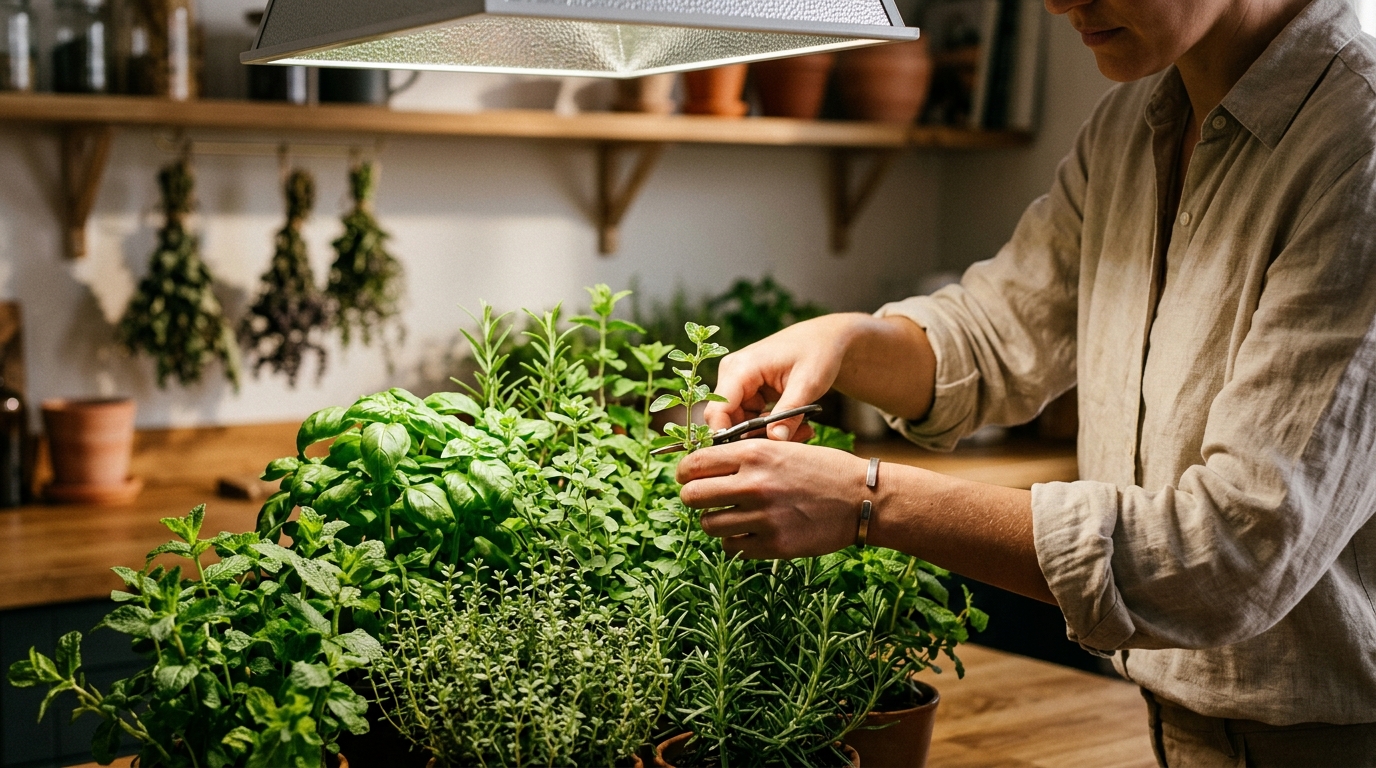
The best grow light for growing herbs indoors is a full-spectrum fixture that delivers consistent photosynthetically active radiation (PAR) without generating excessive heat. For most home growers, the Nano Grow Light 250W CMH fixture offers the ideal balance of spectral quality and canopy coverage. This guide covers the specific light models, herb varieties, and setup strategies needed to maximize your indoor harvest.
Recommended Light Models for Indoor Herbs
Choosing the right fixture depends on your space and the specific needs of your plants. While many growers default to LED panels, the Nano Grow Light 250W CMH provides a continuous spectrum that is highly effective for leafy greens. The fixture uses a Philips MasterColor 250W/830 lamp, which produces a warm-white light with strong red content and moderate blue. This spectral profile is critical for the vegetative growth of herbs like basil and cilantro.
Why Ceramic Metal Halide (CMH)?
Ceramic Metal Halide (CMH) is a type of high-intensity discharge lamp that produces a continuous spectrum rather than the discrete peaks of LED diodes. This continuity ensures that all wavelengths required for photosynthesis are present in a natural ratio. The Nano Grow Light pairs this lamp with a proprietary reflector to maximize the efficiency of that light output.
The Role of the Nano Liquid Photonic Coating
The core differentiator in this fixture is the Nano Liquid Photonic Coating. This nano-scale treatment is applied to the reflector and bulb surface. It functions as a micro-lens array that redirects stray photons back toward the plant canopy. According to manufacturer-reported internal testing, this coating increases PAR concentration by a factor of 1.34x compared to a standard bare aluminum reflector.
Specific Herb Varieties and Their Light Needs
Not all herbs require the same light intensity or duration. Understanding the specific needs of your crop allows you to fine-tune your setup for the best results. The following varieties are the most common for indoor cultivation and respond well to the full-spectrum output of the Nano Grow Light.
Fast-Cycling Herbs: Basil and Cilantro
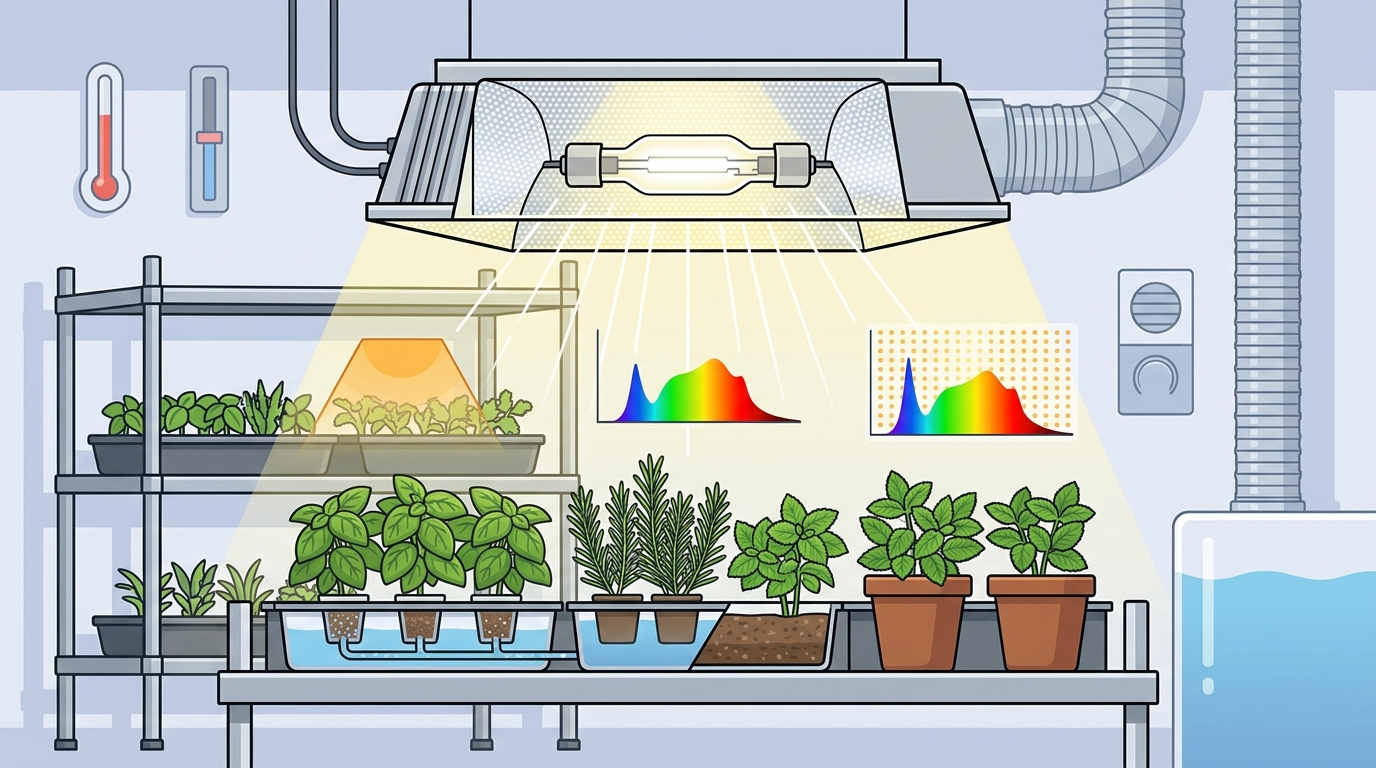
Basil and cilantro are fast-growing and benefit from high light intensity. In our own grow trials, a head of lettuce reached maturity in 28 days under the Nano Grow Light. While basil is not a head crop, it shares similar light requirements. These herbs thrive when the light is positioned close to the canopy, taking advantage of the 1040 µmol/m²/s PPFD measured at 12 inches.
Delicate Herbs: Chives and Parsley
Chives and parsley are more sensitive to heat and light stress. Because the Nano Grow Light is a CMH fixture, it generates more heat than an LED. For these delicate varieties, you should increase the hanging height to 18 or 24 inches. At 18 inches, the fixture delivers 720 µmol/m²/s, which is sufficient for healthy growth without the risk of leaf scorch.
Flowering Herbs: Oregano and Thyme
Herbs that produce flowers, such as oregano and thyme, require a shift in their light environment to trigger blooming. The Nano Liquid Photonic Coating shifts more of the reflected spectrum toward the red wavelength bands. This spectral shift can help encourage flowering in these varieties when the light schedule is adjusted to a shorter photoperiod.
Optimizing Light Schedules for Maximum Yield
Light intensity is only half the equation; duration is the other. A consistent light schedule is essential for regulating the plant's internal clock and promoting steady growth. For most herbs, a 14 to 16-hour light period is the standard recommendation.
Vegetative Growth Phase
During the vegetative phase, herbs need long days to build leaf mass. A 16-hour light and 8-hour dark cycle is ideal for basil, mint, and cilantro. Using a simple timer ensures that the plants receive this consistent schedule every day, which reduces stress and promotes uniform growth.
Flowering and Maturation Phase
When you want to encourage flowering in herbs like oregano or thyme, you should reduce the light period to 12 hours. This shorter photoperiod signals to the plant that it is time to reproduce. The full-spectrum nature of the CMH lamp ensures that the plants receive the necessary red and far-red wavelengths to complete this transition.
Managing Heat and Distance
One of the primary challenges with using a CMH light for indoor herbs is heat management. The Nano Grow Light reports a surface temperature of approximately 45°C at steady state and a heat output of 340 BTU/hr. This heat is a byproduct of the arc tube technology and must be managed to prevent plant stress.
Safe Hanging Heights
For heat-sensitive herbs, you should hang the light at a minimum of 18 inches above the canopy. At this distance, the light intensity is still high enough for growth, but the heat is dissipated more effectively. If you are growing heat-tolerant herbs like basil, you can move the light closer to 12 inches to maximize the PAR delivery.
Ventilation and Airflow
Good airflow is critical when using a CMH fixture. The heat generated by the lamp can raise the ambient temperature in a small grow tent or room. Ensure that you have adequate ventilation to move air across the canopy and out of the space. This not only manages heat but also strengthens the stems of your herbs.
Model Comparison Table
The following table summarizes the key specifications of the Nano Grow Light and how they compare to standard reflector setups. These figures are based on manufacturer-reported internal testing.
| Feature | Nano Grow Light (Coated) | Standard CMH (Bare Aluminum) |
|---|---|---|
| PAR Reflectance | 98.7% | ~85-90% |
| PPFD at 12in | 1040 µmol/m²/s | ~775 µmol/m²/s |
| PPFD at 18in | 720 µmol/m²/s | ~537 µmol/m²/s |
| Beam Spill Reduction | 31% reduction | Baseline |
| Blue Spectrum Gain | +22.4% | 0% |
| Red Spectrum Gain | +28.7% | 0% |
Key Takeaways
- The Nano Grow Light 250W CMH is an excellent choice for indoor herbs due to its full-spectrum output and high PAR efficiency.
- The Nano Liquid Photonic Coating increases PAR concentration by 1.34x, ensuring more light reaches the plant canopy.
- Fast-cycling herbs like basil and cilantro benefit from close hanging heights (12 inches) and long light schedules (16 hours).
- Delicate herbs like chives and parsley require greater hanging distances (18-24 inches) to manage heat stress.
- Flowering herbs like oregano and thyme respond well to the red spectrum shift provided by the coated reflector.
- Always use a timer to maintain a consistent light schedule, which is critical for regulating plant growth cycles.
- Proper ventilation is essential when using CMH lights to manage the 340 BTU/hr heat output.
Frequently Asked Questions
Is the Nano Grow Light suitable for all types of herbs?
Yes, the full-spectrum output of the 250W CMH lamp is suitable for a wide variety of herbs. You can adjust the hanging height and light schedule to accommodate the specific needs of delicate or heat-tolerant varieties.
How much heat does the Nano Grow Light produce?
The fixture produces approximately 340 BTU/hr of heat and reaches a surface temperature of 45°C at steady state. This is normal for CMH technology and should be managed with proper ventilation and hanging distance.
What is the PAR efficiency of the Nano Grow Light?
The manufacturer-reported PAR efficiency is 2.4 µmol/J. This high efficiency is a result of the Nano Liquid Photonic Coating, which reduces light scatter and directs more usable light toward the canopy.
Can I use the Nano Grow Light for microgreens?
Yes, the fixture is well-suited for microgreens. The concentrated PAR delivery is ideal for densely planted trays. Manufacturer-reported testing showed a 34% increase in vegetative biomass and a 19% faster time to harvest for general crops.
How long does the CMH lamp last?
The Philips MasterColor 250W/830 lamp has a rated life of 8,000 hours. This is a standard lifespan for high-quality CMH lamps and should provide several years of use under typical indoor growing conditions.
Do I need a ballast for the Nano Grow Light?
No, the fixture comes with a built-in ballast. You simply need to connect the fixture to a standard power outlet. The enclosed design and passive cooling system make it easy to install and maintain.
Final Thoughts
Choosing the right grow light is the most important step in successful indoor herb cultivation. The Nano Grow Light offers a powerful combination of full-spectrum lighting and advanced reflector technology. By understanding the specific needs of your herbs and managing the heat output of the CMH fixture, you can achieve faster growth and higher yields in your home garden. For more detailed technical specifications, you can review the Nano Liquid Photonic Coating Spec Sheet to see the full range of performance data.