
Which Grow Light Is Best for Growing Microgreens at Home?
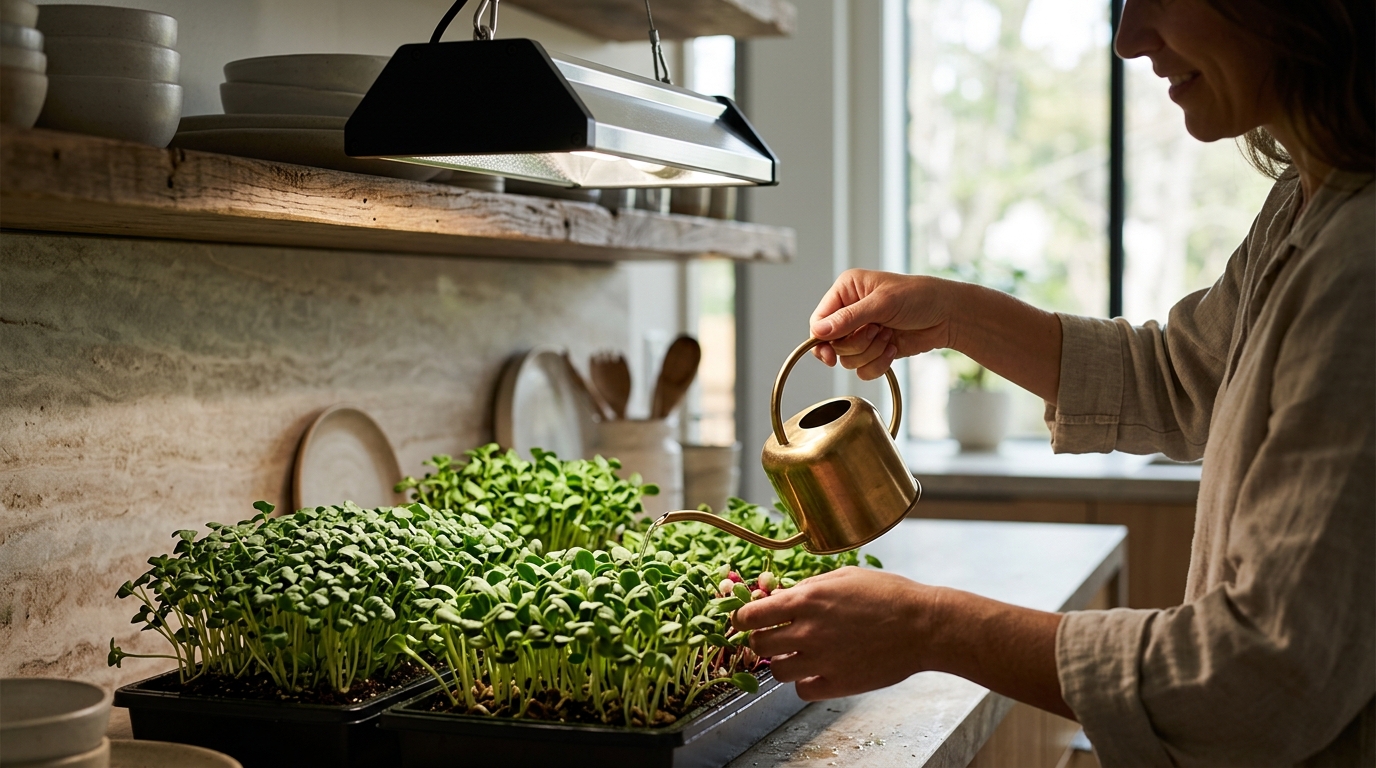
The best grow light for home microgreens is a fixture that delivers high, even light intensity close to the canopy without excessive heat. For most home growers, a compact LED or a 250W ceramic metal halide (CMH) fixture like the Nano Grow Light offers the ideal balance of spectral quality and efficiency. This guide covers the critical factors of mounting height and daily photoperiod to help you optimize your setup for faster, denser harvests.
Choosing the Right Lighting Technology
Microgreens are fast-cycling crops that require a high density of light to prevent etiolation, which is the process where plants stretch and become leggy due to insufficient light. The two primary technologies for home growing are LED and CMH. LED fixtures are highly efficient and run cool, allowing them to be placed very close to the seedlings. In contrast, CMH fixtures produce a continuous spectrum that is often preferred for its full-spectrum quality, though they generate more heat.
The Nano Liquid Photonic Coating technology used in our fixtures is designed to address the heat and efficiency challenges of CMH lighting. By applying a nano-scale crystalline layer to the reflector, the fixture redirects stray photons and concentrates photosynthetically active radiation (PAR) directly toward the canopy. This results in a tighter beam spread and higher light density at the plant level, which is critical for the dense trays typical of microgreen growing.
Spectral Quality and Plant Response
Plants use different wavelengths for different growth stages. Blue light (400-500nm) supports compact leaf development, while red light (600-700nm) drives flowering and fruiting. For microgreens, a balanced full-spectrum output is generally superior to narrow-band lights because it supports the entire life cycle from germination to harvest. Research indicates that the interaction between light intensity and quality significantly impacts the nutritional value and growth rate of these crops.
Optimizing Mounting Height for Canopy Density
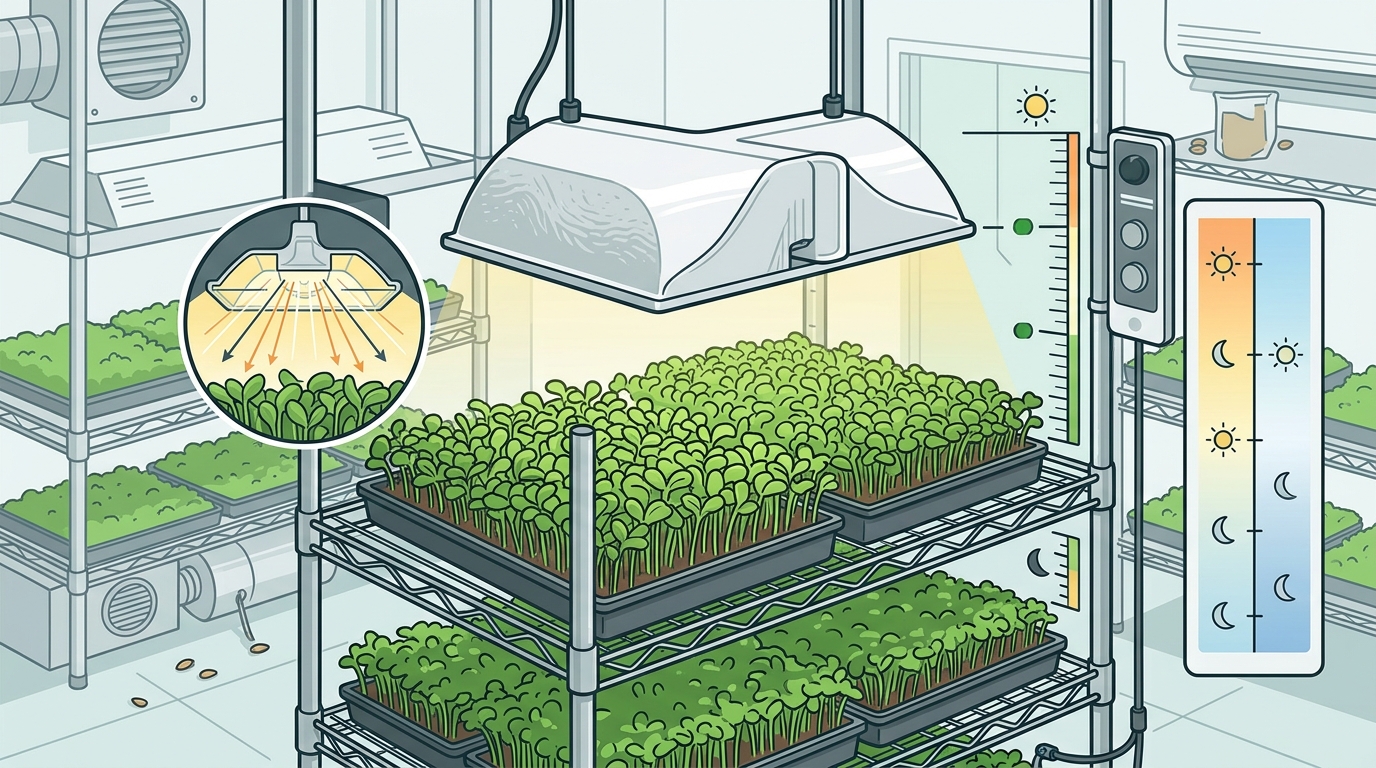
Mounting height is the most common mistake home growers make. If the light is too high, the microgreens will stretch toward the source, resulting in weak stems and poor yields. If it is too low, the leaves can scorch, particularly with higher-intensity fixtures. The goal is to maintain a consistent Photosynthetic Photon Flux Density (PPFD) across the entire tray.
For a 250W CMH fixture like the Nano Grow Light, the effective coverage area is approximately 3.5 by 3.5 feet. Manufacturer-reported internal testing shows that at a 12-inch hanging height, the fixture delivers a center PPFD of 1040 µmol/m²/s. At 18 inches, this drops to 720 µmol/m²/s. For most microgreen varieties, a PPFD range of 300 to 500 µmol/m²/s is ideal during the early stages, increasing to 600-900 µmol/m²/s as the canopy thickens.
Managing Heat and Airflow
Because CMH lamps run hotter than LEDs, you must account for the thermal output when determining height. The Nano Grow Light fixture has a surface temperature of approximately 45°C at steady state. To prevent heat stress, ensure there is adequate airflow around the tray. If you are using a smaller tray, you may need to hang the fixture slightly higher than the 12-inch mark to keep the canopy temperature within a safe range.
Setting the Ideal Daily Photoperiod
The daily photoperiod, or the number of hours the light is on each day, determines the total Daily Light Integral (DLI) the plants receive. DLI is the total amount of light energy a plant receives over a 24-hour period. For microgreens, a higher DLI generally leads to faster harvest times and higher nutritional density.
Most home growers start with a 12 to 14-hour photoperiod. However, because microgreens are harvested quickly, often within 7 to 14 days, extending the photoperiod to 16 or 18 hours can significantly accelerate growth. A study on broccoli microgreens found that continuous or near-continuous lighting can enhance yield and nutritional value, though it requires careful monitoring of temperature and humidity to prevent mold.
Using Timers for Consistency
Consistency is key to successful microgreen production. Use a digital timer to ensure the light turns on and off at the same time every day. This mimics the natural rhythm of the sun and helps regulate the plant's internal clock. For the Nano Grow Light, which uses a CMH lamp, remember that the bulb takes a few minutes to reach full brightness and requires a short cool-down period before it can be restarted. Therefore, avoid frequent on/off cycles during the day.
LED vs. CMH for Microgreens
Choosing between LED and CMH depends on your specific space and goals. The following table summarizes the key differences relevant to microgreen cultivation.
| Feature | LED Grow Light | CMH Grow Light (Nano Grow Light) |
|---|---|---|
| Heat Output | Low | Moderate (approx. 340 BTU/hr) |
| Spectrum Type | Discrete wavelength peaks | Continuous full spectrum |
| Recommended Hanging Height | 2-6 inches | 12-18 inches |
| Efficiency (PPF/Watt) | High | Moderate (2.38 µmol/J) |
| Best For | Small tents, low heat spaces | Full-spectrum quality, dense canopies |
The Nano Liquid Photonic Coating helps bridge the gap between these two technologies by improving the PAR efficiency of the CMH lamp. This allows the fixture to deliver more usable light to the canopy without increasing the wattage or heat output significantly.
Key Takeaways
- Microgreens require high light intensity to prevent stretching and ensure strong stems.
- Mounting height should be adjusted based on the specific PPFD requirements of your crop.
- For the Nano Grow Light, a 12-18 inch hanging height is typically effective for standard trays.
- A photoperiod of 14-18 hours can significantly reduce time to harvest.
- CMH fixtures provide a continuous spectrum that is beneficial for full-spectrum growth.
- Always monitor canopy temperature to prevent heat stress, especially with CMH lamps.
- Use a timer to maintain a consistent daily light schedule for optimal plant development.
- The Nano Liquid Photonic Coating improves light distribution and reduces beam spill.
Frequently Asked Questions
What is the best hanging height for microgreens under a CMH light?
For a 250W CMH fixture, start at 18 inches and adjust down to 12 inches as the canopy thickens. Monitor the plants for signs of stretching or scorching to find the optimal height for your specific variety.
How many hours a day should I run my grow light for microgreens?
A photoperiod of 14 to 18 hours is ideal for maximizing growth speed. Some growers use 24-hour lighting, but this requires careful temperature management to prevent mold and heat stress.
Does the Nano Grow Light run too hot for small spaces?
The fixture has a surface temperature of approximately 45°C. While it runs warmer than LEDs, the passive cooling design and the Nano Liquid Photonic Coating help manage heat distribution. Ensure adequate airflow in your grow space.
Can I use the Nano Grow Light for other plants besides microgreens?
Yes, the full-spectrum CMH output is suitable for a wide range of indoor plants, including herbs, African violets, and leafy greens. The fixture covers an effective area of 3.5 by 3.5 feet.
What is the difference between PPFD and DLI?
PPFD measures the intensity of light at a specific point in time, while DLI measures the total amount of light energy received over a 24-hour period. Both are important for optimizing plant growth.
How long does it take to grow microgreens under the Nano Grow Light?
Harvest time varies by variety, but most microgreens are ready in 7 to 14 days. In internal testing, lettuce reached maturity in 28 days under the fixture, though microgreens are typically harvested much earlier.
Final Thoughts
Selecting the right grow light for microgreens comes down to balancing light intensity, spectrum quality, and heat management. The Nano Grow Light offers a robust solution for home growers who want the benefits of a continuous full-spectrum CMH lamp with the efficiency of modern photonic technology. By optimizing your mounting height and daily photoperiod, you can achieve faster, denser, and more nutritious harvests. For more detailed technical specifications, visit the Nano Liquid Photonic Coating Spec Sheet to see the full performance data.