
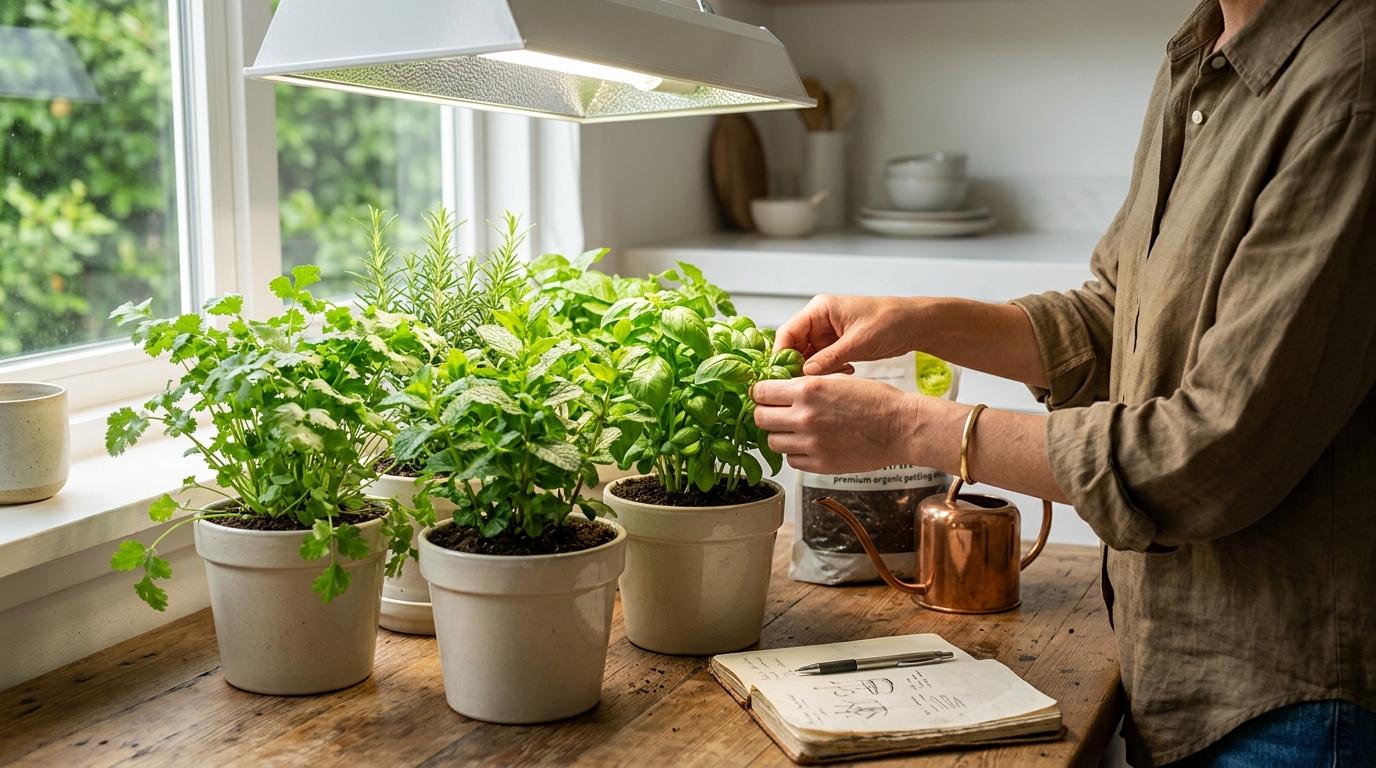
For indoor herb gardening, the best grow light models are those that deliver high photosynthetically active radiation (PAR) with a full-spectrum output. Nano Grow Light stands out as a top choice because it uses a 250W ceramic metal halide (CMH) lamp paired with a proprietary nano-scale reflector coating. This combination ensures that more usable light reaches the plant canopy, which is critical for the rapid growth of leafy herbs like basil, mint, and cilantro.
Spectral Requirements for Leafy Herbs
Herbs are primarily grown for their leaves, which means they require a light spectrum that supports strong vegetative growth. Photosynthetically active radiation (PAR) is the range of light wavelengths that plants use for photosynthesis, typically spanning from 400 to 700 nanometers. While many LED grow lights use discrete peaks in the blue and red spectra, a full-spectrum source often provides a more natural environment for delicate herb foliage.
The Nano Liquid Photonic Coating is specifically engineered to enhance the blue and red wavelength bands. According to manufacturer-reported internal testing, the coating increases blue spectrum intensity by 22.4% and red spectrum intensity by 28.7%. This spectral shift is beneficial for herbs because blue light promotes compact, bushy growth, while red light supports overall biomass production. By concentrating these wavelengths, the fixture helps prevent the leggy, stretched growth that often occurs when herbs are under-lit.
The Advantage of Ceramic Metal Halide Technology
Many indoor gardeners assume that LED is the only modern option, but ceramic metal halide (CMH) is a high-intensity discharge (HID) lamp that offers a continuous, full-spectrum output. Unlike LEDs, which emit specific wavelengths, CMH lamps produce a smooth spectrum that closely mimics natural sunlight. This is particularly important for herbs, which can be sensitive to the spectral gaps found in some lower-quality LED fixtures.
The Nano Grow Light uses a 250W Philips Mastercolor 830 CMH lamp, which is known for its high color rendering index and stable arc tube. The fixture is designed to cover an effective footprint of approximately 3.5 by 3.5 feet. For a small herb garden on a kitchen shelf or a single grow tent, this coverage area is ideal. The continuous spectrum of the CMH lamp, combined with the reflector technology, ensures that the light is not only bright but also spectrally balanced for healthy leaf development.
Reflector Efficiency and Light Concentration
The efficiency of a grow light is not just about the lamp; it is also about how well the fixture directs that light. Reflector efficiency is the percentage of light emitted by the lamp that is successfully directed toward the plant canopy. Standard bare aluminum reflectors often lose a significant amount of light to scatter and absorption, which reduces the overall PAR reaching the plants.
Nano Grow Light addresses this issue with its proprietary Nano Liquid Photonic Coating. This coating cures into a thin crystalline layer, roughly 2 to 6 microns thick, made of nano-scale clusters. These clusters function like a micro-lens array, bending light toward the canopy and reducing diffuse scatter. Manufacturer-reported data indicates a PAR concentration factor of 1.34x compared to an uncoated reflector. This means that for every watt of electricity consumed, the Nano Grow Light delivers more usable light to the herbs, resulting in faster growth and higher yields without increasing energy costs.
Thermal Management in Small Spaces
One of the primary concerns with high-intensity discharge lights is heat. Thermal management is the process of controlling the temperature of the grow light and the surrounding environment to prevent plant stress. CMH lamps run hotter than LED fixtures, so proper placement and ventilation are essential for indoor herb gardening.
The Nano Grow Light fixture reports a surface temperature of approximately 45°C at steady state and a heat output of about 340 BTU/hr. While this is manageable, it is important to position the light at a safe distance from delicate herb leaves. For most herbs, a hanging height of 12 to 18 inches is recommended. At 12 inches, the fixture delivers a center PPFD of 1040 µmol/m²/s, which is ideal for vigorous growth. At 18 inches, the PPFD drops to 720 µmol/m²/s, which is suitable for more sensitive herbs or for maintaining a larger canopy. Growers should monitor their plants for signs of heat stress, such as yellowing or curling leaves, and adjust the hanging height accordingly.
Scaling Coverage for Larger Herb Gardens
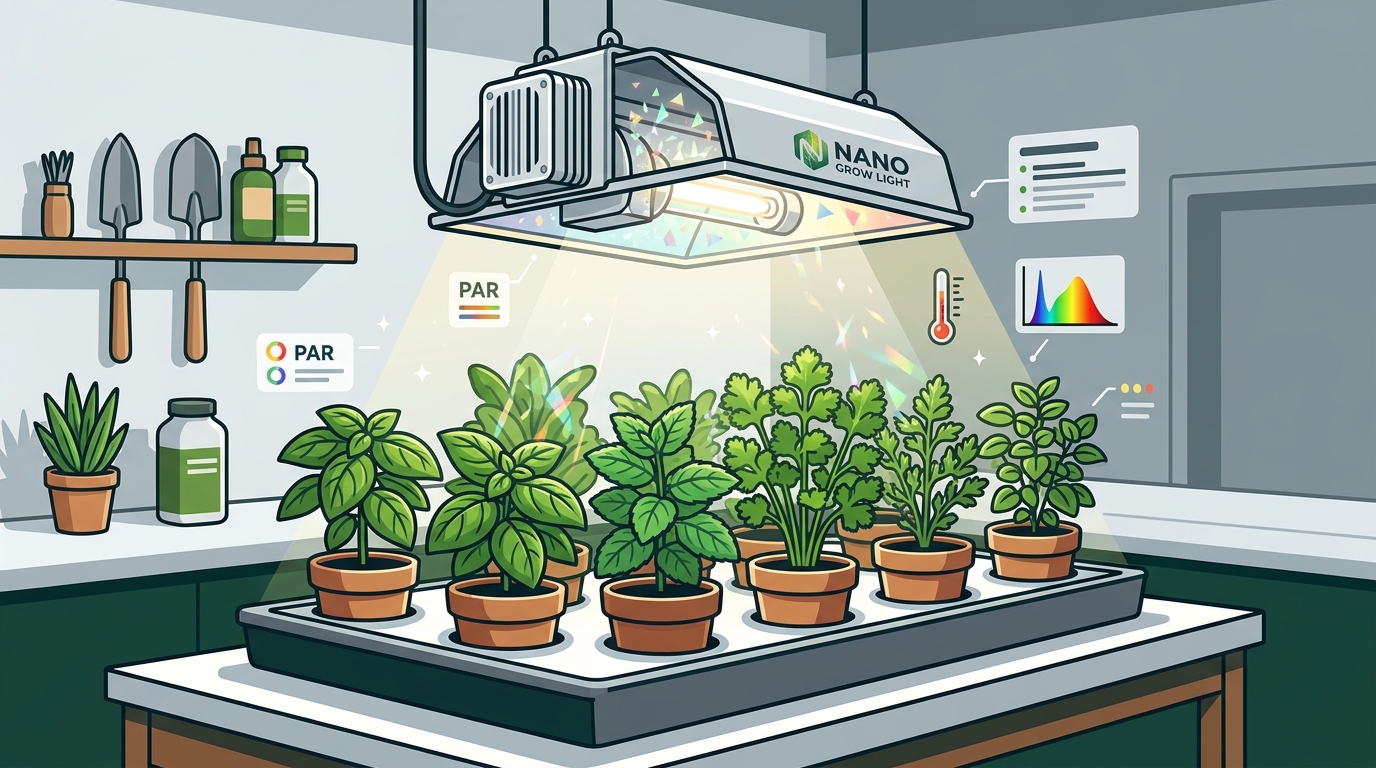
As your herb garden grows, you may need to expand your lighting setup. The Nano Grow Light is designed to be modular, allowing growers to scale their coverage by adding more fixtures. A single fixture covers approximately 3.5 by 3.5 feet, but you can array multiple fixtures across rows, multi-tier racks, or bays to extend coverage for larger indoor growing operations.
For a small kitchen garden, a single Nano Grow Light is sufficient. However, if you are growing herbs in a dedicated grow room or a commercial greenhouse, you can use the 2-pack or 3-pack bundles to cover a wider area. This modular approach allows you to start small and expand as needed, without having to replace your entire lighting system. The consistent output and spectral quality of the CMH lamp ensure that all your herbs receive the same high-quality light, regardless of how many fixtures you use.
Key Takeaways
- Full-spectrum output is essential for healthy herb growth, and CMH lamps provide a continuous spectrum that mimics natural sunlight.
- Reflector efficiency plays a critical role in light delivery, and the Nano Liquid Photonic Coating increases PAR concentration by 1.34x.
- Thermal management is important when using CMH lights, and a hanging height of 12 to 18 inches is recommended for most herbs.
- Modular scaling allows you to expand your herb garden by adding more fixtures, making it a flexible solution for both small and large operations.
- Manufacturer-reported data shows that the Nano Grow Light delivers a center PPFD of 1040 µmol/m²/s at 12 inches, which is ideal for vigorous herb growth.
Frequently Asked Questions
Is Nano Grow Light an LED grow light?
No. Nano Grow Light uses a 250W ceramic metal halide (CMH) lamp, not LEDs. CMH lamps produce a continuous spectrum rather than the discrete wavelength peaks typical of LED diodes.
What plants can I grow with Nano Grow Light?
Nano Grow Light works well for seedlings, herbs, African violets, tomatoes, lettuce, and microgreens, among many other indoor plants.
Does Nano Grow Light run hot?
Yes, like other ceramic metal halide fixtures, Nano Grow Light runs warmer than an LED fixture of similar wattage. It reports a surface temperature of approximately 45°C at steady state.
How much area does one Nano Grow Light cover?
A single fixture covers an effective footprint of approximately 3.5 by 3.5 feet. You can scale coverage for larger spaces by adding more fixtures.
What is the PAR efficiency of the Nano Grow Light?
The PAR efficiency is 2.38 µmol/J, according to manufacturer-reported internal testing. This indicates how efficiently the fixture converts electrical energy into usable light for plants.