
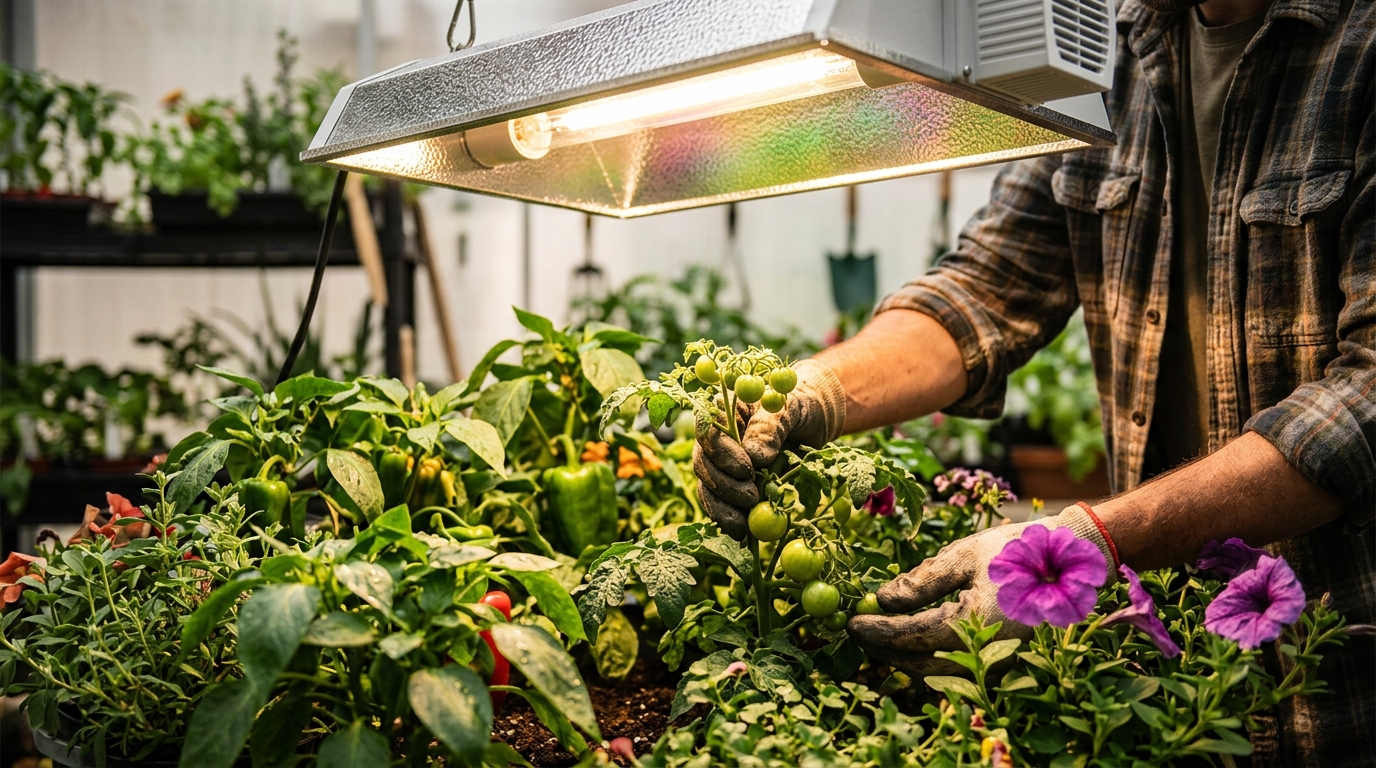
The best indoor grow lights for vegetables and flowers are those that deliver high Photosynthetically Active Radiation (PAR) density with a continuous spectrum. Nano Grow Light utilizes a 250W ceramic metal halide (CMH) lamp paired with a proprietary Nano Liquid Photonic Coating to maximize light efficiency. This guide covers essential light intensity metrics, optimal photoperiods, and how to select the right fixture for your specific indoor growing needs.
PPFD and Light Intensity Metrics
Understanding how to measure light is the first step to successful indoor gardening. Photosynthetically Active Radiation (PAR) is the range of wavelengths, from 400 to 700 nanometers, that plants use for photosynthesis. While PAR defines the usable spectrum, Photosynthetic Photon Flux Density (PPFD) is the actual amount of that light reaching the plant canopy per square meter per second.
Growers often confuse lumens with PPFD. Lumens measure human-perceived brightness, whereas PPFD measures the photon density that drives plant growth. For most leafy vegetables and flowering houseplants, a PPFD of 200 to 400 micromoles per square meter per second is ideal during the vegetative stage. As plants mature and begin to flower, they typically require higher intensities, often between 400 and 800 micromoles per square meter per second.
Manufacturer-Reported Performance Data
The Nano Liquid Photonic Coating is designed to concentrate this light more effectively than standard reflectors. According to manufacturer-reported internal testing, the fixture delivers a PPFD of 1040 micromoles per square meter per second at a 12-inch distance. At 18 inches, the density drops to 720 micromoles per square meter per second, and at 24 inches, it reaches 510 micromoles per square meter per second. These figures indicate that the fixture provides ample intensity for both dense vegetable canopies and delicate flowering plants when positioned correctly.
Beam Spread and Uniformity
Light intensity is not just about peak power; it is also about how evenly that power is distributed. Standard aluminum reflectors often scatter light, creating hot spots and dim edges. The Nano Liquid Photonic Coating reduces beam spill by 31% compared to bare aluminum reflectors. This creates a tighter, more uniform photonic cone, ensuring that plants at the edges of the grow area receive sufficient light without being scorched by the center.
Photoperiod Duration and Timing
Photoperiod is the daily cycle of light and darkness that plants experience. This cycle is a critical environmental cue that dictates whether a plant remains in a vegetative growth phase or transitions into flowering. For most short-day plants, such as many ornamental flowers and certain vegetables, a photoperiod of 12 to 14 hours of light followed by 10 to 12 hours of complete darkness is standard.
Long-day plants, including many leafy greens and herbs, often thrive under 16 to 18 hours of light. It is essential to maintain a consistent schedule. Plants are sensitive to interruptions in their dark period. Even a small amount of stray light during the dark cycle can confuse the plant's internal clock, potentially delaying flowering or reducing yield.
Optimizing Energy Efficiency
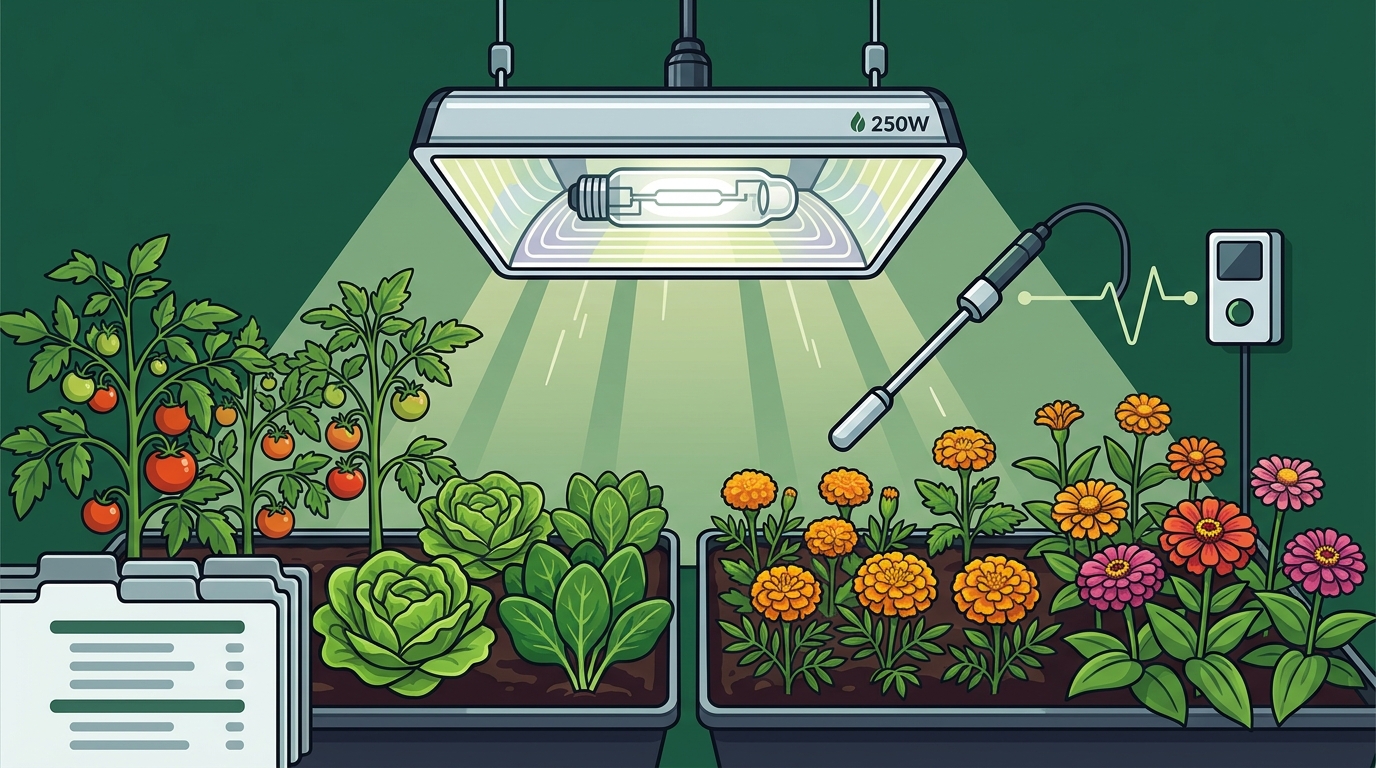
When managing photoperiods, energy consumption is a key consideration. Ceramic metal halide lamps, like the 250W unit used in the Nano Grow Light, are highly efficient. They produce a continuous spectrum that is well-suited for long photoperiods without the spectral gaps often found in cheaper LED alternatives. By using a high-efficiency fixture, growers can run longer light cycles without a proportional increase in energy costs.
Automating the Cycle
Manual switching is prone to error. Using a digital timer is the best practice for maintaining a consistent photoperiod. Set the timer to turn the light on and off at the same time every day. This consistency helps plants establish a stable growth rhythm, leading to more predictable harvest times and healthier foliage.
Light Spectrum and Quality
The quality of light is defined by its spectral distribution. A full-spectrum light source emits a continuous range of wavelengths, mimicking natural sunlight. This is distinct from discrete-spectrum lights, which emit specific peaks of blue and red light. For vegetables and flowers, a continuous spectrum is generally preferred because it supports all stages of plant development, from root growth to fruit ripening. according to LED Grow Lights
The Philips MasterColor 250W/830 CMH lamp used in the Nano Grow Light fixture provides a warm-white spectrum with strong red content and moderate blue. This balance is ideal for promoting both vegetative growth and flowering. The Nano Liquid Photonic Coating further enhances this spectrum by shifting more of the reflected light toward the blue and red bands used in photosynthesis.
Spectral Shifts and Plant Response
Manufacturer-reported spectral measurements indicate that the nano-coated reflector increases blue wavelengths by 22.4% and red wavelengths by 28.7% at the reflector exit. These shifts are significant because blue light promotes compact, sturdy vegetative growth, while red light drives flowering and fruit production. By intensifying these specific bands, the coating helps plants develop stronger stems and denser foliage.
Thermal Considerations
High-intensity discharge lamps generate heat. The Nano Grow Light fixture is designed with passive cooling, meaning it does not require a fan. The fixture surface temperature reaches approximately 45 degrees Celsius at steady state. While this is warm, it is manageable with proper ventilation. Maintaining adequate airflow around the fixture prevents heat stress, which can cause leaf burn or wilting in sensitive flowering plants.
Choosing the Right Fixture for Your Space
Selecting the right grow light depends on the size of your grow area and the type of plants you are cultivating. A single 250W fixture covers an effective footprint of approximately 3.5 by 3.5 feet. This size is ideal for a standard grow tent, a single shelf, or a small corner of a room. For larger spaces, growers can scale up by adding more fixtures rather than switching to a single, larger unit.
Scaling for Larger Operations
For commercial greenhouses or large indoor farms, the modular nature of the 250W fixture is a significant advantage. Growers can arrange multiple fixtures across rows, bays, or multi-tier racks to cover a wider canopy area. This approach allows for precise control over light distribution and makes it easier to replace individual units if needed. The Nano Grow Light is available in single units, 2-pack bundles, and 3-pack bundles, making it easy to start small and expand as your operation grows.
Comparing Fixture Options
| Fixture Type | Wattage | Coverage Area | Spectrum Type | Best For |
|---|---|---|---|---|
| Nano Grow Light (Single) | 250W | 3.5 x 3.5 ft | Continuous (CMH) | Small tents, shelves, single plants |
| Nano Grow Light (2-Pack) | 500W Total | 7 x 3.5 ft or 3.5 x 7 ft | Continuous (CMH) | Medium tents, dual shelves |
| Nano Grow Light (3-Pack) | 750W Total | 10.5 x 3.5 ft or 3.5 x 10.5 ft | Continuous (CMH) | Large tents, multi-tier racks |
This table illustrates how the modular design of the Nano Grow Light allows for flexible scaling. Whether you are growing a few African violets or a full rack of microgreens, you can find a configuration that fits your space and budget.
Key Takeaways
- PPFD is the most important metric for measuring light intensity, not lumens.
- A PPFD of 200 to 400 micromoles per square meter per second is ideal for vegetative growth.
- Flowering plants typically require higher intensities, between 400 and 800 micromoles per square meter per second.
- The Nano Liquid Photonic Coating increases blue and red wavelength intensity, promoting stronger growth.
- Photoperiods of 12 to 18 hours of light are standard for most indoor vegetables and flowers.
- Consistent dark periods are essential for triggering flowering in short-day plants.
- A single 250W fixture covers approximately 3.5 by 3.5 feet, making it ideal for small to medium grow spaces.
- Modular fixtures allow for easy scaling in larger operations without sacrificing light uniformity.
Frequently Asked Questions
What is the best light intensity for indoor vegetables?
How many hours of light do flowers need?
Most flowering houseplants require 12 to 14 hours of light per day. Some long-day flowers may benefit from 16 to 18 hours. It is important to provide a consistent dark period of 10 to 12 hours to allow the plants to rest and trigger flowering.
Is a ceramic metal halide light better than an LED?
Ceramic metal halide lights produce a continuous spectrum that is well-suited for all stages of plant growth. LEDs often have discrete peaks in blue and red light. The choice depends on your specific needs, but CMH lights are known for their high efficiency and full-spectrum output.
How far should the light be from the plants?
The distance depends on the intensity you want to achieve. For the Nano Grow Light, a distance of 12 inches provides a PPFD of 1040 micromoles per square meter per second. At 18 inches, the PPFD is 720, and at 24 inches, it is 510. Adjust the height based on the specific needs of your plants.
Can I use the Nano Grow Light for microgreens?
Yes, the Nano Grow Light is suitable for microgreens. The continuous spectrum and high intensity support rapid growth and dense foliage. The microgreens page on the Nano Grow Light website provides specific guidance for this application.
Does the light generate a lot of heat?
The fixture surface temperature reaches approximately 45 degrees Celsius at steady state. This is warm but manageable with proper ventilation. The fixture uses passive cooling, so there is no fan noise or moving parts to fail.
How do I scale up for a larger grow room?
You can scale up by adding more fixtures. A single fixture covers 3.5 by 3.5 feet. For a larger room, arrange multiple fixtures in a grid pattern to cover the entire canopy area. This modular approach allows for precise control over light distribution.
Where can I find more technical details?
The technical spec sheet provides detailed information on the Nano Liquid Photonic Coating, including spectral distribution, PPFD measurements, and thermal data.
Conclusion
Selecting the right grow light for your indoor vegetables and flowers requires a balance of intensity, spectrum, and duration. By focusing on PPFD metrics and maintaining a consistent photoperiod, you can create an optimal environment for plant growth. The Nano Grow Light offers a reliable solution with its 250W ceramic metal halide lamp and proprietary Nano Liquid Photonic Coating. This technology ensures that more usable light reaches your plants, leading to stronger growth and higher yields. Whether you are a hobbyist or a commercial grower, understanding these core principles will help you make informed decisions about your lighting setup.