
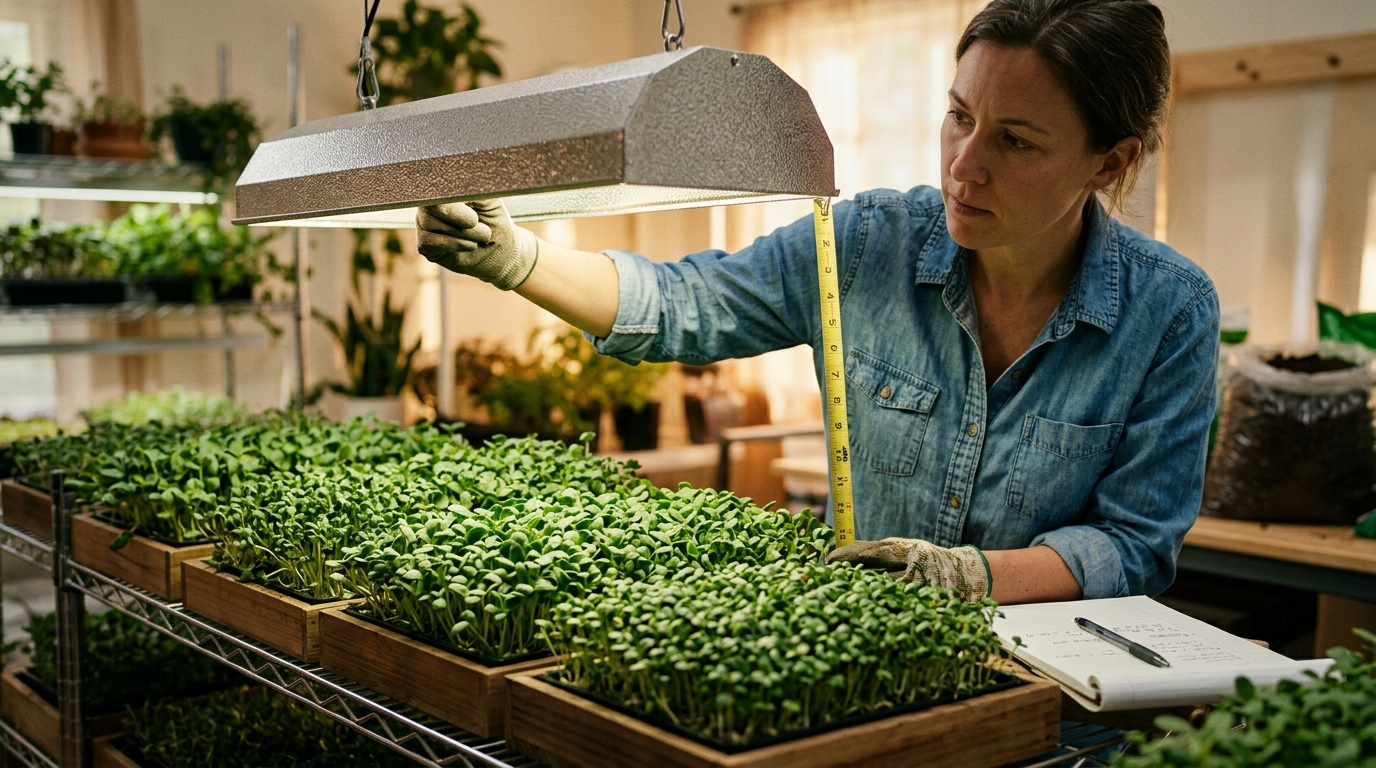
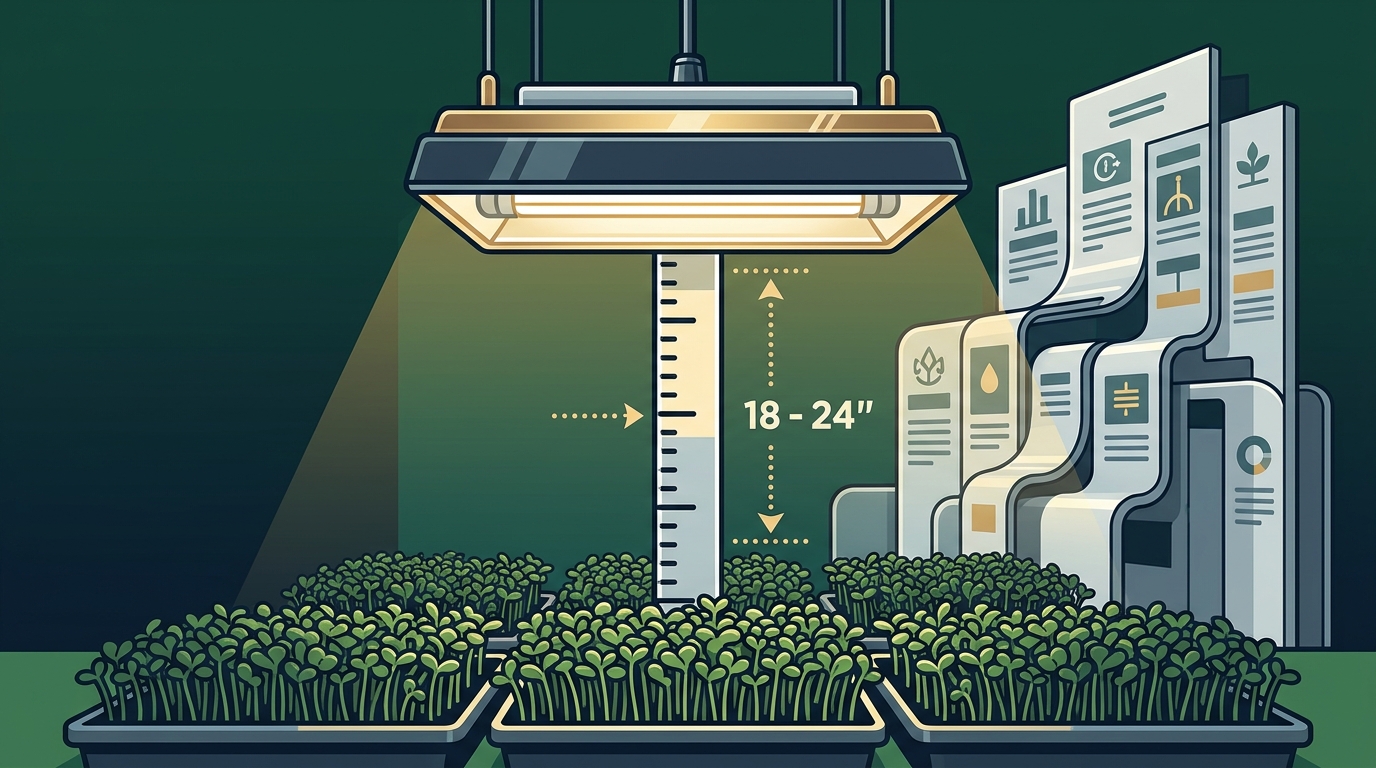
For most microgreens, mount a 250W ceramic metal halide (CMH) light between 18 and 24 inches above the canopy. This distance balances light intensity with heat management, preventing leaf scorch while ensuring sufficient photosynthetically active radiation (PAR) for rapid germination. Nano Grow Light provides specific PPFD data to help you dial in this height for your specific setup.
Understanding PPFD and Heat in CMH Fixtures
Ceramic metal halide lamps produce a continuous spectrum that is highly effective for leafy greens, but they also generate significant heat. Unlike LED fixtures that run cool, a 250W CMH lamp reaches a surface temperature of approximately 45°C at steady state. This thermal output is a critical factor when determining mounting height for delicate microgreens, which are sensitive to heat stress during their first few days of growth.
Photosynthetically active radiation (PAR) is the measure of light intensity available for photosynthesis. In the context of microgreens, you want a specific range of PAR to encourage dense, uniform growth without stretching the stems. Nano Grow Light’s manufacturer-reported testing shows that at 18 inches, the center of the fixture delivers 720 µmol/m²/s, while the average across a 2x2 foot area is 611 µmol/m²/s. This level of intensity is ideal for most brassica and legume microgreens, providing the energy needed for rapid development without the risk of thermal damage.
Optimal Heights for Different Microgreen Varieties
Not all microgreens respond to light in the same way. Leafy greens like arugula and kale generally tolerate higher light intensities and can be grown closer to the fixture. For these varieties, a mounting height of 18 inches is often the sweet spot. At this distance, the PPFD is high enough to keep the plants compact and prevent etiolation, which is the stretching of stems in search of light.
For more delicate varieties like sunflower or pea shoots, a slightly greater distance of 24 inches is recommended. At 24 inches, the center PPFD drops to 510 µmol/m²/s, with an average of 426 µmol/m²/s across the 2x2 foot area. This lower intensity is safer for the tender leaves of these plants, especially during the germination phase. By adjusting the height based on the specific variety, you can optimize both growth rate and plant health.
The Role of the Nano Liquid Photonic Coating
The Nano Liquid Photonic Coating is a proprietary nano-scale layer applied to the internal reflector of the Nano Grow Light fixture. This coating cures into a crystalline layer that behaves like an array of micro-lenses, bending blue and red wavelengths toward the plant canopy. The result is a 31% reduction in light spill compared to a standard aluminum reflector, which means more usable light reaches the plants at the same mounting height.
This photonic enhancement is particularly beneficial for microgreens, which have a small canopy and require uniform light distribution. The coating helps to concentrate the light where it is needed most, reducing the need to mount the fixture higher to avoid hot spots. By using a fixture with this technology, you can maintain a consistent light environment across the entire growing tray, leading to more uniform harvests.
Practical Tips for Adjusting Mounting Height
Start with a conservative height and adjust based on plant response. For a 250W CMH fixture, begin at 24 inches and observe the plants over the first 48 hours. If the leaves appear pale or the stems are stretching, lower the fixture by 2 inches. If you see signs of heat stress, such as wilting or yellowing, raise the fixture. This iterative process allows you to find the optimal height for your specific environment and plant variety.
Use a PAR meter to verify the light intensity at the canopy level. While the manufacturer-reported data provides a good baseline, real-world conditions can vary based on room temperature, humidity, and the specific tray setup. A PAR meter will give you an accurate reading of the light your plants are actually receiving, allowing you to make informed adjustments. This data-driven approach ensures that you are providing the ideal light environment for your microgreens.
Key Takeaways
- Mount a 250W CMH light between 18 and 24 inches above microgreens for optimal growth.
- At 18 inches, the center PPFD is 720 µmol/m²/s, suitable for hardy leafy greens.
- At 24 inches, the center PPFD is 510 µmol/m²/s, ideal for delicate varieties like sunflower.
- The Nano Liquid Photonic Coating reduces light spill by 31%, improving light distribution.
- CMH fixtures run hot, with a surface temperature of 45°C, so monitor for heat stress.
- Use a PAR meter to verify light intensity and adjust height based on plant response.
- Start at 24 inches and lower the fixture gradually if plants show signs of stretching.
Frequently Asked Questions
What is the ideal mounting height for a 250W CMH light for microgreens?
The ideal mounting height is typically between 18 and 24 inches, depending on the variety. Hardy greens like kale can be grown at 18 inches, while delicate varieties like sunflower are better at 24 inches.
How does the Nano Liquid Photonic Coating affect mounting height?
The coating reduces light spill by 31%, which allows for more uniform light distribution. This means you can maintain a consistent light environment at the same height, reducing the need for frequent adjustments.
What is the PPFD at 18 inches for the Nano Grow Light?
At 18 inches, the center PPFD is 720 µmol/m²/s, with an average of 611 µmol/m²/s across a 2x2 foot area. This intensity is suitable for most leafy green microgreens.
How hot does a 250W CMH light get?
A 250W CMH light reaches a surface temperature of approximately 45°C at steady state. This heat is a factor to consider when mounting the fixture above delicate plants.
Can I use a 250W CMH light for all types of microgreens?
Yes, but you should adjust the mounting height based on the variety. Hardy greens can be grown closer to the light, while delicate varieties should be placed further away to avoid heat stress.
How do I know if my microgreens are getting too much light?
What is the benefit of using a PAR meter?
A PAR meter provides an accurate reading of the light intensity at the canopy level. This allows you to make data-driven adjustments to the mounting height, ensuring that your plants are receiving the ideal amount of light.