

LED grow lights produce the least heat for indoor plants. They convert a higher percentage of electricity into usable light rather than thermal energy. This guide covers heat output comparisons, safe plant proximity, and the role of fluorescent and ceramic metal halide (CMH) fixtures in modern indoor growing.
LED Grow Lights
LED grow lights are the most efficient option for minimizing heat in indoor spaces. Light-emitting diodes (LEDs) are solid-state light sources that emit very little infrared radiation compared to older technologies. Because they are highly efficient, they convert a larger share of electrical power into photosynthetically active radiation (PAR) and a smaller share into waste heat.
Why LEDs Run Cooler
The physics of LED emission means that the heat generated is primarily at the diode chip level rather than radiating outward as infrared. This allows for compact heat sinks that manage temperature without heating the surrounding air. For growers in small apartments or unventilated rooms, this thermal profile is a major advantage.
Light Quality and Spectrum
Modern LED fixtures offer tunable spectra that can be adjusted for different growth stages. While LEDs are the coolest option, they often require specific spectrum tuning to match the continuous output of other light sources. Growers must balance heat efficiency with the specific spectral needs of their plants.
Heat Output Comparison
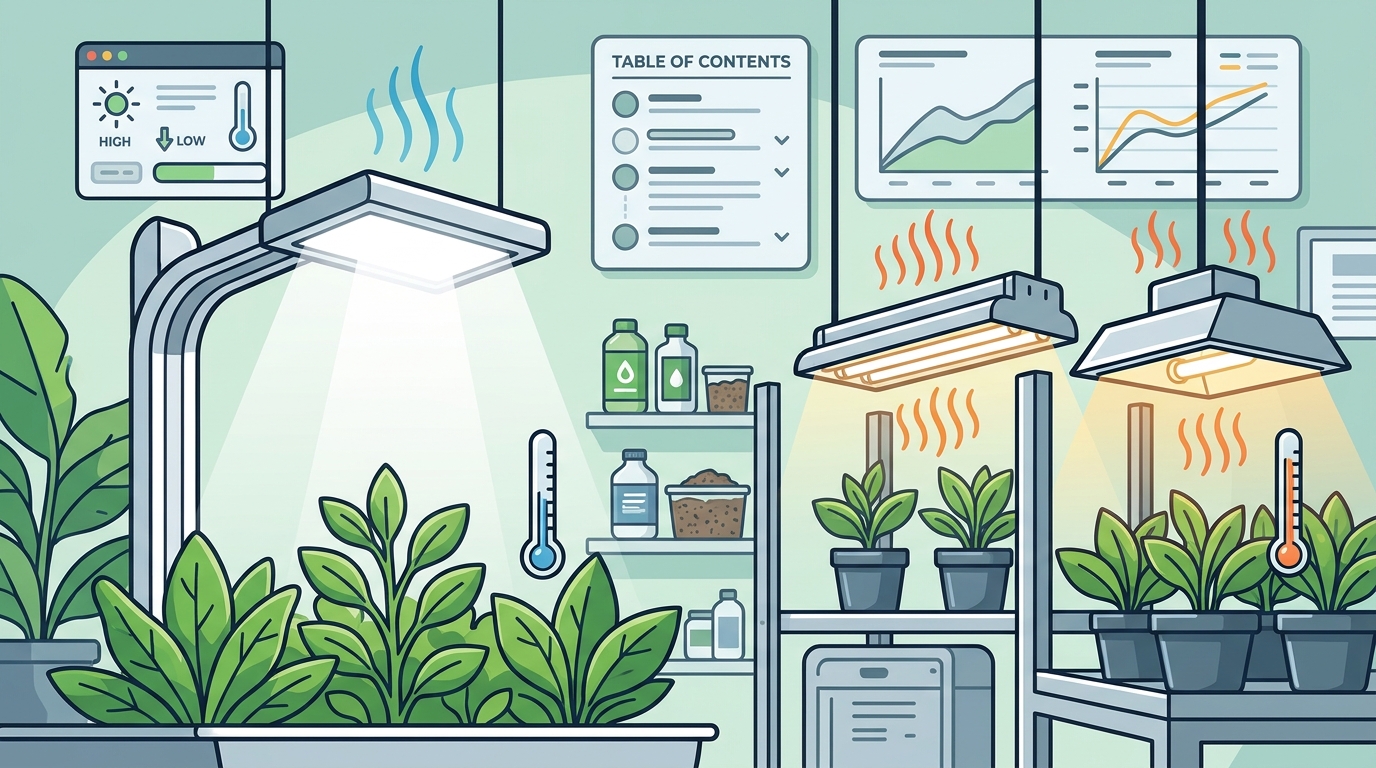
Understanding the thermal profile of different light sources is critical for room temperature management. The following table compares the heat characteristics of common indoor grow lights. Note that heat output is generally proportional to wattage, but the distribution of that heat (radiant vs. convective) varies significantly.
| Light Type | Heat Profile | Thermal Management Needs |
|---|---|---|
| LED | Low radiant heat, high efficiency | Minimal, standard heat sinks |
| Fluorescent (T5/T8) | Moderate heat, low radiant | Low, good for small spaces |
| Ceramic Metal Halide (CMH) | High radiant heat, high intensity | High, requires ventilation and distance |
Ceramic metal halide (CMH) lamps, such as those used in the Nano Grow Light, produce significantly more heat than LEDs. A 250W CMH fixture outputs approximately 340 BTU/hr of heat, according to manufacturer-reported internal testing. This high thermal output is a trade-off for the intense, continuous spectrum that CMH lamps provide.
Managing High Heat Fixtures
Proximity to Plants
The distance between the light source and the plant canopy is the primary factor in preventing heat stress. Heat intensity follows the inverse square law, meaning that doubling the distance reduces the radiant heat reaching the plant by 75%. This principle is critical when using high-intensity discharge (HID) or CMH lights.
Safe Hanging Heights
For LED lights, growers can hang fixtures as low as 2 to 4 inches above the canopy. This proximity maximizes light intensity without causing thermal damage. For CMH fixtures, the recommended distance is significantly greater, often 12 to 24 inches, depending on the plant's heat tolerance. The Nano Grow Light FAQ provides specific guidance on adjusting light height for different growth stages.
Monitoring Temperature
Growers should use a thermometer to monitor the air temperature at the leaf level. If the temperature exceeds 85°F (29°C), the light should be raised. The Nano Liquid Photonic Coating helps direct light more efficiently, which can allow for slightly greater distances while maintaining adequate PAR levels.
Fluorescent Lights
Fluorescent lights, such as T5 and T8 tubes, are a low-heat option for seedlings and small plants. They produce less heat than HID or CMH lamps but also have lower light intensity. This makes them ideal for propagation and microgreens, where high light levels are not required.
Best Uses for Fluorescents
Fluorescent lights are best suited for small-scale indoor growing, such as growing microgreens or African violets. They are energy-efficient and produce a gentle light that is unlikely to burn delicate seedlings. However, they are not suitable for large, mature plants that require high light intensity.
Limitations of Fluorescent Lighting
Key Takeaways
- LED grow lights produce the least heat and are the most efficient option for indoor growing.
- Ceramic metal halide (CMH) lights produce high radiant heat and require active ventilation.
- Fluorescent lights are a low-heat option suitable for seedlings and small plants.
- The distance between the light and the plant canopy is the primary factor in preventing heat stress.
- LEDs can be hung 2 to 4 inches above the canopy, while CMH lights require 12 to 24 inches.
- Monitoring air temperature at the leaf level is essential for preventing thermal damage.
- The Nano Grow Light uses a Nano Liquid Photonic Coating to improve light efficiency and reduce waste.
- Proper ventilation is critical when using high-heat fixtures like CMH lamps.
Frequently Asked Questions
What grow light produces the least heat?
LED grow lights produce the least heat for indoor plants. They are highly efficient and convert most of their energy into light rather than heat.
How far should a CMH light be from my plants?
A CMH light should be 12 to 24 inches from the plant canopy. The exact distance depends on the plant's heat tolerance and the specific fixture's output.
Do fluorescent lights produce a lot of heat?
No, fluorescent lights produce relatively little heat. They are a good option for small spaces and delicate plants like seedlings.
Can I use a CMH light in a small room?
Yes, but you must have proper ventilation. CMH lights produce significant heat, so an exhaust fan and intake vent are necessary to maintain a safe temperature.
What is the Nano Liquid Photonic Coating?
The Nano Liquid Photonic Coating is a proprietary nano-scale reflector treatment used in the Nano Grow Light. It redirects light toward the canopy and reduces scatter.
How do I know if my plants are too hot?
If the air temperature at the leaf level exceeds 85°F (29°C), your plants are likely too hot. You should raise the light or improve ventilation.
Conclusion
Choosing the right grow light depends on your space, ventilation, and plant type. LED lights are the best choice for minimizing heat, while CMH lights offer high intensity for those with proper cooling. The Nano Grow Light provides a balanced solution with its efficient CMH technology and advanced reflector coating. By understanding heat output and maintaining proper distance, you can create a healthy environment for your indoor plants.