

Indoor gardening has evolved from a niche hobby into a global industry driven by the need for fresh produce and aesthetic greenery regardless of climate. The primary barrier to entry for many enthusiasts is the operational cost of lighting, which can account for up to 75% of a grow room's total energy consumption. According to the U.S. Department of Energy, lighting systems in controlled environment agriculture are critical determinants of both yield quality and energy overhead. As growers seek to maximize yield per watt, understanding the technological differences between traditional and modern lighting solutions becomes essential for sustainable cultivation. (Customer Support We 039)
LED vs. Metal Halide: The Efficiency Debate
For decades, Metal Halide (MH) lamps were the standard for vegetative growth. However, MH technology operates by passing an electric arc through ionized gas, a process that inherently generates significant waste heat. While MH lamps provide a broad spectral distribution, they lack the precision required for modern high-density growing. The energy efficiency of traditional MH systems is often compromised by the need for extensive ventilation to remove excess heat, which further increases the facility's total energy load.
Light Emitting Diodes (LEDs) have largely replaced MH fixtures due to their superior lumens-per-watt ratio. LEDs convert electricity directly into light with minimal thermal waste. However, not all LED grow lights are created equal. Standard LED arrays often suffer from "diode gaps," where light intensity drops between individual diodes, leading to uneven plant growth. Furthermore, standard LEDs scatter photons in all directions, meaning a significant portion of the light never reaches the plant canopy. This scattering effect reduces the effective Photosynthetically Active Radiation (PAR) delivered to the leaves, forcing growers to use higher wattage fixtures to compensate for lost energy.
This is where advanced optical engineering changes the equation. Technologies like Nano Liquid Photonic Coating address the inefficiencies of both traditional MH and standard LED systems by redirecting scattered light into a tighter, more usable beam. This approach ensures that nearly every photon generated contributes to photosynthesis, dramatically improving the energy efficiency of the entire system.
How Nano Liquid Photonic Coating Works
Nano Liquid Photonic Coating is a proprietary optical technology designed to optimize light delivery in horticulture. Unlike standard reflectors that simply bounce light randomly, this coating is engineered at the molecular level to shape and redirect photons with pinpoint accuracy. The result is a custom-tailored beam of light that eliminates the scattered "disco ball" effect seen in traditional fixtures.
The core mechanism involves redirecting scattered light into a tighter, more usable beam for faster indoor plant growth. By tightening the beam spread, the technology allows for deeper canopy penetration, ensuring that lower leaves receive adequate light intensity. This targeted delivery reduces energy waste by ensuring that only the wavelengths plants can use are directed at the crop. In real-world trials, this precision has allowed fast-cycling crops like lettuce to mature in as little as 28 days, compared to the typical 42 days required outdoors or under less efficient indoor lighting.
For growers operating in compact spaces such as tents, cabinets, or vertical farms, this efficiency is critical. The ability to deliver high photon density without generating excessive heat allows for closer fixture placement. This proximity increases the PAR value at the canopy level without risking thermal damage to the plants, a common limitation with high-wattage MH or poorly engineered LED units.
Spectral Purity and PAR Delivery
Energy efficiency in grow lights is not just about wattage; it is about spectral purity. Photosynthetically Active Radiation (PAR) refers to the range of light wavelengths (400-700 nanometers) that plants use for photosynthesis. A light fixture may consume 100 watts, but if only 40 watts are within the PAR range, its efficiency is low.
Standard LED grow lights often produce "spiky" spectra with intense peaks at specific wavelengths and gaps in between. This imbalance can stress plants and reduce growth rates. In contrast, Nano Liquid Photonic Coating sharpens spectral purity, delivering a balanced, beam-tightened output that supports stronger vegetative growth and healthier maturity. The coating ensures that the light reaching the plant is not just bright, but biologically active.
This precision is particularly beneficial for sensitive plants like African Violets. These plants require stabilized full-spectrum halide output to bloom consistently. The deep spectral continuity provided by nano-enhanced systems promotes continuous violet blooms and faster leaf expansion. By eliminating the diode gaps and scattered wavelengths of standard LEDs, growers can achieve richer coloration and more robust plant structures using less energy.
Heat Management and Canopy Safety
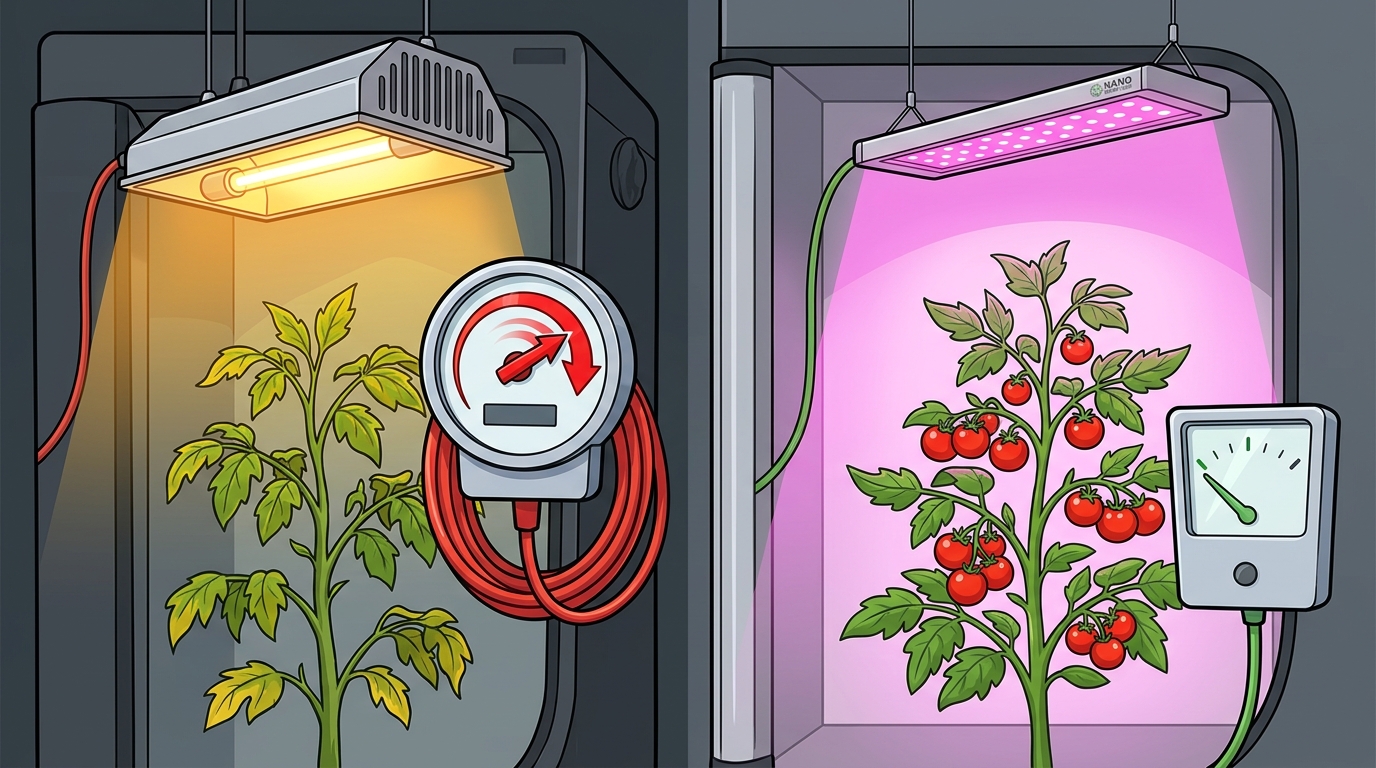
One of the most overlooked aspects of grow light efficiency is heat management. Traditional high-intensity discharge (HID) lights, including Metal Halide and High-Pressure Sodium (HPS) lamps, emit up to 80% of their energy as heat. This necessitates powerful exhaust fans and air conditioning systems to maintain optimal growing temperatures. These auxiliary systems consume additional electricity, effectively doubling the energy cost of the lighting operation.
Low-heat operation is a hallmark of advanced LED and nano-coated systems. Because Nano Grow Lights utilize metal halide technology enhanced with nano-coating, they deliver higher photon density for flowering crops while maintaining a lower surface temperature than traditional MH bulbs. This low-heat profile makes the fixtures ideal for shelves, tents, and cabinets where heat buildup is a critical concern.
The reduced heat stress on plants allows for closer hanging distances. When a fixture can be hung closer to the canopy without burning the leaves, the light intensity at the plant level increases exponentially. This allows growers to use lower wattage fixtures to achieve the same yield, further reducing energy consumption. The combination of targeted photon delivery and low heat output creates a synergistic effect that maximizes efficiency.
Efficiency Comparison Table
The following table compares the key efficiency metrics of traditional lighting technologies against advanced nano-enhanced systems.
| Feature | Traditional Metal Halide | Standard LED | Nano-Enhanced MH |
|---|---|---|---|
| Spectral Distribution | Broad, but scattered | Spiky, with diode gaps | Tightened, high purity |
| Heat Output | Very High | Moderate | Low |
| PAR Efficiency | Low | Moderate | Ultra-High |
| Canopy Penetration | Shallow | Variable | Deep |
| Best For | Large commercial spaces | General home use | Compact, high-yield grows |
Key Takeaways
- Energy Consumption: Lighting accounts for up to 75% of grow room energy costs, making efficiency paramount.
- Nano Technology: Nano Liquid Photonic Coating redirects scattered light, increasing usable PAR and reducing waste.
- Growth Speed: Trials show fast-cycling crops like lettuce can mature in 28 days, significantly faster than outdoor or standard indoor methods.
- Heat Reduction: Advanced systems offer low-heat operation, reducing the need for costly ventilation and cooling infrastructure.
- Spectral Purity: Tightened spectral output supports stronger vegetative growth and healthier maturity without diode gaps.
- Compact Suitability: Nano-enhanced lights are engineered for small and medium grow spaces, providing strong, even canopy coverage.
- Plant Health: Balanced output promotes up to 3x faster development in ideal conditions, with plants growing up to 1 inch per day.
Frequently Asked Questions
Are nano-enhanced grow lights more energy efficient than standard LEDs?
Yes, nano-enhanced systems can be more efficient because they redirect scattered photons into a tighter beam, ensuring more light reaches the canopy. This reduces the need for higher wattage fixtures to achieve the same yield.
How does Nano Liquid Photonic Coating work?
Nano Liquid Photonic Coating is a molecular-level engineering process that shapes and redirects light with pinpoint accuracy. It eliminates scattered wavelengths and delivers highly targeted photon density to the plant canopy.
Can I use these lights for African Violets?
African violets respond exceptionally well to stabilized full-spectrum halide output. The deep spectral continuity and low heat of nano-enhanced lights promote continuous violet blooms and faster leaf expansion.
What is the difference between MH and LED grow lights?
Metal Halide (MH) lights provide a broad spectral distribution ideal for vegetative growth, while LEDs offer high efficiency with minimal heat. Nano-enhanced MH combines the spectral benefits of MH with the precision and efficiency of nano-optics.
How much faster do plants grow with nano technology?
In real-world testing, growers have brought fast-cycling crops like lettuce to harvest in as little as 28 days. This is a significant reduction from the typical 3-month cycle, with plants growing up to 1 inch per day.
Do these lights generate less heat?
Yes, the low-heat operation of nano-enhanced fixtures makes them ideal for shelves, tents, and cabinets. This reduces heat stress on plants and lowers the energy load required for cooling.
Is nano technology suitable for microgreens?
Microgreens benefit greatly from the high photon density and spectral purity provided by nano-enhanced lights. The targeted beam delivery accelerates photosynthesis and improves yield quality.
Start Growing Smarter
Transitioning to energy-efficient grow lights is not just about saving money; it is about optimizing your garden's potential. By leveraging advanced technologies like Nano Liquid Photonic Coating, you can achieve faster growth, higher yields, and healthier plants with less energy consumption. Explore our Shop Now page to find the perfect fixture for your indoor garden. For more information on our technology, visit our How It Works guide. If you have specific questions about your setup, contact our Customer Support team today.