

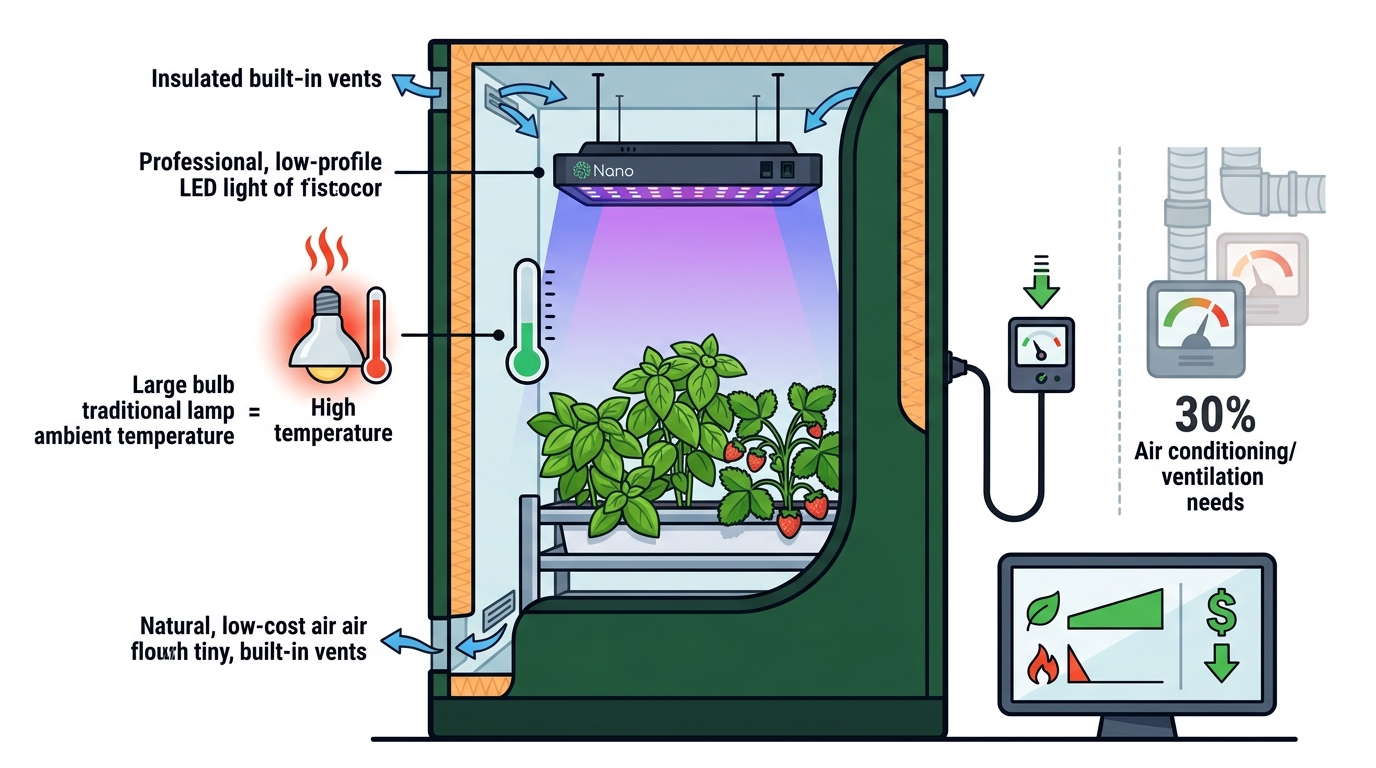
Indoor cultivation faces a critical thermal challenge that often limits yield and plant health. Traditional high-intensity discharge lamps can raise ambient temperatures by 10 to 15 degrees Fahrenheit, forcing growers to invest heavily in ventilation and air conditioning. According to recent horticultural efficiency studies, managing this excess heat can consume up to 30% of a facility's total energy budget. This thermal load stresses plants, accelerates transpiration, and creates an environment ripe for mold and pest infestations. Identifying the right light source is therefore not just about photosynthesis but about thermal management. (Contact Nano Grow Light)
The LED Advantage in Thermal Management
Light Emitting Diodes (LEDs) have become the standard for low-heat indoor growing due to their inherent efficiency. Unlike older technologies that generate heat as a byproduct of gas excitation, LEDs produce light through electron movement in a semiconductor material. This process is significantly more efficient at converting electricity into usable light rather than infrared radiation.
However, not all LEDs are created equal. Standard commercial LEDs often suffer from "diode gaps," where light is scattered inefficiently, requiring larger fixtures that can still radiate heat into the grow space. The key to true low-heat performance lies in how the light is directed. When photons are scattered, they hit surfaces other than the plant canopy, turning the grow tent or room into a heat trap. Effective thermal management requires a light source that delivers photons directly to the leaves, minimizing stray radiation.
For growers dealing with delicate species, such as African violets or seedlings, even moderate heat can cause leaf scorch or stunted growth. The goal is to maintain a stable canopy temperature that allows for optimal stomatal opening without triggering heat stress responses. This is where advanced optical engineering becomes critical for professional and hobbyist results alike.
Nano Liquid Photonic Coating Explained
Nano Liquid Photonic Coating is a proprietary optical technology designed to redirect scattered light into a tighter, more usable beam for faster indoor plant growth. This innovation addresses the fundamental flaw in traditional lighting where energy is wasted on wavelengths plants cannot use or on photons that miss the canopy entirely.
By applying this nano-film at the molecular level, the light beam is sharpened and directed with pinpoint accuracy. This results in higher photon density at the canopy level while simultaneously reducing the overall heat load in the grow environment. The coating ensures that the light produced is not just bright, but biologically active and thermally efficient.
This technology is particularly beneficial for small and medium grow spaces. In confined areas like cabinets, shelves, or small tents, heat accumulation happens rapidly. A light source that minimizes radiant heat allows for closer placement to the plants, which is essential for maximizing yield in compact setups. The result is a custom-tailored beam of light that promotes stronger vegetative growth and sturdier plant structure without the risk of thermal damage.
Metal Halide vs. LED Heat Output
Metal Halide (MH) technology has long been a staple in horticulture for its broad spectral distribution and high photon density. However, MH lamps operate at extremely high temperatures, often exceeding 1,000 degrees Fahrenheit at the bulb surface. This intense heat requires significant distance between the light and the plants to prevent burning, which can reduce light intensity at the canopy.
While MH lights do produce a natural full-spectrum output that some growers prefer for flowering crops, the thermal cost is substantial. In contrast, modern nano-enhanced systems offer a compelling alternative. They deliver the spectral benefits of MH technology but with a fraction of the heat output. This allows growers to achieve similar or better results with lower energy consumption and reduced cooling requirements.
The comparison is not just about initial cost but total cost of ownership. The energy saved on ventilation and the reduced wear on plants from thermal stress often outweigh the higher upfront cost of advanced LED or nano-coated systems. For those prioritizing plant health and energy efficiency, the shift away from traditional high-heat sources is a logical progression.
Technology Comparison Matrix
| Lighting Technology | Heat Output Level | Spectral Efficiency | Ideal Use Case |
|---|---|---|---|
| Nano Liquid Photonic Coating | Very Low | High (Targeted PAR) | Compact spaces, delicate plants |
| Standard LED | Low to Moderate | Moderate | General home growing |
| Metal Halide (MH) | Very High | High (Broad Spectrum) | Large commercial facilities |
| Fluorescent (T5) | Low | Moderate | Seedlings, microgreens |
Key Takeaways
- Nano Liquid Photonic Coating redirects scattered light to minimize heat while maximizing usable PAR.
- Traditional Metal Halide lights generate significant heat, requiring extensive ventilation and cooling.
- LED technology offers a baseline for low-heat growing, but optical refinement is key to efficiency.
- Reduced heat output allows for closer light placement, increasing yield in small spaces.
- Delicate plants like African violets benefit significantly from stabilized, low-heat full-spectrum output.
- Energy efficiency in lighting directly correlates with lower operational costs for climate control.
- Nano Grow Light technology has been tested across 60+ harvests, showing accelerated growth cycles.
Frequently Asked Questions
Do LED grow lights produce less heat than HID lights?
Yes, LEDs generally produce significantly less radiant heat than High-Intensity Discharge (HID) lights like Metal Halide or High-Pressure Sodium. This makes them safer for small indoor spaces and delicate plants.
How does Nano Liquid Photonic Coating reduce heat?
It works by redirecting scattered photons into a tighter beam. This ensures that more light reaches the plant canopy and less is wasted as stray radiation or absorbed by surrounding surfaces, thereby lowering ambient temperature.
Can I use grow lights too close to my plants?
With low-heat technologies like nano-coated LEDs, you can place lights closer to the canopy than with traditional HID lights. However, always monitor leaf temperature to prevent any potential stress.
Are nano grow lights suitable for flowering plants?
Absolutely. The nano-enhanced spectrum provides the necessary wavelengths for robust flowering, often with better efficiency and less heat stress than traditional metal halide setups.
What is the best grow light for African violets?
African violets thrive under stabilized full-spectrum halide output or advanced nano-coated LEDs. These provide the consistent, low-heat environment they require for continuous blooming.
How does heat affect plant growth?
Excessive heat can cause plants to close their stomata to conserve water, which halts photosynthesis. It can also lead to nutrient uptake issues and increased susceptibility to pests like spider mites.
Is Nano Grow Light energy efficient?
Yes, by maximizing photon delivery to the canopy, the system reduces energy waste. This translates to lower electricity bills and a smaller carbon footprint for your indoor garden.
Start Growing Smarter Today
Take control of your indoor climate and maximize your yield with advanced lighting technology. Visit Shop Now to explore our range of low-heat, high-efficiency grow lights. For more information on how our technology works, check out our How It Works guide. If you have specific questions about your setup, contact our Customer Support team for expert advice.