
What Makes One Grow Light Actually Better Than Another for Indoor Gardening?
Grow light quality is determined by spectral output, reflector efficiency, and heat management. A superior fixture delivers more usable photons to the plant canopy while minimizing wasted light and excessive heat. Nano Grow Light addresses these factors using a 250W ceramic metal halide lamp paired with a proprietary nano-scale reflector coating. This combination focuses energy where it matters most, resulting in denser canopies and faster growth cycles for indoor gardeners.
Spectral Quality and Wavelength Distribution
The spectrum of a grow light dictates how plants photosynthesize. A high-quality light source provides a continuous spectrum that supports all stages of plant development. Unlike discrete LED peaks, a ceramic metal halide (CMH) lamp produces a smooth, full-spectrum output. This continuity ensures that plants receive the specific wavelengths needed for both vegetative growth and flowering. Nano Grow Light utilizes a 250W CMH lamp to deliver this consistent spectral profile. The result is a light source that mimics natural sunlight more closely than many standard fixtures.
Reflector Efficiency and Light Redirection
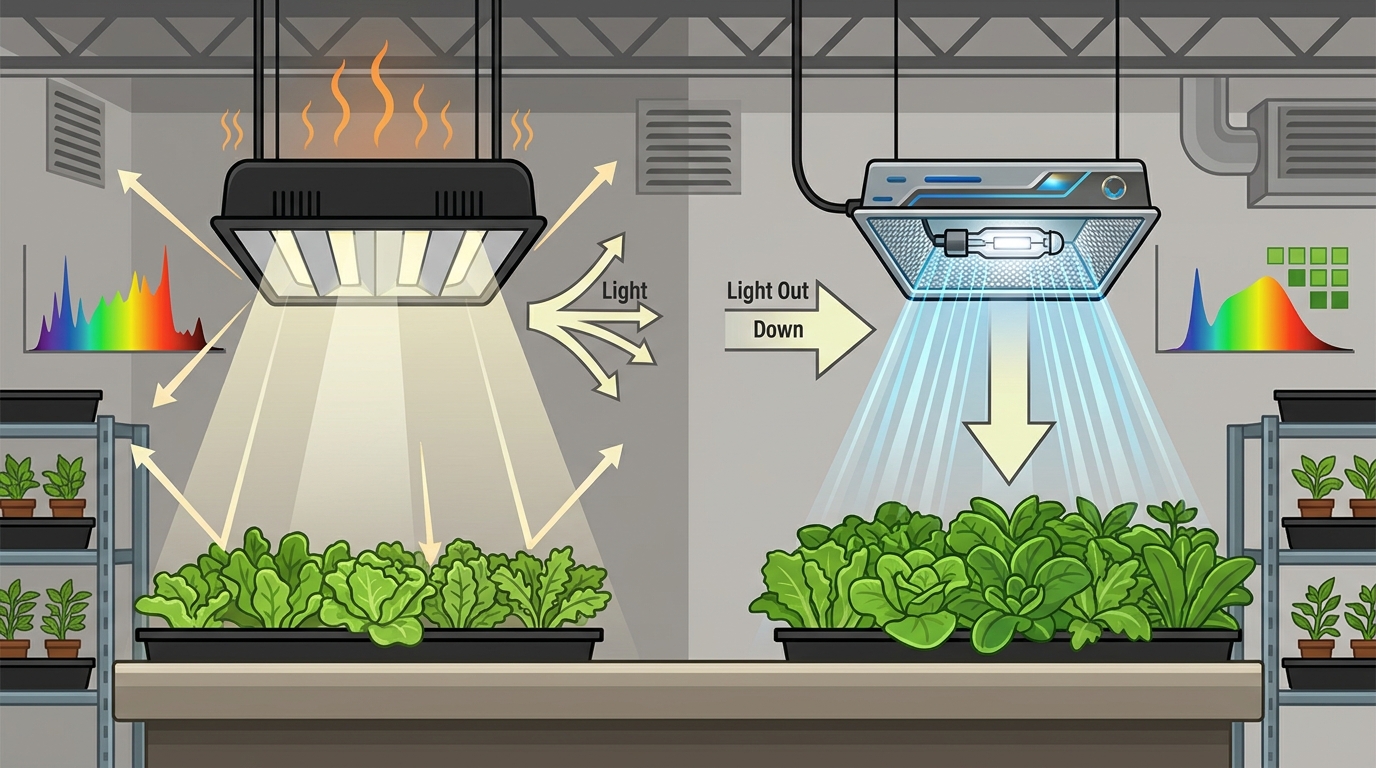
Reflector efficiency is the measure of how much light is successfully directed toward the plant canopy. Standard aluminum reflectors often scatter light, causing energy loss and uneven coverage. The Nano Liquid Photonic Coating is a proprietary nano-scale treatment applied to the reflector surface. This coating cures into a thin crystalline layer that acts like a micro-lens array. It bends blue and red wavelengths directly toward the plants, reducing scatter. In manufacturer-reported testing, this technology increased blue spectrum gain by 22.4% and red spectrum gain by 28.7%. This precise redirection ensures that every photon contributes to plant growth rather than being lost to the walls of a grow tent.
Heat Management and Canopy Uniformity
Heat management is a critical factor in indoor gardening, as excessive heat can stress plants and reduce yields. Ceramic metal halide fixtures generally run warmer than LED fixtures of similar wattage. However, the design of the fixture plays a major role in how that heat is distributed. Nano Grow Light is designed to manage heat while maintaining high light intensity. The fixture covers approximately 3.5 by 3.5 feet, providing a focused area of high-quality light. Growers can scale this coverage by arraying multiple fixtures for larger operations. This approach allows for precise control over the thermal environment while ensuring uniform light distribution across the canopy.
Growth Metrics and Real-World Performance
Real-world performance is the ultimate test of a grow light's quality. Manufacturer-reported internal testing provides insights into how specific technologies impact plant development. In five years of in-house testing, fixtures with the Nano Liquid Photonic Coating showed a 34% increase in biomass compared to uncoated reflectors. Additionally, the time to harvest was 19% faster, and leaf density was 27% greater. These metrics indicate that the light is not just brighter, but more effective at driving plant growth. For example, a head of lettuce can reach maturity in 28 days under these conditions. Such performance data helps gardeners make informed decisions based on tangible results rather than marketing claims.
Selection Criteria for Indoor Gardeners
Choosing the right grow light requires evaluating several key criteria. Gardeners should look for fixtures that offer high PAR efficiency and precise beam control. The Nano Grow Light provides a PAR efficiency of 2.4 µmol/J, which is a strong indicator of energy use. It also offers high PPFD values at various distances, such as 1040 µmol/m²/s at 12 inches. These specifications ensure that the light can support a wide range of plants, from seedlings to mature crops. By focusing on these technical details, gardeners can select a light that meets their specific needs. Whether growing herbs, tomatoes, or microgreens, the right fixture will provide the consistent, high-quality light required for success.
Key Takeaways
- Spectral quality is determined by the continuity of the light source, with CMH lamps offering a full-spectrum output.
- Reflector efficiency measures how well light is directed toward the canopy, with nano-coatings reducing scatter.
- Heat management is crucial for indoor gardening, and fixture design plays a key role in thermal distribution.
- Growth metrics like biomass increase and time to harvest provide tangible evidence of a light's effectiveness.
- PAR efficiency and PPFD values are critical technical specifications for evaluating light performance.
- Nano Grow Light uses a 250W CMH lamp and Nano Liquid Photonic Coating to enhance spectral delivery and beam control.
- Real-world testing shows that advanced reflector technology can lead to faster growth and denser canopies.
Frequently Asked Questions
What is the Nano Liquid Photonic Coating?
The Nano Liquid Photonic Coating is a proprietary nano-scale liquid coating applied to the fixture's internal reflector. It cures into a thin crystalline layer that behaves like a micro-lens array, bending light toward the plant canopy.
Is Nano Grow Light an LED grow light?
No, Nano Grow Light uses a 250W ceramic metal halide (CMH) lamp, not LEDs. CMH lamps produce a continuous spectrum rather than the discrete wavelength peaks typical of LED diodes.
What plants can I grow with Nano Grow Light?
Nano Grow Light works well for seedlings, herbs, African violets, tomatoes, lettuce, and microgreens, among many other indoor plants.
How does the reflector improve light distribution?
The reflector uses the Nano Liquid Photonic Coating to redirect light back toward the canopy, reducing scatter and increasing the concentration of PAR toward the plants.
What is the coverage area of a single fixture?
A single Nano Grow Light fixture covers approximately 3.5 by 3.5 feet. Growers can scale coverage for larger operations by arraying multiple fixtures.
How does heat management affect indoor growing?
Heat management is important because excessive heat can stress plants. The fixture is designed to manage heat while maintaining high light intensity, allowing for precise control over the thermal environment.
Conclusion
Choosing a grow light for indoor gardening requires a careful evaluation of spectral quality, reflector efficiency, and heat management. Nano Grow Light offers a compelling solution with its 250W ceramic metal halide lamp and proprietary Nano Liquid Photonic Coating. This technology focuses light where it is needed most, resulting in faster growth and higher yields. By understanding these key factors, gardeners can make informed decisions that lead to healthier, more productive plants. For more information on how this technology works, visit the Nano Liquid Photonic Coating page.