

Heat management is the silent killer of indoor gardens. According to the U.S. Department of Energy, efficient lighting technology has evolved to minimize thermal waste, yet many growers still struggle with canopy burn. Traditional high-intensity discharge (HID) lamps, such as metal halide and high-pressure sodium fixtures, convert only about 10% of their energy into usable light, dumping the remaining 90% as radiant heat. This thermal load forces growers to invest heavily in ventilation systems just to keep plant temperatures stable. The shift toward solid-state lighting has changed this dynamic entirely, allowing for dense plantings without the risk of thermal stress.
Why Heat Management is Critical
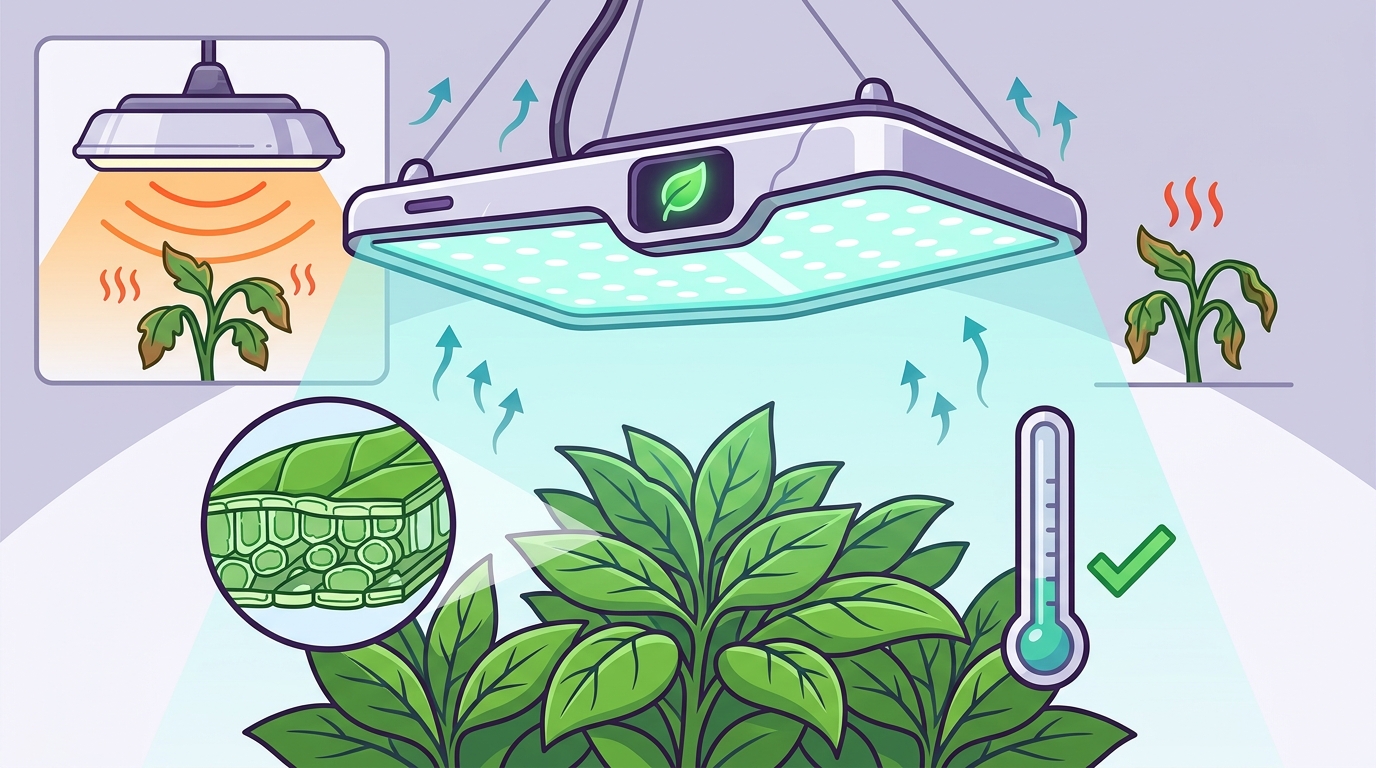
Indoor environments lack the natural airflow found outdoors. When light sources emit excessive heat, the air temperature around the canopy rises rapidly. This creates a microclimate that can stress plants, causing them to close their stomata and halt photosynthesis. Stomatal closure prevents the uptake of carbon dioxide, effectively starving the plant of the fuel it needs to grow. Furthermore, high temperatures increase the transpiration rate, leading to rapid soil drying and nutrient lockout.
For growers using compact spaces like closets, tents, or cabinets, heat accumulation is even more dangerous. Without adequate exhaust, temperatures can spike above 90 degrees Fahrenheit within hours. This environment invites pests like spider mites, which thrive in warm, dry conditions. By selecting a light source that emits minimal infrared radiation, you maintain a stable vegetative environment. This stability allows the plant to focus its energy on root development and foliage production rather than survival.
The LED Advantage
Light Emitting Diodes (LEDs) have become the standard for low-heat indoor cultivation. Unlike HID bulbs that generate heat through a plasma arc or filament, LEDs produce light through electroluminescence. This process is inherently cooler. However, not all LEDs are created equal. Cheap LED panels often lack proper thermal sinks, causing the diodes themselves to overheat. When diodes overheat, their efficiency drops, and their lifespan shortens significantly.
High-quality LED grow lights incorporate advanced thermal management systems. These systems use aluminum heat sinks and passive or active cooling fans to draw heat away from the diodes and dissipate it into the room air, away from the plant canopy. This design ensures that the light reaching the leaves is pure photon energy, not thermal radiation. The result is a light source that can be placed closer to the plant without causing burn, maximizing the Photosynthetic Photon Flux Density (PPFD) at the canopy level.
Nano Liquid Photonic Coating
Recent innovations in optical engineering have introduced a new standard for light efficiency and heat reduction. Nano Liquid Photonic Coating is a proprietary technology that redirects scattered light into a tighter, more usable beam. This coating is applied to the LED emitters to enhance spectral purity and photon density. By tightening the beam, the light reaches the plant canopy with greater intensity, reducing the need for higher wattage inputs.
This technology offers several distinct advantages for heat-sensitive growers. First, the redirected photons increase usable Photosynthetically Active Radiation (PAR) at the canopy. This means plants receive more of the light they need for photosynthesis without a corresponding increase in heat output. Second, the low-heat operation makes these lights ideal for delicate plants. African violets, for example, respond exceptionally well to stabilized full-spectrum output with minimal thermal load. The deep spectral continuity ensures that all stages of growth, from vegetative to flowering, are supported efficiently.
In real-world applications, growers have reported faster development cycles with nano-enhanced photon delivery. The balanced output supports stronger vegetative growth and sturdier plant structure. Because the light is more focused, you can achieve the same growth results with less energy consumption. This efficiency translates to lower electricity bills and a reduced carbon footprint for your indoor garden.
Lighting Technology Comparison
Choosing the right light requires understanding the trade-offs between different technologies. The table below compares traditional HID lighting with modern LED and nano-coated options.
| Feature | Metal Halide (MH) | High-Pressure Sodium (HPS) | Standard LED | Nano Liquid Coated LED |
|---|---|---|---|---|
| Heat Output | Very High | Extreme | Low to Moderate | Minimal |
| Energy Efficiency | Low | Moderate | High | Very High |
| Spectral Purity | Broad | Red-Heavy | Customizable | Targeted & Tight |
| Canopy Distance | 12-18 inches | 18-24 inches | 6-12 inches | 4-8 inches |
| Lifespan | 10,000 hours | 18,000 hours | 50,000+ hours | 50,000+ hours |
As shown in the comparison, traditional HID lights require significant distance from the canopy to prevent burning. This distance reduces the effective light intensity. Nano Liquid Photonic Coating allows for closer placement, which increases the PAR density at the leaves. This closer proximity is possible because the thermal radiation is minimized. The result is a more efficient use of space and energy.
Key Takeaways
- Thermal Efficiency: LEDs convert more energy to light and less to heat compared to HID bulbs.
- Nano Technology: Nano Liquid Photonic Coating redirects scattered photons for tighter beam focus.
- Canopy Proximity: Low-heat lights allow placement closer to plants, boosting PAR density.
- Plant Health: Reduced heat stress prevents stomatal closure and nutrient lockout.
- Energy Savings: Higher efficiency leads to lower electricity costs over the lifespan of the light.
- Spectral Purity: Targeted wavelengths accelerate photosynthesis and improve bloom quality.
- Versatility: Ideal for delicate plants like African violets and compact grow spaces.
Frequently Asked Questions
Do LED grow lights produce heat?
Yes, all electronic devices produce some heat. However, high-quality LEDs direct this heat away from the plant canopy using heat sinks. The light emitted is cool to the touch, allowing for safe proximity to foliage.
How close can I place a low-heat grow light to my plants?
With standard LEDs, you can typically place lights 6 to 12 inches away. With Nano Liquid Photonic Coating technology, you can place the light even closer, often 4 to 8 inches, without risking leaf burn.
Are nano-coated lights better for African violets?
African violets are sensitive to heat and require consistent light. The stabilized full-spectrum output and low heat of nano-coated lights make them an excellent choice for these delicate flowering plants.
Can I use low-heat lights for flowering plants?
Absolutely. Modern full-spectrum LEDs provide the red and blue wavelengths necessary for flowering. The nano coating ensures these wavelengths are delivered efficiently to the canopy.
Do I need extra ventilation with low-heat lights?
You still need ventilation to manage ambient room temperature and humidity. However, the load on your exhaust fan is significantly reduced compared to HID systems, making climate control easier.
What is Nano Liquid Photonic Coating?
Nano Liquid Photonic Coating is a specialized optical layer that redirects scattered light into a tighter beam. This increases photon density and spectral purity while minimizing thermal waste.
How does heat affect plant growth?
Excessive heat causes plants to close their stomata to conserve water. This halts carbon dioxide uptake, stopping photosynthesis and stunting growth. Low-heat lights prevent this stress response.
Start Your Low-Heat Grow
Transform your indoor garden with technology designed for efficiency and plant health. Explore our Nano Grow Light collection to find the perfect solution for your space. Learn more about how our technology works to deliver superior results. Visit our African Violets guide for specific care tips. Check our FAQ page for more answers. Contact our support team for personalized advice. Shop now to upgrade your grow setup today.